

On a Friday night in February 1926, a crowd of some 1,500 packed the Renaissance Casino in New York City’s Harlem neighborhood for the 58th masquerade and civil ball of Hamilton Lodge.
Nearly half of those attending the event, reported the New York Age, appeared to be “men of the class generally known as ‘fairies,’ and many Bohemians from the Greenwich Village section who…in their gorgeous evening gowns, wigs and powdered faces were hard to distinguish from many of the women.”
The tradition of masquerade and civil balls, more commonly known as drag balls, had begun back in 1869 within Hamilton Lodge, a black fraternal organization in Harlem. By the mid-1920s, at the height of the Prohibition era, they were attracting as many as 7,000 people of various races and social classes—gay, lesbian, bisexual, transgender and straight alike. https://www.history.com/news/gay-culture-roaring-twenties-prohibition

In 1904 publisher Bernard Madfadden denounced “the shoals of painted, perfumed, Kohl-eyed, lisping, mincing youths that at night swarm on Broadway in the Tenderloin section, or haunt the parks and 5th Avenue, ogling every man that passes…” In the following decade another New Yorker declared that “our streets and beaches are overrun by… fairies.”
Gay New York : gender, urban culture, and the makings of the gay male world, 1890-1940 by George Chauncey (published 1994) reveals that a thriving, diverse and liberated queer subculture was growing in the USA up until the 1930s, when a more homophobic era sent queers into the closet until the end of the 1960s. In fact this period brought the ‘closet’ term into being – in early 20th century America ‘coming out’ referred to ‘being formally presented to the largest collective manifestation of prewar gay society, the enormous drag balls that were patterned on the debutante and masquerade balls of the dominant culture and were regularly held in New York, Chicago, New Orleans, Baltimore and other cities. An article in the Baltimore Afro-American in the spring of 1931 under the headline “1931 DEBUTANTES BOW AT LOCAL ‘PANSY’ BALL” drew the parallel explicity and unselfconsciously: “The coming out of new debutantes into homosexual society.. was the outstanding feature of Baltimore’s eighth annual frolic of the pansies when the Art Clube was host to the neuter gender at the Elk’s Hall, Friday night.”‘
Chad Heap, a professor at George Washington University, has said of the drag balls: “It’s pretty amazing just how widespread these [drag] balls were. Almost every newspaper article about them has a list of 20 to 30 well known people of the day who were in attendance as spectators. It was just a widely integrated part of life in the 1920s and 30s.” Quoted at https://nymsdiary.blogspot.com/2019/01/nycs-gay-culture-of-1920s-and-invention.html. “It’s not just that they were visible, but that popular culture and newspapers at the time remarked on their visibility – everyone knew that they were visible.”

“In the half century between 1890 and the beginning of the Second World War, a highly visible, remarkably complex and continually changing gay male world took shape in New York City. That world included several gay neighbourhood enclaves, widely publicized dances and other social events, and a host of commercial establishments where gay men gathered, ranging from saloons, speakeasies, and bars to cheap cafeterias and elegant restaurants. The men who participated in that world forged a distinctive culture with its own language and customs, its own traditions and folk histories, its own heroes and heroines. They organised male beauty contests at Coney Island and drag balls in Harlem; they performed at gay clubs in the Village and at tourist traps in Times Square. Gay writers and performers produced a flurry of gay literature and theater in the 1920s and early 1930s; gay impresarios organised cultural events that sustained and enhanced gay men’s communal ties and group identity. Some gay men were involved in long term monogamous relationships they called marriages; others participated in an extensive sexual underground that by the beginning of the century included well-known cruising areas in the city parks and streets, gay bathhouses and saloons with back rooms where men met for sex.
“The gay world that flourished before World War II has been almost entirely forgotten in popular memory and overlooked by professional historians; it is not supposed to have existed.
“By the 1890s gay men had made the Bowery a centre of gay life, and by the 1920s they had created three distinct gay neighbourhood enclaves in Greenwich Village, Harlem and Times Square, each with a different class and ethnic character, gay cultural style, and public reputation…. Tourists visited the Bowery, the Village and Harlem in part to view gay men’s haunts. In the early 1930s, at the height of popular fascination with gay culture, literally thousands of them attended the city’s drag balls to gawk at the drag queens on display there, while newspapers filled their pages with sketches of the most sensational gowns.
“The drag queens on parade and the effeminate homosexual men, usually called ‘fairies’, who managed to be flamboyant even in a suit were the most visible representatives of gay life…”
George Chauncey on: FAIRY
“As the dominant pejorative category in opposition to which male sexual ‘normality’ was defined, the fairy influenced the culture and self-understanding of all sexually active men. The fairy thus offers a key to the cultural archaeology of male sexual practices and mentalities in this era and to the configuration of sex, gender and sexuality in the early 20th C.
“The determinative criterion in the identification of men as fairies was not the extent of their same-sex desire or activity (their ‘sexuality’), but rather the gender personal and status they assumed…. The fairies’ sexual desire for other men was not regarded as the singular characteristic that distinguished them from other men, as is generally the case for gay men today. That desire was seen as simply one aspect of a much more comprehensive gender role inversion (or reversal), which they were also expected to manifest through the adoption of effeminate dress and mannerisms… The fundamental division of male sexual actors in much of the turn-of-the-century working-class thought…was not between ‘heterosexual’ and ‘homosexual’ men, but between conventionally masculine males, who were regarded as men, and effeminate males, known as fairies or pansies, who were regarded as virtual women, or more precisely, as members of a ‘third sex’ that combined elements of the male and female.
“Most of the .. doctors writing about inversion in the late C19 and early C20 adopted a related approach by conceptualising fairies (as well as lesbians or ‘lady lovers’) as a ‘third sex’ or an ‘intermediate sex’ between men and women, rather than as men or women who were also ‘homosexuals.'”
Gay male activists and writers of the time opposed the new term on the block ‘homosexual’ (which is a combination word with both greek and latin roots and makes sexual activity the focus of identity). Edward Carpenter offered the entirely greek-rooted ‘homogenic’ as an alternative. In Germany Karl Heinrich Ulrichs characterized the male Urning (Uranian in English) as ‘woman’s spirit in a man’s body’. Carpenter, Magnus Hirschfeld in Germany and others saw Uranians as a 3rd sex or intermediate gender, hermaphroditically combining psychic qualities of both the male and the female. This was also the distinction made by Marcel Proust in his classic account of inversion, the Sodom and Gomorrah volume of Remembrance of Things Past, in which the narrator reflects on the nature of ‘inverts’ who are forced to live in a secret society, as they are never able to live out in the open. He compares them to flowers, whose reproduction through the aid of insects depends solely on happenstance.
George Chauncey’s book reveals that ‘fairy’ was a not uncommon term for queer men in the early twentieth century. Songs such as ‘Let’s All Be Faeries’ and ‘Masculine Women, Feminine Men’ emerged from what has been called ‘the pansy craze’.
“Although fairies were known as ‘female impersonators’, transvestism was not central to their self-representation. Relatively few men wore women’s clothes…. a much larger number of men adopted a more subtle, but still telling, clothing cues; the essential ingredient of a fairy’s dress, as Ralph Werther explained, was that it be ‘as fancy and flashy as a youth dare adopt.’
“Much evidence suggests that the fairy, so long as he abided by the conventions of this cultural script, was tolerated in much of working-class society… he was so obviously a ‘third-sexer’, a different species of human being, that his very effeminacy served to confirm rather than threaten the masculinity of other men… The fairies reaffirmed the conventions of gender even as they violated them: they behaved as no man should, but as any man might wish a woman would. Their representation of themselves as ‘intermediate types’ made it easier for men to interact with them (and even have sex with them) by making it clear who would play the ‘man’s part’ in the interaction.
“The men who adopted the styles of the fairy boldly announced to the world that they were sexually different from other omen and that they sexually desired other men. They made their existence obvious to everyone in the city and provoked a range of responses from ‘normal’ men: desire, contempt, fascination, abuse. Becoming a fairy offered men a way to make sense of their feeling sexually different from other men and to structure their relations with other men…. Some men who desired other men.. rejected the style and identity of the fairy altogether, but that style and identity had numerous meanings even to the men who embraced it. Some men.. identified with the image of the fairy completely; becoming a fairy seemed a ‘natural’ way to express their ‘true’ feminine natures…. Gay men themselves believed that such effeminacy was more natural to some men than to others.
“The fairy became one of the most prominent and volatile signs of the fragility of the gender order, at once a source of reassurance to other men and the repository of their deepest fears.
“The fairy provoked a high degree of anxiety and scorn among middle class men because he embodied the very things middle class men most feared about their gender status…. His womanlike manner challenged the supposed immutability of gender differences by demonstrating that anatomical males did not inevitably become men and were not inevitably different from women. The fairy’s feminisation of his body seemed to ridicule and highlight the artificiality of the efforts of other men to masculinise theirs.
“The transition from the world of fairies and men to the world of homosexuals and heterosexuals was a complex, uneven process, marked by substantial class and ethnic differences…” George Chauncey
REPRESSION:
“The very growth and visibility of the gay subculture during the Prohibition years of the 1920s and early 1930s precipitated a powerful cultural reaction in the 1930s… A host of laws and regulations … suppressed the largest of the drag balls, censored lesbian and gay images in plays and films, and prohibited restaurants, bars and clubs from employing homosexuals or even serving them… Hundreds of gay men were arrested in New York City every year in the 1920s and 1930s, for cruising or visiting gay locales; thousands were arrested every year in the postwar decade.
“… the state built a closet in the 1930s and forced gay people to hide in it.” George Chauncey.
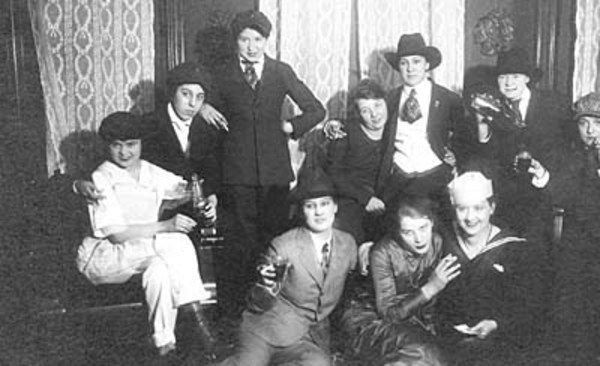
https://www.theguardian.com/music/2017/sep/14/pansy-craze-the-wild-1930s-drag-parties-that-kickstarted-gay-nightlife: “In January 1931, mobster Charles Sherman was shot and stabbed at the Club Abbey, female impersonator Karyl Norman (appearing in a revue entitled Pansies on Parade) was caught up in a police raid on Manhattan’s appropriately named Pansy Club, and on the same night, police shut down the Club Calais speakeasy, another popular pansy haunt…
“Tired of the trouble the pansy clubs attracted, New York’s police commissioner Edward P Mulrooney stationed a cop at the door of every known pansy nightspot and barred female impersonators from the local clubs. Some acts tried valiantly to cling on but [drag star Gene] Malin, effectively barred from working in New York, went to Boston where, according to the front page of scandal sheet Brevities: “Queers seek succor! Fairies cruise in daisy beds of Boston, making the city a lavenderish camp of love.”
 rainbow messenger