

It was in the 4th century CE that the first laws were enacted to punish gender-variant and same-sex attracted men, by Roman Emperors who had adopted Christianity as their, and the Empire’s, religion. In the Greek civilisation, which heavily influenced the Roman, gay male relationships had played a significant role in civilian life and in the military, in education, art and literature. However a prejudice against effeminate and passive males was already taking form in the heyday of Greece and took deeper roots in the more macho Latin culture. This prejudice was boosted by Christianity’s adoption of Old Testament attitudes and gained the force of law behind it once the ruling classes had adopted the new religion and saw the potential in the prohibition of same sex love as a political tool, to suppress both religious and political competition.
Emperor Constantine issued the Edict of Milan in 313CE, establishing toleration for Christianity, at at time when less than a third of the citizens of the Roman Empire had converted to the religion. Apart from during the reign of Julian (known in Christian tradition as the Apostate, in pagan as the Philosopher), who was Caesar of the West from 355 to 360 and Roman emperor from 361 to 363, and who promoted a return to classical Neoplatonic Hellenism, Christianity enjoyed a privileged position and increasingly influenced society’s moral views, becoming in time the only official religion.
Soon after his conversion, Constantine took action to suppress a pagan temple at Aphaca in Phoenicia, in the Middle East (modern Lebanon/Israel), and execute its effeminate pagan priests “whose homosexuality was taken for granted” (Louis Crompton, Homosexuality and Civilisation p131). These effeminate pagan priests were described by Church Father Eusebius in his biography of Constantine as being “dedicated to the foul demon known by the name of Venus… where men unworthy of the name forgot the dignity of their sex and propitiated the demon by their effeminate conduct.” Venus was here a generic term for the many Goddesses worshipped all around the ancient Mediterranean since time immemorial, all of whom had gender-fluid queer men, some of whom we would now call trans, serving alongside the women priestesses in the temples, which for centuries were vital administrative as well as sacred centres. Eusebius wrote that the Emperor gave orders that the temple at Aphaca “with its offerings should be utterly destroyed” by military force.
After this, “inasmuch as the Egyptians, especially those of Alexandria, had been accustomed to honor their river through a priesthood composed of effeminate men, a further law was passed commanding the extermination of the whole class as vicious, that no one might thenceforward be found tainted with the like impurity.” (Eusebius)
Historian Louis Crompton says that “Under Constantine and his successors, campaigns against non-Christian religions and against homosexuality went hand in hand.” His sons, Constantius and Constans issued a law in 342 that declared:
“When a man ‘marries’ (cum vir nubit) as a woman who offers herself to men, what does he wish, when sex has lost its significance; when the crime is one which it is not profitable to know; when Venus is changed into another form, when love is sought and not found? We order the statues to arise, the laws to be armed with an avenging sword, that those infamous persons who are now, or who hereafter may be, guilty may be subjected to exquisite punishment.”
Historians mostly agree that the reference to exquisite punishment means the death penalty, marriage here is a reference to sex, and that this law was targeting only the passive partners in man to man sex, alongside men who displayed an effeminate nature. Ancient Rome had a name for these men — cinaedi, which has Persian roots. Cinaedi were seen as suspicious because of their sensuality, passivity and desire for other men, they were targets of abuse and satire, but also of desire. They were the out ‘gay men’ of the ancient world. In fact the Roman language had so many words for bottoms and passive gay roles — eg mollis, pathicus, concubinus, puer delictus, catamite, scultimodius (arsehole-bestower) — that we can be sure there was a lot of it about. Male prostitution was common, and taxed, until the Christian era.
Roman senator Firmicus Maternus wrote a polemic called ‘The Error of the Pagan Religions’ in 346 which firmly associated pagan cults with sexual immorality and especially homosexuality. He got particularly fired up about the effeminate priests or holy men, writing that those who serve a Carthaginian love goddess:
“…can minister to her only when they have feminised their faces, rubbed smooth their skin, and disgraced their manly sex by donning women’s regalia. In their very temples we see scandalous performances, accompanied by the moaning of the throng: men letting themselves be handled as women, and flaunting with boastful ostentatiousness this ignominy of their impure and unchaste bodies…. Next, being thus divorced from the masculine, they get intoxicated with the music of flutes and invoke the goddess with an unholy spirit so they an ostensibly predict the future to fools.”
The atmosphere gradually darkened, then the suppression of pagan temples and practices took off in earnest in the 380s when an edict against sacrifices led to what historian Albert Montefiore Hyamson in 1913 described as “an orgy of destruction and spoilation,” when monks and fanatics went around destroying pagan temples. Emperor Theodosius issued an edict in 390 which quoted the Levitical prohibition on sex between men, and targeted male sexworkers, setting out to “punish all those whose criminal practice it is to condemn the male body to the submissiveness appropriate to the opposite sex.” It called for such men to be dragged out of the shameful male brothels and subjected to “avenging flames in the sight of the people.”
Theodosius II issued a law code in 438 CE that repeated the edicts of 342 and 390, but omitted the reference to prostitution. “All persons who have the shameful custom of condemning a man’s body, acting the part of a woman’s… shall expiate the crime of this kind in avenging flames in the sight of the people.” Crompton points out that from this point onward the law “now clearly and unambiguously condemned all passive males to death by burning.”
Prejudice against effeminate and passive men gradually expanded to include the active partner too, and in the 6th century the law followed suit, setting the precedent that has led to the deaths of thousands of men who loved men in medieval and into modern times, first in Europe and then around the world as the Christian kingdoms expanded their empires. This legacy of hate is still virulent in parts of Africa and Asia today. Only by understanding where it came from, what its motivation really was, can we ever hope to fully dispose of this darkness from the world.
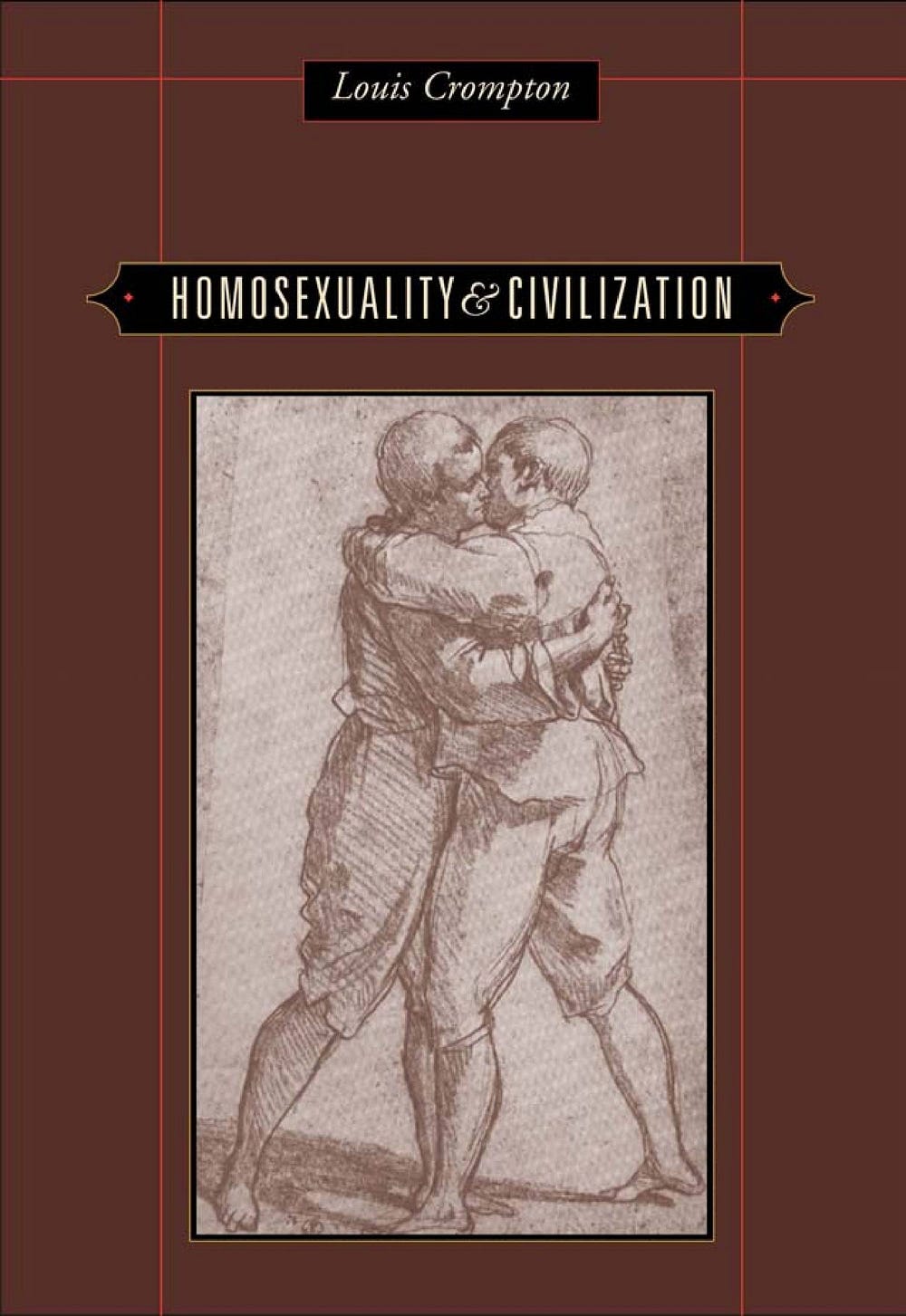
At the height of the Roman Empire it had been taken for granted that men would have sex with other men as well as with women. It was only the men who wanted exclusively to be passive sexually with other men, and revealed that through their demeanour, who came under suspicion.
It took, however, two centuries from the establishment of Christianity in the Empire before laws targeted both passive and active gay sex partners, and other factors were involved, including a series of natural disasters that were interpreted as God’s punishment for ‘sodomitical sins.’ Two Fathers of the Church in the 5th century played hugely influential roles in spreading homophobia to the masses — Augustine, bishop of Hippo in north Africa and John Chrysostom, who became Patriarch of the Church of Constantinople.
While a young man, Augustine had a lively sex life, experimenting with lower class prostitutes in Carthage, and falling in love with a male friend but eventually feeling guilty that he had “polluted the springwater of friendship with the filth of concupiscence.” However, while in love, “by which I was longing to be captured… in secret I attained the joy that enchains.” His lover died just a year into their relationship, however, and Augustine was bereft. He clearly never recovered, going on to condemn all same sex relations, declaring in his Confessions that “the social bond between God and us is violated when the nature of which he is the author is polluted by a perversion of sexual desire.” In City of God, Augustine highlighted sex between males as the reason for the destruction of Sodom and Gomorrah, following the ideas of Jewish philosopher Philo in the 1st century BCE. Clement of Alexandria, in the 3rd century, was the only Christian teacher to have made that connection previously — Jesus had referred to the inhospitality to guests as the cause of God’s punishment for the cites of the plains — but Augustine’s book would lead to sodomite becoming the key word for men who had sex with other men until the 20th century.
John Chrysostom was a fiery preacher whose passion led to him being invited to become the Patriach of Constantinople in 397CE. He had a lot of rage, which he directed at the rich and powerful, but also at Jews and men who loved men. His hatred left a legacy that has influenced the world ever since. Louis Crompton says that Chrysostom “can be said to have contributed uniquely to the development of homophobia. With far more to say on the subject than any other church father, he labored unrelentingly to create fear and prejudice.” In his sermons he called male love ‘monstrous,’ ‘execrable,’ calling those who speak in favour of it “even worse than murderers.” He also attacked “women who abused women” and condemned the pagan world for its love of adultery and boys — in his essay Agains the Opponents of the Monastic Life he declared that gay sex was a “new(!) and lawless lust,” calling it “a terrible and incurable disease… plague more terrible than all plagues… Fornication now seems like a minor offence against forms of unchastity… and womankind is in danger of being superfluous when young men take their place in every activity.” He commented that “such a great abomination is performed with great fearlessness and lawlessness… No one is afraid, no one trembles. No one is ashamed, no one blushes…” Great to know! However, this was not to last.
“One more step remained. To turn this theological terror into legal terrorism,” writes Louis Crompton in Homosexuality and Civilisation. The Eastern Roman Emperor Justinian provided that in the 520–30s.
Justinian undertook the compilation of Roman law, the Code of Justinian, completed in 534CE. This remained in operation in the eastern Roman empire until its fall to the Turks in the 15th century, and became the chief influence on western European lawmakers in the Middle Ages through to the Napoleonic Era and “of prime importance in determining the status of Europe’s homosexuals throughout the Middle Ages, the Renaissance, and the eighteenth century.” (Crompton, p 142)
Justinian was passionate about theology, and about suppressing opposition. In the year 528, just a year into his reign, he kicked off a persecution of men who loved men, targeting firstly powerful Church figures. Byzantine historian John Malalas (c491–578) recorded that :
“… bishops of divers provinces were prosecuted for the lustful act of sleeping with males. Among them were the bishops Isaiah of Rhodes… and Alexander of Diospolis in Thrace… After they were brought to Constantinople by an edict of the Emperor they were examined by the prefect of the city, stripped of their rank and punished. After he had suffered severe torture, Isaish was sent into exile. Alexander, on the other hand, had mis male organ cut off, and was placed in a litter and exposed as a spectacle to the people. Shortly after, the emperor passed a law that the crime of sex with males should be punished by castration. And at that time many androkoitai (men who slept with men) were seized and their genitals were cut off. And a great fear ensued among those who suffered from the evil desire for males.”
The Secret History, written by Procopius, Justinian’s court historian, informs us that there were more than religious motives underlying this action. Having described his horror at the “reckless fashion” in which this law was enforced, Procopius indicates that the punishment was directed at first towards political opponents and those “possessed of great wealth or those who in some other way chanced to have offended the rulers.” Justinian soon emptied the imperial treasury through expensive wars and building churches and palaces: Procopius informs us that “No sooner had he thus disposed of the public wealth, than he turned his eyes towards his subjects, and he straightaway robbed great numbers of them of their estates… charging some with belief in polytheism, others with adherence to some perverse sect among the Christians, or with paiderastias.”
Two more laws during Justinian’s reign served to deepen the atmosphere of fear for male-male lovers. Novella 77, in 538 CE, warned that gay acts would “incur the just anger of God, and bring about the destruction of cities along with their inhabitants… crimes of this decription cause famine, earthquake and pestilence.” It may well be that a violent earthquake in 525 in Constantinople, another in 526 in Antioch formed part of the background to what Crompton calls the “pogrom of 528” and this legislation. In 557 the earth shook again in Constantinople, followed by a deadly plague — Novella 141, in March 559, set the scene for centuries to come: the state and Church hand in hand “adopting a tone of paternal benevolence but threatening ferocious punishments.” (Crompton p147). While invoking “His abounding kindness, His tolerance, and His infinite patience,” the law targeted “persons who are guilty of abominable offences, which are deservedly detested by God. We have reference to the corruption of males, a crime which some persons have the sacriligious audacity to perpertrate.”
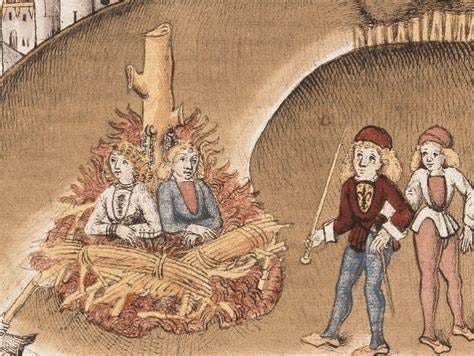
The laws of the late Roman Empire called for men to be burned in “avenging flames in the sight of the people.” This phrase would reappear in late medieval Europe, but in the early Middle Ages there were no legal prohibitions amongst the people of northern Europe. After the fall of the Western Empire in 476 homophobic laws were imposed only in the Visigothic kingdom, which stretched from the Loire to the south of Spain and survived from the fall of Rome until the Arab conquest of 711. Castration was the initial punishment, along with lashings, shearing and exile added after the Council of Toledo in 693. Crompton says that the early Germanic and Anglo-Saxon law codes in these centuries punished adultery and rape but did not refer to sex between men.
For several centuries Church councils, texts and penitentials railed against the sin, but it was not until the second millennium that secular authorities joined the persecution. A West Frisian (modern Netherlands) law code in the 11th century decreed that men having sexual relations should receive one of three punishments — being burned, being buried alive, or self-castration. In late 12th century Scandinavia the King and the Church came to a deal whereby they divided the financial gains from prosecuting sodomites between them. A statute of 1280 in Sweden simply decreed: “Whoever sins against nature shall pay 9 marks to the bishop.” In France the Livres de jostice et de plet, around 1260, declared: “Whoever is proved to be a sodomite shall lose his testicles. And if he does it a second time he shall lose his member. And if he does it a third time he shall be burned.”
The spread of sodomy laws from the 13th century came during a period of plague, war and fear of God’s wrath, just as had happened in Byzantine Rome in the 6th century. As Christian rulers reconquered Spain from Islam they brought back the Visigothic laws and added to them. A 1255 law called for both partners in the sex crime ‘against nature to “be castrated before all the people, and after three days, shall be suspended by the legs until they die, and shall never be taken down.” Through Spain’s conquests in the New World, these medieval laws were exported to the Americas, and were still being cited by jurists in the 19th century. A Spanish law in 1497 insisted on the death penalty “…because the penalties hitherto established are not sufficient to castigate and extirpate totally… such an abominable crime against nature.” Persecution, prosecutions and executions continued in Spain and her colonies through the following centuries.
In Italy the first secular authority to set the death penalty for sodomy was Bologna in 1259. Other cities followed suit, including Rome in 1363, Milan 1476, the laws mostly prescribing burning for a first offence. The 15th and 16th centuries saw vicious campaigns of persecution in Venice and Florence.
In England the first mention of sodomy in legal terms came in the 1290s — a legal compilation called Britton called for death by fire as punishment, describing sodomy as a ‘mixed’ crime, ie one that could be tried by church or state: “The inquirers of the Holy Church shall make their inquests of sorcerers, sodomiters, renegates and misbelievers; and if they find any such, they shall deliver him to the king’s court to be put to death.” But there is little evidence of enforcement and it was not until 1533 that a national law was enacted — Henry VIII’s Buggery Act. Buggery had become an alternative word for sodomy during the late middle ages due to the association the Bulgarian Bogomil heresy (which spread across western Europe from the 11th-15th centuries) with freely expressed sexuality. The Buggery Act removed the ‘benefit of clergy’ whereby ecclesiastics could escape prosecution by the secular authorities — then in 1835 agents were sent to visit monasteries and report on sexual misconduct taking place. The many reports of sexual, especially same-sexual, activities was used by Henry as justification to dissolve the monasteries, and seize their wealth to fill up his empty royal treasury. Robert Burton wrote in ‘Anatomy of Melancholy’ in 1621 that “.. the most prudent Henry VIII… inspected the cloisters … of priests and votaries, and found among them so gresat a number of wenchers, gleded youths, debauchees, catamites, boy-things, pederasts, sodomites, Ganymedes etc, that in everyone of them you may be certain of a new Gomorrah.”
Henry’s Buggery Act, which was dropped during the brief reign of Catholic Queen Mary and then reinstated under Elizabeth, was rarely used to prosecute individuals at first, but came into fierce application in the 18th century, at the end of which, as other European nations embraced the ‘enlightenment’ culture and repealed anti-gay laws, England doubled down on its persecution. The last execution in England for sodomy took place in the 1830s, the death penalty was finally repealed in 1861, but fierce punishments for gay sex remained in place until 1967.
THE RELIGIOUS AND LEGAL SUPPRESSION OF GENDER-VARIANCE AND SAME-SEX EROTIC LOVE HAVE GONE HAND IN HAND FOR CENTURIES, AND PLATO SAW IT COMING:
Back in the 4th century BCE Plato wrote:
“Same sex love is regarded as shameful by barbarians and by those who live under despotic governments just as philosophy is regarded as shameful by them, because it is apparently not in the interest of such rulers to have great ideas engendered in their subjects, or powerful friendships or passionate love-all of which same sex love is particularly apt to produce.”
Suppression of gender-fluidity and of same-sex love has always been a power grab. The Old Testament prohibitions on these things were an attempt by the Hebrew patriarchs to draw a line between the Jewish people and the pagan tribes all around them. Back in 1886, Richard Burton wrote in ‘The Thousand Nights and a Night’ — “The Hebrews entering Syria, found it religionised by Assyria and Babylonia, when the Accadian Ishtar had passed West, and had become Ashtoreth, Ashtaroth, or Ashirah, the Anaitis of Armenia, the Phoenician Astarte, and the Greek Aphrodite, the great Moon-goddess who is queen of Heaven and Love. . . . She was worshipped by men habited as women, and vice versa; for which reason, in the Torah (Deut. xxii. 5), the sexes are forbidden to change dress.”
The Christian Church Fathers sought to make the same distinction between their religion and that of the many pagan gods and goddesses, who had long been associated with free sexuality and genderbending priests. The 4th-5th century Roman emperors, converting to Christianity at a time of rising chaos and danger in the world, turned this distinction into laws:
“When the Empire adopted Christianity, it had therefore the traditions of the Mosaic law and the first chapter of the Epistle to the Romans to guide its legislators on this topic. The Emperors felt obscurely that the main pulses of human energy were slackening; population all tended to dwindle; the territory of the empire shrank slowly year by year before their eyes. As the depositaries of a higher religion and a nobler morality, they felt it their duty to stamp out pagan customs, and to unfurl the banner of social purity.”
John Addington-Symonds wrote in A Problem in Modern Ethics (1896).
In Africa today, biblical sources continue to be quoted as justification for harsh homophobic laws. Uganda has issued one of the fiercest anti-gay laws ever enacted. Other African countries are considering following suit. For a summary of current legal situation in Africa check out: The State of LGBTQ+ Rights in Africa | by Matthew’s Place | Matthew’s Place | Oct, 2023 | Medium
In 1891 John Addington-Symonds wrote “…it is of the highest importance to obtain a correct conception of the steps whereby the Christian nations, separating themselves from ancient paganism, introduced a new and stringent morality into their opinion on this topic, and enforced their ethical views by legal prohibitions of a very formidable kind.”
Indeed. The gay liberation movement of the 20th century did not tackle this issue, it emerged in a secular age and decided to pretty much leave the religious debate alone. But the issue will not die, as the terrible things happening in Africa today make clear. Until we rise to the call of the Victorian Addington-Symonds and expose the roots of religious homophobia, and the political motivations behind the laws that institutionalised that homophobia, the world will continue to wallow in ignorance, fear and hatred. Until same sex love is accorded the same sacredness as heterosexual love humanity will be stuck in the shadows. Once love can flow freely between adults of whatever sexual or gender orientation and identity humanity will be able to evolve, will open the doors to its own evolution.
 rainbow messenger