
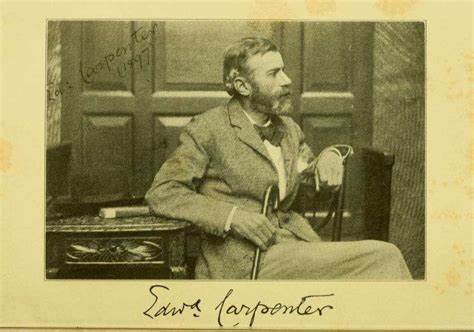
Quoted from Intermediate Types Among Primitive Peoples (published 1914), Edward Carpenter points out that ancient traditions around the world viewed the creator God, and the first humans created, as uniting both male and femaleness in one being:
“…the reason or reasons for this tendency must be accounted quite deep-rooted and anything but fanciful. One reason, it seems to me, is the psychological fact that in the deeps of human nature (as represented by Brahm and Siva in the Hindu philosophy, by Zeus in the Orphic Hymns, by Mithra in the Zend-avesta, etc.) the sex-temperament is undifferentiated; and it is only in its later and more external and partial manifestations that it branches decidedly into male and female; and that, therefore, in endeavoring through religion to represent the root facts of life, there was always a tendency to cultivate and honor hermaphroditism, and to ascribe some degree of this quality to heroes and divinities.”
“Brahm, in the Hindu mythology, is often represented as two-sexed. Originally he was the sole Being. But,
“delighting not to be alone he wished for the existence of another, and at once he became such, as male and female embraced (united). He caused this his one self to fall in twain.”
[Quoted from the Yajur-Veda. See Bible Folk-lore: a study in Comp. Mythology (London, 1884), p. 104.]

“Siva, also, the most popular of the Hindu divinities, is originally bi-sexual. In the interior of the great rockhewn Temple at Elephanta the career of Siva is carved in successive panels. And on the first he appears as a complete full-length human being conjoining the two sexes in one – the left side of the figure (which represents the female portion) projecting into a huge breast and hip, while the right side is man-like in outline, and in the centre (though now much defaced) the organs of both sexes. In the second panel, however, his evolution or differentiation is complete, and he is portrayed as complete male with his consort Sakti or Parvati standing as perfect female beside him. There are many such illustrations in Hindu literature and art, representing the gods in their double or bi-sexual role – e.g., as Brahma Ardhanarisa, Siva Ardhanarisa (half male and half female). And these again are interesting in connection with the account of Elohim in the 1st chapter of Genesis, and the supposition that he was such an androgynous deity. For we find (v. 27) that
“Elohim created man in his own image, in the image of Elohim created he him, male and female created he them.”
“And many commentators have maintained that this not only meant that the first man was hermaphrodite, but that the Creator also was of that nature. In the Midrasch we find that Rabbi Samuel-bar-Nachman said that
“Adam, when God had created him, was a man-woman (androgyne);”
“and the great and learned Maimonides supported this, saying that
“Adam and Eve were created together, conjoined by their backs, but God divided this double being, and taking one half (Eve), gave her to the other half (Adam) for a mate.”
“And the Rabbi Manasseh-ben-Israel, following this up, explained that when
“God took one of Adam’s ribs to make Eve with,”
“it should rather be rendered
“one of his sides”
“that is, that he divided the double Adam, and one half was Eve.“
“In the Brihadaranyaka Upanishad (I Adhyaya, 4th Brahmana) the evolution of Brahm is thus described :-
“In the beginning of this (world) was Self alone, in the shape of a person. . . . But he felt no delight. . . . He wished for a second. He was so large as man and wife together (i.e., he included male and female). He then made this his Self to fall in two; and thence arose husband and wife. Therefore, Yagnavalkya said: We two are thus (each of us) like half a shell (or as some translate, like a split pea).”
[Sacred Books of the East, vol. xv., p. 85.]
“The singular resemblance of this account to what has been said above about the creation of Adam certainly suggests the idea that Jehovah, like Brahm (and like Baal and other Syrian gods), was conceived of as double-sexed, and that primitive man was also conceived as of like nature. The author (Ralston Skinner) of The Source of Measures says (p. 159)
“The two words of which Jehovah is composed make up the original idea of male-female of the birth-originator. For the Hebrew letter Jod (or J) was the membrum virile, and Hovah was Eve, the mother of all living, or the procreatrix Earth and Nature.”
[See H. P. Blavatsky, Secret Doctrine, vol. ii., p. 132, quoted in vol. v., Jahrbuch fur S. Z., p. 76.
“The tradition that mankind was anciently hermaphrodite is world-old. It is referred to in Plato’s Banquet, where Aristophanes says:-
“Anciently the nature of mankind was not the same as now, but different. For at first there were three sexes of human beings, not two only, namely male and female, as at present, but a third besides, common to both the others – of which the name remains, though the sex itself has vanished. For the androgynous sex then existed, both male and female; but now it only exists as a name of reproach.”
“He then describes how all these three sorts of human beings were originally double, and conjoined (as above) back to back; until Jupiter, jealous of his supremacy, divided them vertically
“as people cut apples before they preserve them, or as they cut eggs with hairs”
“after which, of course, these divided and imperfect folk ran about over the earth, ever seeking their lost halves, to be joined to them again.
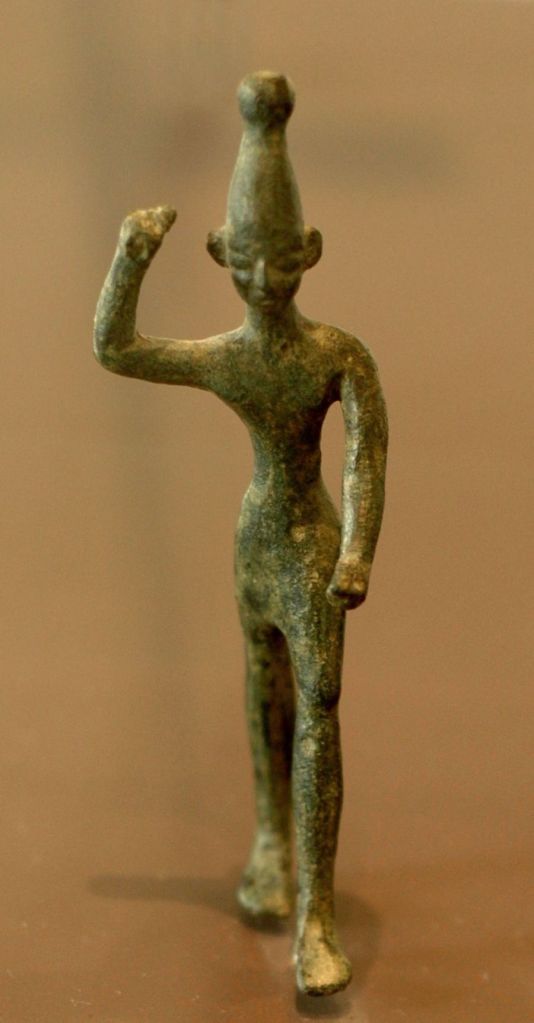
“I have mentioned the Syrian Baal as being sometimes represented as double-sexed (apparently in combination with Astarte). In the Septuagint (Hos. ii. 8, and Zeph. i. 4) he is called ii Baal (feminine) and Arnobius tells us that his worshippers invoked him thus
“Hear us, Baal! whether thou be a god or goddess.”
[Inman’s Ancient Pagan and Modern Christian Symbolism (Trubner, 1874), p. 119.]
“Similarly Bel and other Babylonian gods were often represented as androgyne. Mithras among the Persians is spoken of by the Christian controversialist Firmicus as two-sexed, and by Herodotus (Bk. i., c. iii) as identified with a goddess, while there are innumerable Mithraic monuments on which appear the symbols of two deities, male and female combined. (ibid., p. 307) Even Venus or Aphrodite was sometimes worshipped in the double form.
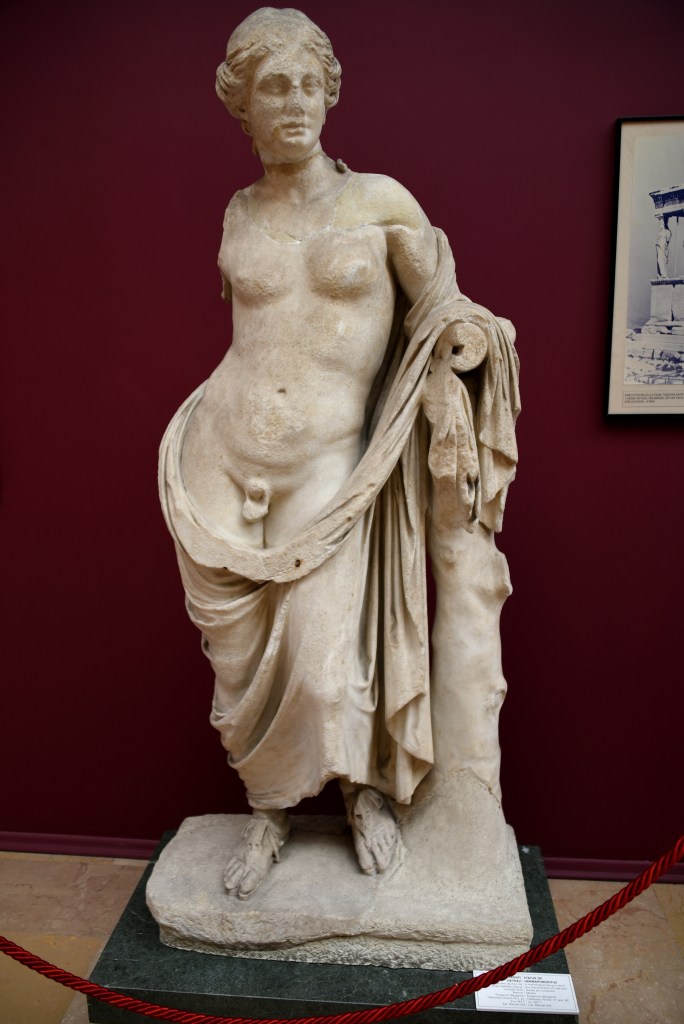
“In Cyprus,”
“says Dr. Frazer in his Adonis, etc. (p. 432, note),
“there was a bearded and masculine image of Venus (probably Astarte) in female attire: according to Philochorus the deity thus represented was the moon, and sacrifices were offered to him or her by men clad as women, and by women clad as men (see Macrobius Saturn iii. 7, 2).”
“This bearded female deity is sometimes also spoken of as Aphroditus, or as Venus Mylitta. Richard Burton says:-
“The Phoenicians spread their androgynic worship over Greece. We find the consecrated servants and votaries of Corinthian Aphrodite called Hierodouloi (Strabo, viii. 6), who aided the 10,000 courtesans in gracing the Venus-temple. . . . One of the headquarters of the cult was Cyprus, where, as Servius relates (Ad. Aen. ii. 632), stood the simulacre of a bearded Aphrodite with feminine body and costume, sceptred and mitred like a man. The sexes when worshiping it exchanged habits, and here the virginity was offered in sacrifice.”
[The Thousand Nights and a Night (1886), vol. x., p. 231. 76]
“The worship of this bearded goddess was mainly in Syria and Cyprus. But in Egypt also a representation of a bearded Isis has been found, – with infant Horus in her lap; while again there are a number of representations (from papyri) of the goddess Neith in androgyne form, with a male member (erected). And again, curiously enough, the Norse Freya, or Friga, corresponding to Venus, was similarly figured. Dr. von Romer says:-
“Just as the Greeks had their Aphroditos as well as Aphrodite so the Scandinavians had their Friggo as well as their Friga. This divinity, too, was androgyne. Friga, to whom the sixth day of the week was dedicated, was sometimes thought of as hermaphrodite. She was represented as having the members of both sexes, standing by a column with a sword in her right hand, and in her left a bow.”
[See his study already quoted, Jahrbuch, pp. 735-744.]
“In the Orphic hymns we have
“Zeus was the first of all, Zeus last, the lord of The lightning;
Zeus was the head, the middle, from him all things were created;
Zeus was Man, and again Zeus was the Virgin Eternal.”
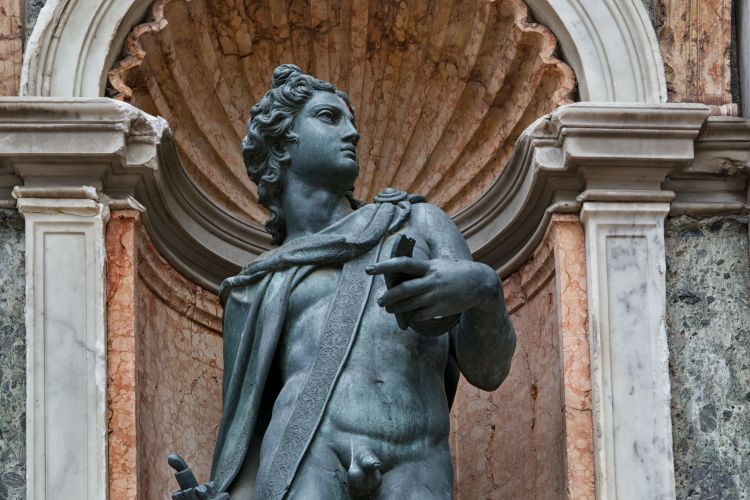
“And in another passage, speaking of Adonis
“Hear me, who pray to thee, hear me 0 many-named and best of deities,
Thou, with thy gracious hair . . . both maiden and youth, Adonis.”
“Again, with regard to the latter, Ptolemaeus Hephaestius (according to Photius) writes:-
“They say that the androgyne Adonis fulfilled the part of a man for Aphrodite, but for Apollo the part of a wife.”
[See Jahrbuch, as above, pp. 806, 807 and 809.]
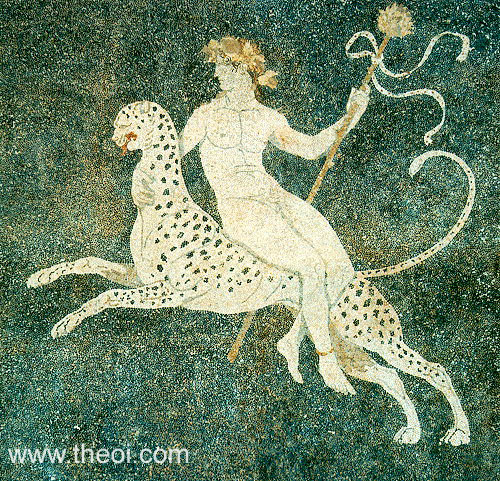
“Dionysus, one of the most remarkable figures in the Greek Mythology, is frequently represented as androgyne. Euripides in his Bacchae calls him “feminine-formed” or thelumorphos, and the Orphic hymns “double-sexed” or diphues; and Aristides in his discourse on Dionysus says:-
“Thus the God is both male and female. His form corresponds to his nature, since everywhere in himself he is like a double being; for among young men he is a maiden, and among maidens a young man, and among men a beardless youth overflowing with vitality.”
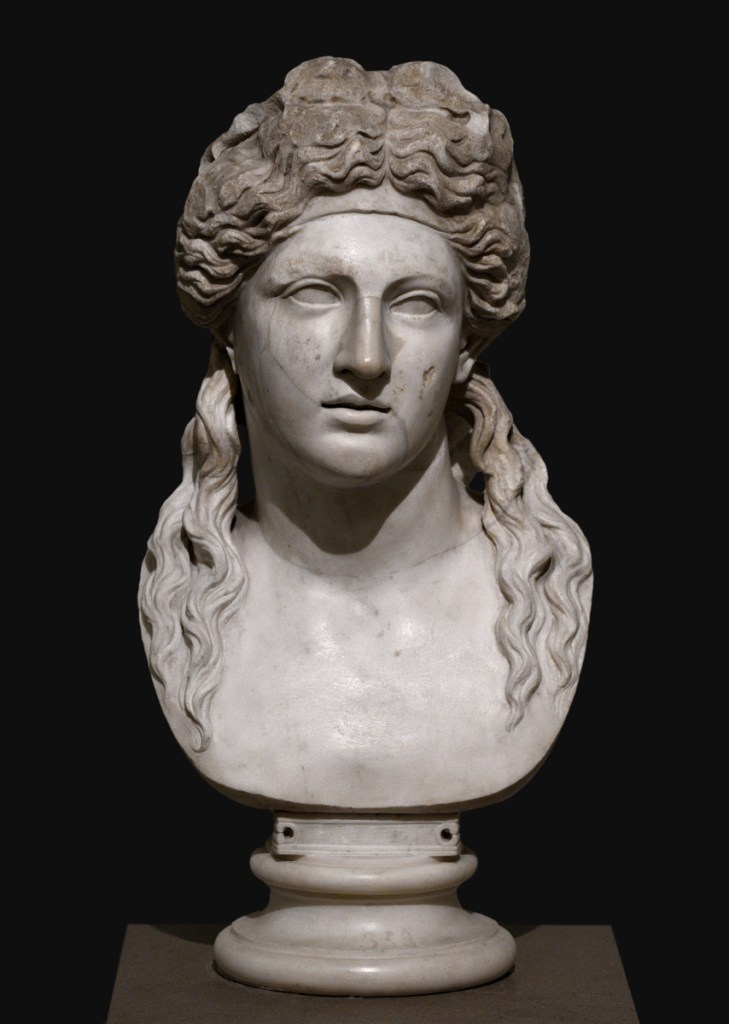
“In the museum at Naples there is a very fine sculptured head of Dionysus, which though bearded has a very feminine expression, and is remindful of the traditional head of Christ.
“In legend and art,”
“says Dr. Frazer,
“there are clear traces of an effeminate Dionysus, and in some of his rites and processions men wore female attire. Similar things are reported of Bacchus, who was, of course, another form of Dionysus. Even Hercules, that most masculine figure, was said to have dressed as a woman for three years, during which he was the slave of Omphale, queen of Lydia.”
[Adonis, etc., p. 432.]
“If we suppose,”
“says Dr. Frazer,
“that queen Omphale, like queen Semiramis, was nothing but the great Asiatic goddess, or one of her Avatars, it becomes probable that the story of the womanish Hercules of Lydia preserves a reminiscence of a line or college of effeminate priests who, like the eunuch priests of the Syrian goddess, dressed as women in imitation of their goddess, and were supposed to be inspired by her. The probability is increased by the practice of the priests of Heracles at Antimachia in Cos, who, as we have just seen, actually wore female attire when they were engaged in their sacred duties. Similarly at the vernal mysteries of Hercules in Rome the men were draped in the garments of women.”
[Ibid., p. 431.]
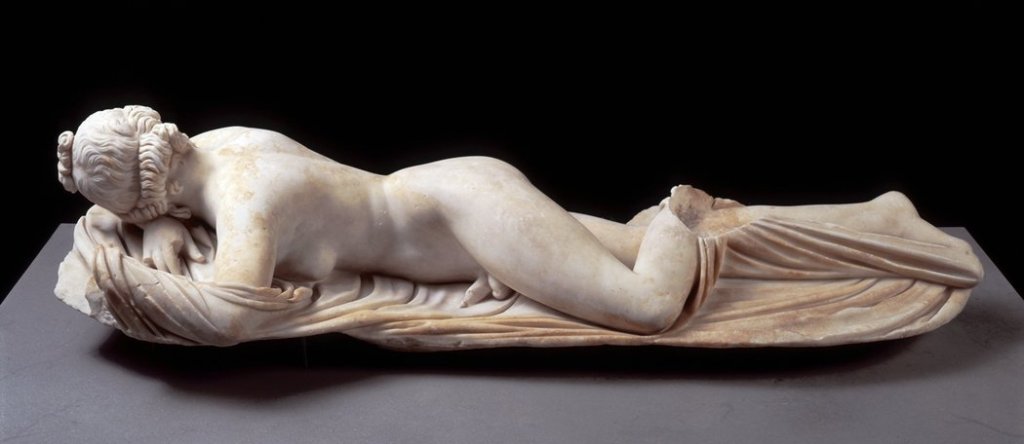
“Such instances could be rather indefinitely multiplied. Apollo is generally represented with a feminine – sometimes with an extremely feminine – bust and figure. The great hero Achilles passed his youth among women, and in female disguise. Every one knows the recumbent marble Hermaphrodite in the Louvre. There are also in the same collection two or three elegant bronzes of Aphrodite-like female figures in the standing position – but of masculine sex.”
 rainbow messenger