
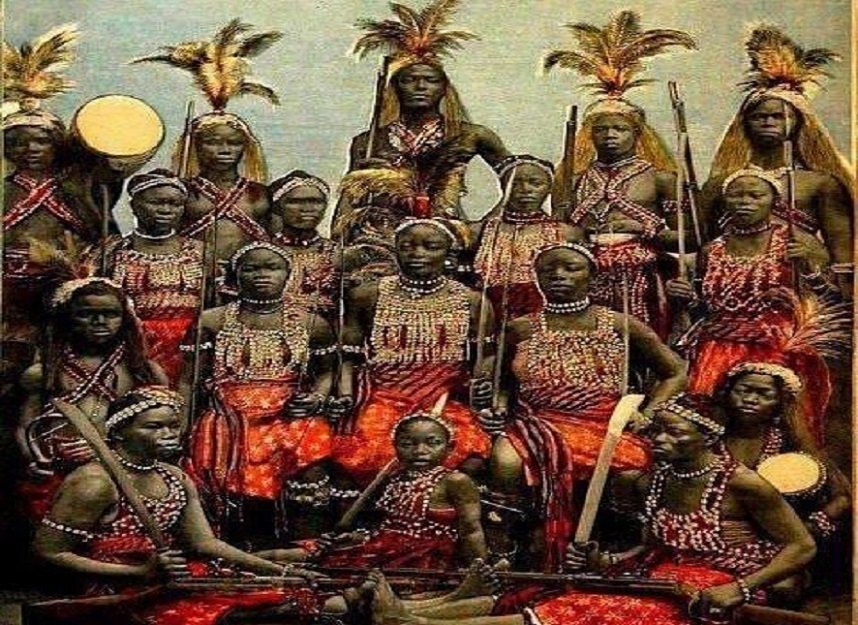
When Western explorers visited the West African kingdom of Dahomey in the 19th century they discovered that the King’s military was made up of female as well as male troops – in the 1860s British explorer Richard Burton wrote an entire chapter about the ‘so-called Amazon’ troops of King Gelele. Alfred Ellis, a British army office and ethnographer, wrote that the women were “called the amazons by Europeans and known in Dahomi by the titles of The Kings Wives and Our Mothers.”
Some of these fierce women went as far as to declare they had ceased to be women and become men.
In Boy-wives and female husbands : studies in African homosexualities (1998) historians Will Roscoe and Stephen O Murray report:
In his account of his 1863-64 mission, Burton devoted a chapter to “the so-called Amazon” troops o King Gelele. In Burton’s view, “the origin of the somewhat exceptional organisation” of the women troops, which he estimated to number about 2.500, was “the masculine physique of the women, enabling them to compete with men in enduring toil, hard- ship and privations” . He also offered an historical explanation- the female troops were organized after the early eighteenth-century King Agaja depleted the ranks of male soldiers.
Ellis, noting that Dahomean women “endured all the toil and performed all the hard labour,” elaborated on the historical evolution of the Amazon institution:
The female corps, to use the common expression, the Amazons, was raised about the year 1729, when a body of women who had been armed and furnished with banners, merely as a stratagem to make the attacking forces appear larger, behaved with such unexpected gallantry as to lead to a permanent corps of women being embodied [by King Trudo]. Up to the reign of Gezo, who came to the stool in 1811, the Amazon force was composed chiefly of criminals, that is criminals in the Dahomi sense of the word. Wives detected in adultery, and termagants and scolds were drafted into its ranks and the great majority of the women “given to the king” by the provincial chiefs, that is, sent to him as being worthy of death for misdemeanours or crimes, were, instead of being sacrificed at the Annual Custom, made women soldiers. Gezo, who largely made use of the Amazons to keep his own subjects in check and to promote military rivalry, increased and improved the force; He directed every head of a family to send his daughters to Agbomi for inspection: the most suitable were enlisted, and the corps thus placed on a new footing. This course was also followed by Gelele, his successor, who had every girl brought to him before marriage, and enrolled those who pleased him.
Burton reported nothing, and Ellis next to nothing, about the sexuality of these “Amazons.” They were distinguished from the king’s numerous wives, and “two-thirds are said to be maidens”. In his “Terminal Essay” to his translation of the Arabian Nights, Burton wrote, “In the Empire of Dahomey I noted a corps of prostitutes kept for the use of the Amazon-soldieresses”. In his 1864 account he merely noted, “All the passions are sisters. I believe that bloodshed causes these women to remember, not to forget LOVE” (2:73).
Commander Frederick Forbes’s journals of his 1849-50 missions to King Gezo of Dahomey (published in 1851) also fail to describe the sexual behavior of the “Amazons,” but they are clearer than Burton about the “Amazons masculine gender identification:
The amazons are not supposed to marry, and, by their own statement, they have changed their sex. “We are men,” say they, “not women.” All dress alike, diet alike, and male and female emulate each other what the males do, the amazons will endeavour to surpass. They all take great care of their arms, polish the barrels. and, except when on duty, keep them in covers. There is no duty at the palace except when the king is in public, then a guard of amazons protects the royal person, and, on review, he is guarded by the males… The amazons are in barracks within the palace enclosure, and under the care of eunuchs and the camboodee or treasurer.
Indeed, in a parade on July 13, 1850, amazon troops sang about the effeminacy of the male soldiers they had defeated:
We marched against Attahpahms as against men. We came and found them women.
What we catch in the bush we never divide.
Some 2.400 amazons joined the parade, pledging to conquer Abeah- keutah (a British ally in Sierra Leone) or to die trying. An amazon chief then began a speech by referring to their gender transformation: “As the blacksmith takes an iron bar and by fire changes its fashion, so we have changed our nature. We are no longer women, we are ‘men”.


MORE FROM ALFRED ELLIS, The Eʻwe-speaking peoples of the Slave Coast of West Africa : their religion, manners, customs, laws, languages, &c. (1890):
The women of Dahomi, having for many generations past endured all the toil and performed all the hard labour of the country, have, for the weaker sex, an exceptional physique, which enables them to bear hardships and privations as well as, if not better than, the men; and this fact no doubt was an important factor in the causes which led to the formation of the corps. As Captain Burton noted, the women are generally tall, muscular, and broad, and the men “smooth, full-breasted, round-limbed, and effeminate-looking.”
By state policy the Amazons are considered the king’s wives, and cannot be touched without danger of death. They are sworn to celibacy, a necessary restriction in the case of a female corps, but the king has the privilege of taking any of their number to wife. A peculiar võ-sesa, placed over the palace-gate, is supposed to cause certain pregnancy in the Amazon who has been frail; and it is said that the dread of impending discovery has often led the woman to confess, and doom herself and her paramour to a dreadful death. Nature, however, will assert itself, and when Captain Burton visited Agbomi, 150 Amazons were found to be pregnant, and were brought to trial. Such offenders are always put to death in secret within the palace, with cruelties that are only whispered of outside.
In peace time one of the duties of the Amazons is to escort the palace-women when they go to the wells outside Agbomi to fetch water. They, in common with the real wives of the king, never leave their quarters without being preceded by a bell, which is the signal for men to leave the road. The Amazons only meet the opposite sex when on the march or in the field; for when the two corps of the standing army parade at the palace, the sexes are kept apart by pieces of bamboo laid along the ground, which barrier no one may pass.
The Amazon corps is divided into three bodies, called the Right Wing, the Left Wing, and the King’s Body-guards. The male corps is divided into Right and Left Wings only, except when the male population, or reserve, is called out, when it also, with the latter, is divided into three bodies like the Amazons. The wings are named right and left, from the positions they take up before the king on ceremonial occasions.
 rainbow messenger