
“The rainbow is a sign from Him who is in all things,” said the old, wise one. “It is a sign of the union of all peoples like one big family. Go to the mountaintop, child of my flesh, and learn to be a Warrior of the Rainbow, for it is only by spreading love and joy to others that hate in this world can be changed to understanding and kindness, and war and destruction shall end!”
-A grandmother to a young Native American who asked her for an explanation of why Great Spirit had permitted the white people to destroy their culture, as quoted in Warriors of the Rainbow by William Willoya and Vinson Brown 1962
Since the 1970s the Rainbow has been used as a symbol of community by both the counter-culture movement known as the Rainbow Family or Rainbow Circle and by the Gay Liberation movement – which has grown into the LGBTQ+ movement, evolving the flag’s design as it did so to reflect the diversity of race and identity within the broad ‘queer’ community, even including a black stripe for those who died of AIDS, the first time the dead have been included in a rainbow flag.
Both the Rainbow Family and Gay Liberation grew directly out of the sexual liberation movements of the late 1960s and both use the rainbow to symbolise community and the unity of all peoples. Both are movements that seek freedom for people to simply be themselves, free of imposed, moralistic, laws that attempt to control our personal behaviours and choices. Among the Radical Faerie community (the nature-loving counter-culture to the gay mainstream that first met in 1979 and now has sanctuaries and gatherings around the world) the commonality of the two movements becomes crystal clear.
Like Rainbow folk we Radical Fae meet in nature for heart centred, earth honouring, community building, spirit connecting gatherings, gaining strength and inspiration from our fellow kin which empowers our lives, and our activism, in the outer world. We are an intergenerational community, a space where elders have a respected place as they do in the Rainbow Family, and of course Rad Fae fiercely celebrate diversity of personal creativity and gender expression. Both communities are strongly influenced by both Native American and Celtic Pagan paths and practices, and both are about bringing us into harmony with the Earth’s cycles, in order that we might grow, thrive and prosper.

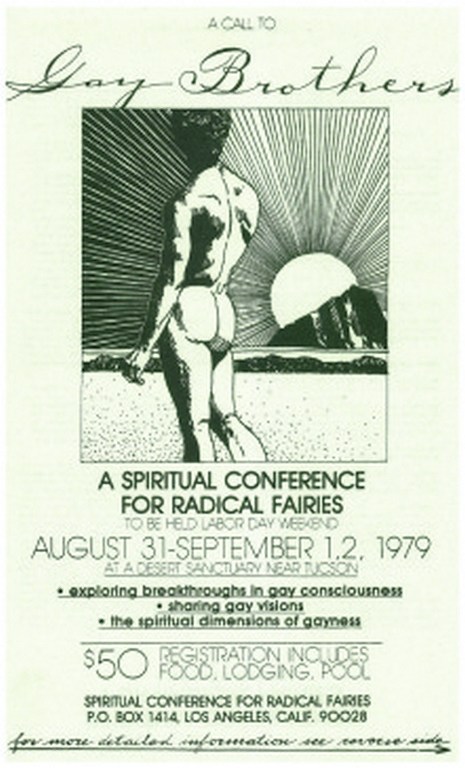
The Rainbow Family is a loose, international affiliation of individuals who have a stated goal of trying to achieve peace and love on Earth. Participants make the claim that they are the “largest non-organization of non-members in the world.” There are no official leaders or set structure, no official spokespersons, and no formalized membership. Strictly speaking, the only goals are set by each individual, as no individual can claim to represent all Rainbows in word or deed. Also contained within the philosophy are the ideals of creating an intentional community, embodying spirituality and conscious evolution, and practicing non-commercialism.
This description also fits the Radical Faerie tribe well, and while the LGBTQ rainbows may not be exactly on that spiritual or conscious page, this is largely because this aspect of queer people’s nature has been denied and hidden. Yet spiritual service to the community is one of the key roles that same-sex attracted and gender-fluid/nonbinary people have played throughout history in every culture.
“It’s tragic that many in the LGBTQ community struggle with issues around spirituality. We confuse it with religion and, no wonder, given the treatment we have received at the hands of most religions… But what’s ironic about that is that before the patriarchal cultures and religions, people that we today refer to as LGBTQ were not only spiritually inclined, but were honored for the roles of spiritual service and leadership they played all over the world.”
- Christian de la Huerta, author of Coming Out Spiritually and Awakening the Soul of Power.

I have just spent some time at a Rainbow Camp in the Forest of Dean in the UK, where I hosted a Queer Spirit space and spoke about the spiritual nature of LGBTQ people. This was well received and while there were maybe not many queer identified people on site, there were several parents of queer or trans children who were pleased to hear what I had to say, and many straight identified people who could entirely relate to the notion that, psychologically, biologically and spiritually, everyone is a mix of masculine and feminine energies, and that the inner marriage is a doorway to spiritual growth and knowledge. From a spiritual perspective, transgender people are those souls who are ready to embody the sacred power of androgynous spirit, but born into a culture that has long aimed to suppress any deviation from socially sanctioned gender roles, and one that has long lost touch with spirit, lost any sense of human com-munity with the earth itself. The destruction and chaos that is resulting from our disconnection from our unity with the planet and each other is reaching extreme levels. The future could be bleak, but this is where the Rainbow people come in…
***
“There will come a day when people of all races, colors, and creeds will put aside their differences. They will come together in love, joining hands in unification, to heal the Earth and all Her children. They will move over the Earth like a great Whirling Rainbow, bringing peace, understanding and healing everywhere they go. Many creatures thought to be extinct or mythical will resurface at this time; the great trees that perished will return almost overnight. All living things will flourish, drawing sustenance from the breast of our Mother, the Earth.
“The great spiritual Teachers who walked the Earth and taught the basics of the truths of the Whirling Rainbow Prophecy will return and walk amongst us once more, sharing their power and understanding with all. We will learn how to see and hear in a sacred manner. Men and women will be equals in the way Creator intended them to be; all children will be safe anywhere they want to go. Elders will be respected and valued for their contributions to life. Their wisdom will be sought out. The whole Human race will be called The People and there will be no more war, sickness or hunger forever.”
~Navaho/Hopi Whirling Rainbow Prophecy as quoted on Wikipedia

A book published in 1962 – Warriors of the Rainbow by William Willoya and Vinson Brown – recorded many prophecies and visions from both Native American and Asian Indian sources that relate to the coming of a time of peace and love following serious trials for humanity. It has been claimed that this book was written by Christian evangelicals who sought to assimilate Native teachings and has been said to be the source of the ‘Rainbow Prophecy’ that has become very well known in recent decades.
The prophecy has been condemned as ‘fakelore’ by scholar Michael Niman, who said of the book, “If anything, it was an attack on Native culture. It was an attempt to evangelize within the Native American community.” I disagree – the two authors (one the son of a white doctor who lived and worked in a Sioux community in the 1890s, the other an Eskimo native) are extremely critical of Christianity – Willoya writes of “Christian churches hopelessly divided and separated by walls of narrow thought and doctrine that caused them to be pushed back by the waves of materialism and hate and prejudice that beset the world,” and calls for Rainbow Warriors to arise, specifically from the Native tribes, who “Like the great Indians of old, they will teach unity, love and understanding among all people.”
The Rainbow Prophecy is often simply quoted thus –
When the earth is ravaged and the animals are dying, a new tribe of people shall come unto the earth from many colors, classes, creeds, and who by their actions and deeds shall make the earth green again. They will be known as the warriors of the Rainbow.
These lines do not appear anywhere in the Warriors book – in fact Rainbows actually only appear twice in the book, firstly in what is described as an archetypal story, that of the Grandmother and child, and then in the story related by author Vinson of his own dreams after being given an Sioux pipe bag as a young boy. He tells of flying over the land seeing Native people unhappy, suffering below, then seeing a white dove with “a feeling about it of immense power, as if all that was in the sky centered upon it.
“As the dove came near the top of one of the hills, a strange and remarkable thing happened. The Indians there suddenly sprang to their feet, gazing up at the dove. The white men’s rags fell from their bodies and disappeared. Instead they now lifted their heads proudly under handsome headdresses and their bodies were covered with clean buckskin that glittered with beads and with buckles of shell. Their faces glowed with happiness and joy. Their bodies arched like bows drawn back to send forth humming arrows. Then, to my amazement, they began to march up into the sky after the dove, marching with the springing steps of conquerors, like lords of the world.
“As the dove dipped low again and again, other dark-skinned peoples rose joyously from hill after hill and marched up into the sky, following the beautiful white bird. I saw many costumes in my dream, but I did not know what they meant or what tribes they represented, only that feathers were waving, beads of many colors glittered, and brown arms gleamed with bronze and gold. Drums began to mutter, lifting and rolling into thunder, and pipes shrilled with triumph. Voices chant-ed ancient songs and shouted age-long cries of the peoples.
“Slowly a bow formed in the sky, a rainbow of people marching to glory, a rainbow of unity and a vision so marvelous in its sense of beauty and joy that I can never forget it nor hope to see anything its equal. Slowly, at the end of each dream, this vision of glory would fade away, but the promise of it always remained, the promise of a wonderful change coming.”
The other stories in the Warriors of the Rainbow book follow similar trajectories to this summary of the vision of Black Elk of the Sioux tribe, which he had in 1872:
“The central meaning of Black Elk’s dream is very clear, for it is repeated over and over in different ways. The people of the world shall go through a very bad time, a time of wars and troubles, a black road time. Then they shall be awakened; their hearts will be enlightened and they will work to bring a good time to the whole earth, a time when all men learn to gather power and goodness from God. Here indeed is a wonderful vision of the future in which all the people will be gathered into the one fold and the one shepherd’s flock, when all the many religions will become one big religion, with nothing narrow about it, big enough for all, and there will be no war any more.”
***
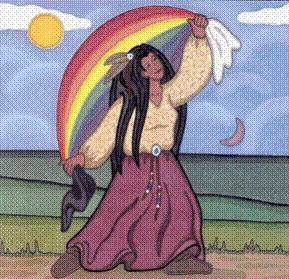
The rainbow was a very important symbol in many ancient cultures. Native America Indians regarded the rainbow as a sign of the great mystery and the future.
“As Native Americans, we believe the Rainbow is a sign from the Spirit in all things. It is a sign of the union of all people, like one big family. The unity of all humanity, many tribes and peoples, is essential,” Late Thomas Banyacya, Spokesman, Hopi traditional elders, Hotevilla said
“We have the opportunity to build a Rainbow bridge into the Golden Age. But to do this, we must do it together with all the colors of the Rainbow, with all the peoples, all the beings of the world. We who are alive on Earth today are the Rainbow Warriors who face the challenge of building this bridge,” Brooke Medicine Eagle, Daughter of the Rainbow, Crow and Lakota said.
“There is truth in the prophecies of the Rainbow and the Rainbow people. People from all of the Americas will unite with people from all the other nations, and they will realize that we are all Family, brothers and sisters. This is not my personal vision, but the cosmic vision presented by all the elders, a vision that we all share,” Don Alejandro Cirilo Perez, Maya Elders Council, Guatemala said.
From The Prophecy Of The Rainbow Warriors And Future Of Planet Earth – Ancient Pages
***
The rainbow flag has a longer history than the 1970s though, and all of us, whatever kind of rainbow person we are, can be proud to walk in the footsteps of those who have flown it before. Drawing on the biblical story of the flood, it has been a symbol of freedom and progressive thinking for centuries.
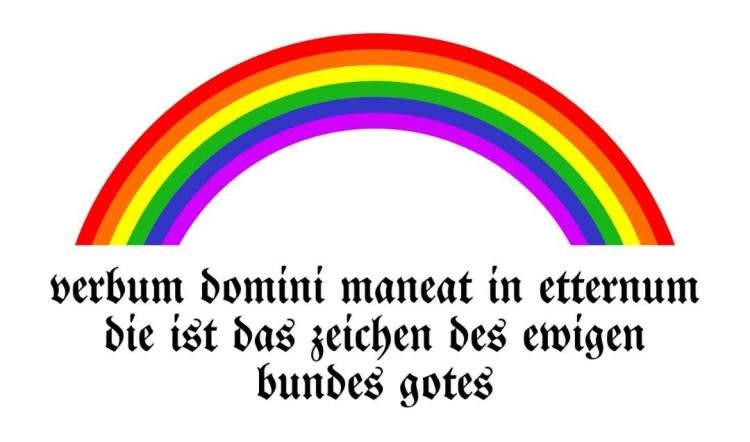
The rainbow held a political significance, appealing to those seeking a better life, seeking the end of oppression, since the early 16th century, when German preacher Thomas Muntzer adopted a rainbow banner as his symbol of resistance to the Catholic Church, as well as to the teachings of Martin Luther and the whole feudal system. He became a prominent figure in the German Peasants War of 1525, in which the rainbow was used as the sign of a new era, of hope for social change.
In the 18th Century, the English-American revolutionary and author of the influential political tract Rights of Man, Thomas Paine, advocated for the adoption of the rainbow flag as a universal symbol for identifying neutral ships at sea.
Formed in the 1890s in London, the Rainbow Circle was a political group consisting of Liberals, Fabians and socialists who met to try to bring together the various progressive forces of the time. They first met at the Rainbow Tavern in Fleet Street, keeping the Rainbow Circle name when they moved to Bloomsbury Square. Among its leading figures were Charles Trevelyan and Ramsay MacDonald, and the Circle was one of the key roots of the modern Labour party.
The rainbow flag has been the cooperative emblem since 1921 when the International Co-operative Congress of World Co-op Leaders met in Basel, Switzerland to identify and define the growing cooperative movement’s common values and ideals to help unite co-ops around the world.
In Essen, Germany in 1922, the International Co-operative Alliance (ICA) designed an international co-op symbol and a flag for the first “Co-operators’ Day,” which was held in July 1923. After some experiments with different designs, a famous French cooperator, Charles Gide, suggested using the seven colours of the rainbow for the flag. He pointed out that the rainbow symbolized unity in diversity and the power of light, enlightenment and progress. The first co-op rainbow flag was completed in 1924 and was adopted as an official symbol of the international cooperative movement in 1925.

The Rainbow flag as a peace symbol was first used in Italy at a peace march in 1961. The flag was inspired by similar multi-coloured flags used in demonstrations against nuclear weapons. A previous version had featured a dove drawn by Pablo Picasso.
The most common variety of the Peace flag has seven colours—purple, blue, azure, green, yellow, orange, and red—and is emblazoned in bold with the Italian word PACE, meaning “peace”. It became popular with the Pace da tutti i balconi (“peace from every balcony”) campaign in 2002, starting as a protest against the impending invasion of Iraq the rainbow peace flag soon spread around the world.
Greenpeace boat Rainbow Warrior took its name from the Native American legends. During the late 1970s and early 1980s Rainbow Warrior was active in several anti-whaling, anti-seal hunting, anti-nuclear testing and anti-nuclear waste dumping campaigns. Since early 1985, the ship was based in the southern Pacific Ocean, where its crew campaigned against nuclear testing. After relocating 300 Marshall Islanders from Rongelap Atoll, which had been polluted by radioactive fallout by past American nuclear tests, it travelled to New Zealand to lead a flotilla of yachts protesting French nuclear testing at the Mururoa Atoll. Here it was blown up by French agents in Operation Satanique, an act of state terrorism.
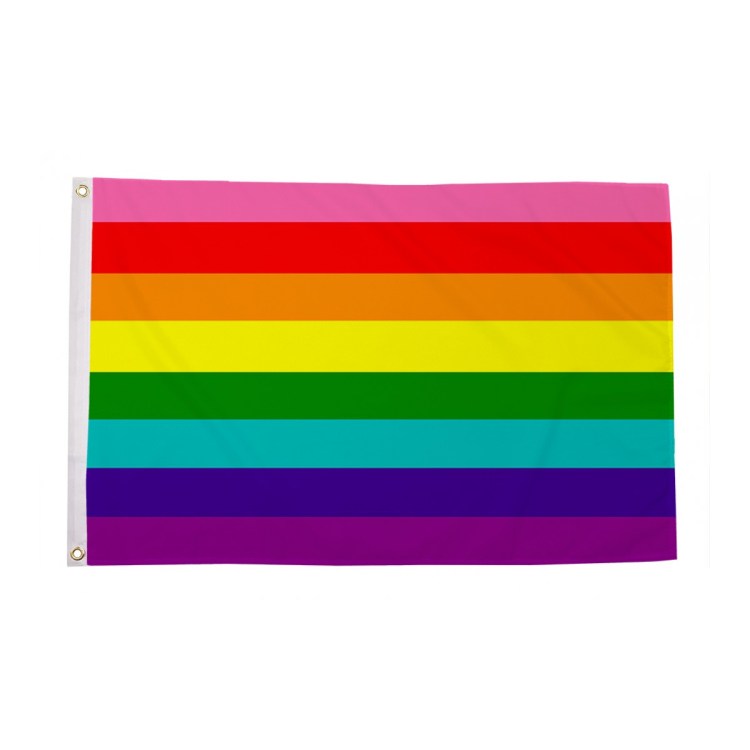
The Gay Liberation flag was designed by Gilbert Baker in 1978, having been urged by Harvey Milk, one of the first openly gay elected officials in the U.S., to create a symbol of pride for the gay community. Baker said in an interview, “Our job as gay people was to come out, to be visible, to live in the truth, as I say, to get off the lie. A flag really fit that mission, because that’s a way of proclaiming your visibility or saying, ‘This is who I am!” He saw the rainbow as a natural flag from the sky, so he adopted eight colors for the stripes, each color with its own meaning (hot pink for sex, red for life, orange for healing, yellow for sunlight, green for nature, turquoise for art, indigo for harmony, and violet for spirit). Production issues, once the demand for flags exploded, led to the loss of pink and turquoise, and during the 1980s rainbows exploded around the gay world, due to both activist and capitalist motivations, the rainbow becoming the official symbol of the global LGBT community in 1994.
Baker wrote that, “A Rainbow Flag was a conscious choice, natural and necessary. The rainbow came from earliest recorded history as a symbol of hope. In the Book of Genesis, it appeared as proof of a covenant between God and all living creatures. It was also found in Chinese, Egyptian and Native American history. A Rainbow Flag would be our modern alternative to the pink triangle. Now the rioters who claimed their freedom at the Stonewall Bar in 1969 would have their own symbol of liberation.”

Since its adoption as a global emblem the LGBTQ rainbow flag has evolved into the Progress Pride version, complete with pink, blue and white stripes for trans people, brown for racial diversity and black for our beloveds who died of AIDS. Most recently also adding a purple circle on a yellow background for people born intersex. The Progress Pride flag emphasises the diversity of racial experience as well as of gender and sexuality in the quest for equality between all peoples, and I celebrate that it includes the men who died of AIDS – I survived three years with full blown AIDS, but lost friends to it, friends who I experience as still being very close to us, still with our tribe guiding us towards our ultimate liberation.
That ultimate liberation is not the end of the journey, it’s the end of the game of separation and delusion. It doesn’t end the game – it changes it, forever. That ultimate liberation is the realisation that we humans are on an eternal journey, that the spirit is right here with us awaiting our reconnection to it, waiting for our awakening and return to Oneness. The Great Spirit, also known in the ancient world as the Great Mother, pulses through nature, through the cosmos and through us.
The rainbow is the symbol of liberation through reunion with nature and spirit, it represents our ‘wholeness’. This reunion is the realm of ‘magic’, this is the mystic awakening in us, this is the cosmic conscious future, and whether we camp with rainbows or march with them, it is this liberated future we are calling into being, where all people are free and safe to live and love as their nature calls them to be, where we recognise the divine in each other and in nature, and change how we live on planet earth accordingly.
“The world is sick today because it has turned away from The Great Spirit. When men turn once more to the Ancient Being with love and world understanding, the earth will become beautiful again.” – From Warriors of the Rainbow
 rainbow messenger