
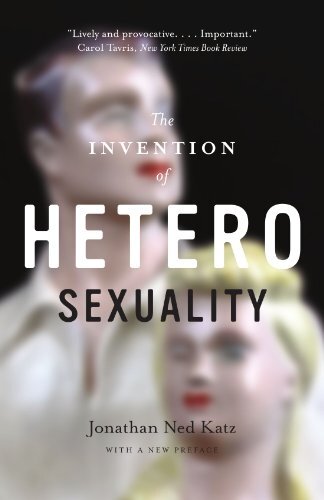
“Contrary to today’s bio-belief, the heterosexual/homosexual binary is not in nature, but is socially constructed, therefore deconstructable.” Jonathan Ned Katz
“The myths, fantasies, and narratives of heterosexual love are among the most powerful Western society has ever produced. Anyone who grew up watching Disney fairy tales or reading the novels of Jane Austen can be excused for thinking that heterosexuality is and always has been a fundamental fact of human interaction…. While scholars have spilled no small amount of ink tracing the origins of homosexuality and various other sexual “unorthodoxies,” heterosexuality has largely escaped such close scrutiny.” Ryan Linkoff, University of South California
“Heterosexual” and “heterosexuality” are creations of a particular, distinct, well-documented time and place. They are words, and ideas, developed by people whose names are known to us and whose handwritten letters we can still read. Their adoption and integration into Western culture was a remarkable process that historian Jonathan Ned Katz, the first to chronicle it, has aptly called “the invention of heterosexuality.” Hanne Blank
The Invention of Heterosexuality by Jonathan Ned Katz was published in 1995, and was celebrated in Hanne Blank’s 2012 work Straight: The Surprisingly Short History of Heterosexuality. Their conclusions deserve to be widely known!
The division of people into sexual categories came with the scientific mindset of the late 19th century. Homosexuality was named first and heterosexuality followed. We are often told (following the ideas of Foucault) that until that time gay sex was something people did, not how they self-identified. What’s more it was taken for granted that anybody might be tempted by same sex erotic attractions – hence the many centuries of church decrees and state enacted laws to try to control the sex lives of the population. It was not assumed that men would be exclusively attracted to women – and history shows that bi-sexuality has been the norm for many men in all cultures (but in fact, challenging Foucault’s conclusion, through the centuries we find many comments about men who are only attracted to other men.
Karl Maria Kertbeny, a Hungarian writer and bookseller born in 1824, first coined the terms. He intended them to be used as neutral descriptive words in arguments for civil rights, but homosexuality, and for a time also heterosexuality, became associated with pathologies and negative stereotypes.
Jonathan Ned Katz:
“Kertbeny first publicly used his new term homosexuality in the fall of 1869, in an anonymous leaflet against the adoption of the “unnatural fornication” law throughout a united Gen many. The public proclamation of the homosexual’s existence preceded the public unveiling of the heterosexual. The first public use of Kertbeny’s word heterosexual occurred in Germany in 1880, in a published defense of homosexuality, in a book by a zoologist on The Discovery of the Soul. Heterosexual next made four public appearances in 1889, all in the fourth German edition of Krafft-Ebing’s Psychopathia Sexualis. Via Krafft-Ebing, heterosexual passed in three years into English… first reaching America in 1892. That year, Dr. Kiernan’s article on “Sexual Perversion” spoke of Krafft-Ebing’s “heterosexuals,” associating them with nonprocreative perversion.
“In the last decades of the nineteenth century, the new term heterosexual moved into the world, sometimes linked with nonprocreative “perversion,” sometimes with “normal,” pro-creative, different-sex eroticism. The theorizing of Sigmund Freud played an influential role in stabilizing, publicizing, and normalizing the new heterosexual ideal.”
However, “Freud’s idea that heterosexuals are made, not born, is still one of his most provocative and, potentially, his most subversive theories.”
“In the first years of the twentieth century, with Freud’s and other medical men’s help, the nineteenth century’s tentative, ambiguous heterosexual concept was stabilized, fixed, and widely distributed as the ruling sexual orthodoxy -The Heterosexual Mystique- the idea of an essential, eternal, normal heterosexuality. As the term heterosexual moved out of the small world of medical discourse into the big world of the American mass media, the heterosexual idea moved from abnormal to normal, and from normal to normative… Only slowly was heterosexuality established as a stable sign of normal sex. In 1923, “heterosexuality” made its debut in Merriam-Webster’s authoritative New International Dictionary. “Homo sexuality” had, surprisingly, made its debut fourteen years earlier, defined as “sexual passion for one of the same sex.” The Merriam-Webster dictionary defined “heterosexuality” as a “Med.” term meaning “morbid sexual passion for one of the opposite sex.” Only in 1934 does “heterosexuality” first appear in Webster’s hefty Second Edition Unabridged defined in what is still the dominant modern mode. There, heterosexuality is finally a “manifestation of sexual passion for one of the opposite sex; normal sexuality.” Heterosexuality had finally attained the status of norm.
“In the same 1934 Webster’s, “homosexuality” had changed as well. It’s simply “eroticism for one of the same sex.” Both terms’ medical origins are no longer cited. Heterosexuality and homosexuality had settled into standard American.”

Hanne Blank:
“With the help of good old-fashioned scientific taxonomy, a model for sexual desire and activity between men and women had not only been legitimized; it had been made emblematic of an inherent physical and psychological normalcy that suited both respectable middle-class families and the well-regulated secular state. The modern heterosexual had officially been born.”
“…it took less than a century for “heterosexual” and “heterosexuality” to leap out of the honestly rather obscure medical and legal backwaters where they were born and become part of a vast and opaque umbrella sheltering an enormous amount of social, economic, scientific, legal, political, and cultural activity…
“There is, biomedically speaking, nothing about what human beings do sexually that requires that something like what we now think of as “sexual orientation” exists. If there were, and the attribute we now call “heterosexuality” were a prerequisite for people to engage in sex acts or procreate, chances are excellent that we would not have waited until the late nineteenth century to figure out that it was there.
“Heterosexual” became a success, in other words, not because it represented a new scientific verity or capital-T Truth. It succeeded because it was useful. At a time when moral authority was shifting from religion to the secular society at a precipitous pace, “heterosexual offered a way to dress old religious priorities in immaculate white coats that looked just like the ones worn among the new power hierarchy of scientists. At a historical moment when the waters of anxiety about family, nation, class, gender, and empire were at a rather hysterical high, “heterosexual” seemed to offer a dry, firm place for authority to stand. This new concept, gussied up in a mangled mix of impressive-sounding dead languages, gave old orthodoxies a new and vibrant lease on life by suggesting, in authoritative tones, that science had effectively pronounced them natural, inevitable, and innate…”
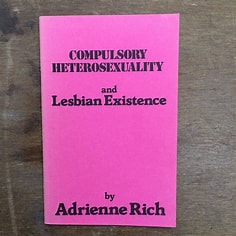
Lesbian feminist Adrienne Rich had already argued in a 1980 essay “Compulsory Heterosexuality and Lesbian Existence,” that heterosexuality has been constructed by men historically and culturally to further the male agenda, that it is not a “natural” human instinct, but an institution imposed upon many cultures and societies that keeps women in a subordinate position. “…heterosexuality as institution has been organized and maintained through the female wage scale, the enforcement of middle-class women’s ‘leisure,’ the glamorization of so-called sexual liberation, the withholding of education from women, the imagery of “high art’ and popular culture, the mystification of the “personal” sphere, and much else.” After Adrienne, it took a few years before Katz and more until Blank published their books, and it’s taking time for the rest of the world to notice! Conservative types who stand for ‘traditional’ ways have really no idea what they are talking about!
Hanne Blank: “Heterosexual privilege is the result of an enormous cultural machine. Parts of the apparatus existed long before the concept of “heterosexual” was so much as a twinkle in Karl-Maria Kertbeny’s eye; parts were machined by the urban industrialist nine-teenth century, and still other parts have been cobbled together over time by psychiatrists and statisticians, ad executives, lawyers, and a veritable army of moony, June-y songwriters. It is a complex and frankly monumental cultural inheritance, accreted over decades, filtering in from every direction and thus seemingly none at all. Our art is steeped in it; our media are driven by it. We remember our most classic stories through its tunnel vision-Antony and Cleopatra’s tale is a political thriller and a bloodbath, not a swoony romance. Regardless of whom we desire or have sex with, no matter whom we form our households or raise our children with, heterosexuality influences how we keep house, how we spend our money, and how we build our families. The models we have, and the standards we are expected to maintain, come to us via heterosexuality as a normative state. Heterosexuality-whatever the current version of that concept happens to be-is unremarkable because it is the standard by which everything else is measured. That is heterosexual privilege.
“Heterosexuality seems to be bigger than we are, independent, more powerful. It is not. In reality, we are the ones whose imaginations created the heterosexual/homosexual scheme, and we are also the ones whose multitudes that scheme ultimately cannot contain. Eventually as a culture we will imagine our way into some different grand explanation, some other scheme for explaining our emotions and our desires and our passionate entanglements. For now, we believe in heterosexual. And this, too, shall pass.”
From review of Straight: The Surprisingly Short History of Heterosexuality on OutHistory:
“Straight concludes by returning to the opening problem, of how to talk about sexual orientation when it involves a person who is neither a textbook male or female, with an extended look at the various points at which the hetero/homo scheme breaks down. Intersexed individuals, transsexuals, new reproductive technologies that allow for conception without penis-in-vagina intercourse, and even the simple (yet vast) array of sexual behaviors in which humans engage all challenge the ability of “heterosexual” to rule the day. In the end, it is clear, “heterosexual” is not an inevitable answer but a temporary one, an idea and a term we developed because it was useful to us, and an idea and term whose usefulness we will eventually outgrow.”
Jonathan Ned Katz in Gay/Lesbian Almanac, 1983: “The invention of a creature whose feelings were legitimately “hetero” and “sexual” was something new in the late Victorian night, a creature quite as unique as the “homosexual” under the late Victorian moon. The elaborating and detailing of the hetero’s character was one epochal, historically specific mission of the Dr. Frankensteins of early twentieth century sexology. The medical manufacture of “the heterosexual” as name, concept, feeling, act, and relation, was quite a profound in effect as the invention of “the homosexual.” That newly invented “heterosexual” was no more “natural” than the “homosexual” was “unnatural.” To paraphrase Mae West, nature had nothing to do with it.”
 rainbow messenger
One thought on “Heterosexuality is a Myth.”