
“The history of feminism tends to be written as a secular movement, one indifferent at best to the spiritual side of life, if not actively hostile. And while that might be true of some individual figures, most of feminist history has emerged from—and alongside—esoteric developments like Spiritualism, Theosophy, and Paganism.” Jessa Crispin, author of The Dead Ladies Project, columnist for the Guardian US and host of the podcast Public Intellectual. jessacrispin.com
“Spiritual feminism is characterised by a spirituality that is grounded in the earth and acknowledges that we are all a part of a larger community that is interrelated… it is based on the principles of kindness, compassion, and nonviolence.’’ Carol P. Christ
“The so called division between cultural feminism and political feminism is a debilitating result of our oppression. It comes from the patriarchal view that the spiritual and the intellectual operate in separate realms. To deny the spiritual while doing political work or to cultivate the spiritual at the expense of another’s political and economic well being, is continuing the patriarchal game.” Judy Davis and Juanita Weaver, Dimensions of Spirituality in Spretnak’s The Politics of Women’s Spirituality.
First wave feminism is regarded as beginning at the Seneca Falls Convention in New York in 1848, where 300 women and a few men gathered for the first ever Women’s Rights Convention, led by Elizabeth Cady Stanton and Lucretia Mott.
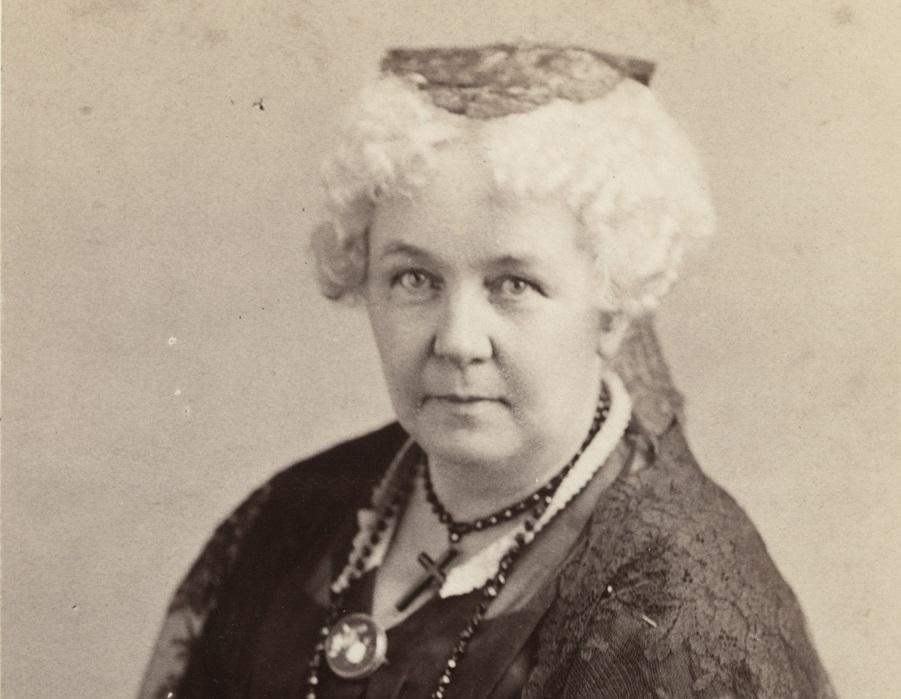
Elizabeth Cady Stanton (1815-1902) was also engaged in mediumship in the Spiritualist movement and led a group of women in a rewrite of the Scriptures to produce the ‘Women’s Bible’. She believed the Bible and the Church to be “the greatest stumbling blocks in the way of women’s emancipation.” Prominent American social reformer and women’s rights activist, Susan B Anthony, who played a pivotal role in the women’s suffrage movement, called the Women’s Bible ‘gospel truth.’
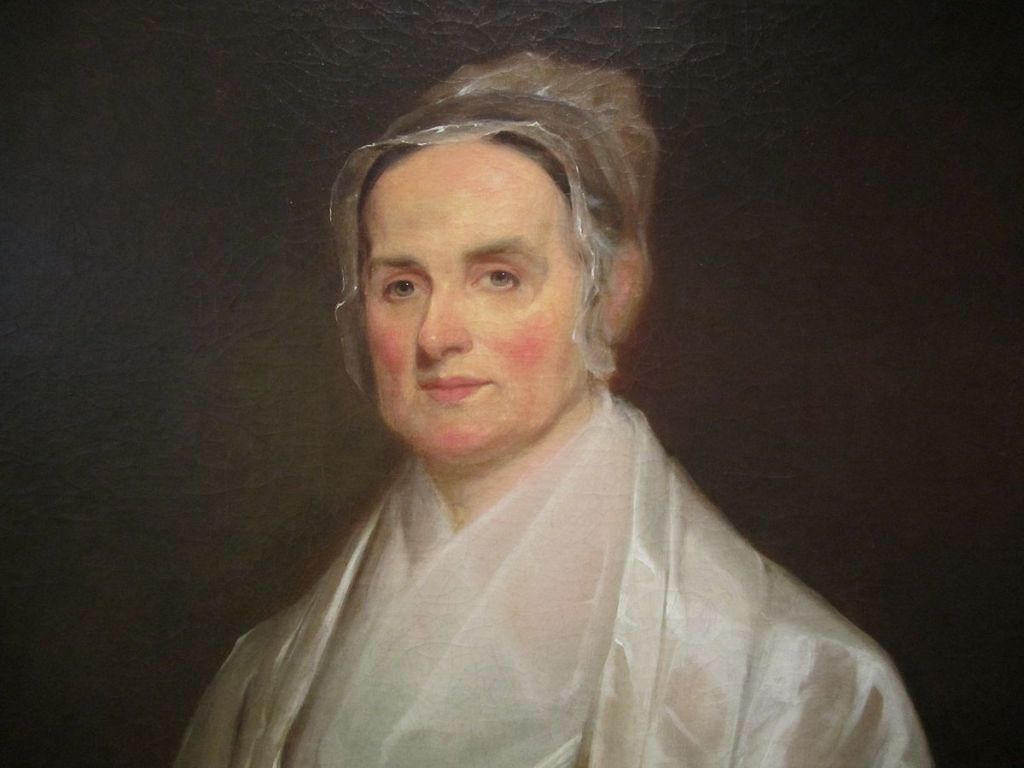
Lucretia Mott (1793-1880) was a Quaker preacher in her 20s whose sermons emphasised the presence of the divine in every individual. She became an advocate for black people as well as women to get the right to vote and has been called the “foremost white female abolitionist in the United States.” In her book, Discourse on Women, Mott argued that a true reading of the Scriptures shows that male and female are in an equal position to one another, and that hierarchy is a man-made concept: “‘Male and female created he them, and blessed them, and called their name Adam.’ He gave dominion to both over the lower animals, but not to one over the other . . .. The laws given on Mount Sinai for the government of man and woman were equal, the precepts of Jesus made no distinction.”
The women at the 1848 Convention penned the Declaration of Sentiments following the format of the Declaration of Independence: “We hold these truths to be self-evident: that all men and women are created equal; that they are endowed by their Creator with certain unalienable rights; that among these are life, liberty and the pursuit of happiness . . .. The history of mankind is a history of repeated injuries and usurpations on the part of man toward woman . . . ” The list of such injuries included religious and theological as well social topics: “He allows her in Church, as well as State, but a subordinate position, claiming Apostolic authority for her exclusion from the ministry… He has usurped the prerogative of Jehovah himself, claiming it as his right to assign for her a sphere of action, when that belongs to her conscience and to her God.”

Another prominent first wave feminist, Matilda Joslyn Gage (1826-1898), who also campaigned for Native American rights, was a vocal critic and opponent of the Christian Church which she considered to be central to the process of men subjugating women through its doctrine which was used to portray women as morally inferior and inherently sinful. Her 1893 book, ‘Woman, Church and State’ outlined the ways in which Christianity had oppressed women and reinforced male dominance. She campaigned for the secularisation of the state, but also became a Theosophist and “In the closing years of her life Mrs Gage was much interested in the occult mysteries of Theosophy and other Eastern speculations as to reincarnation and the illimitable creative power of man.” This quotation is from an obituary, written by Elizabeth Cady Stanton, in Free Thought magazine. Gage had contributed an astrological commentary on the Book of Revelation to the Women’s Bible which Stanton wrote served to “mitigate, in a measure, the terrible pictures as they appear in plain English to the ordinary mind.”
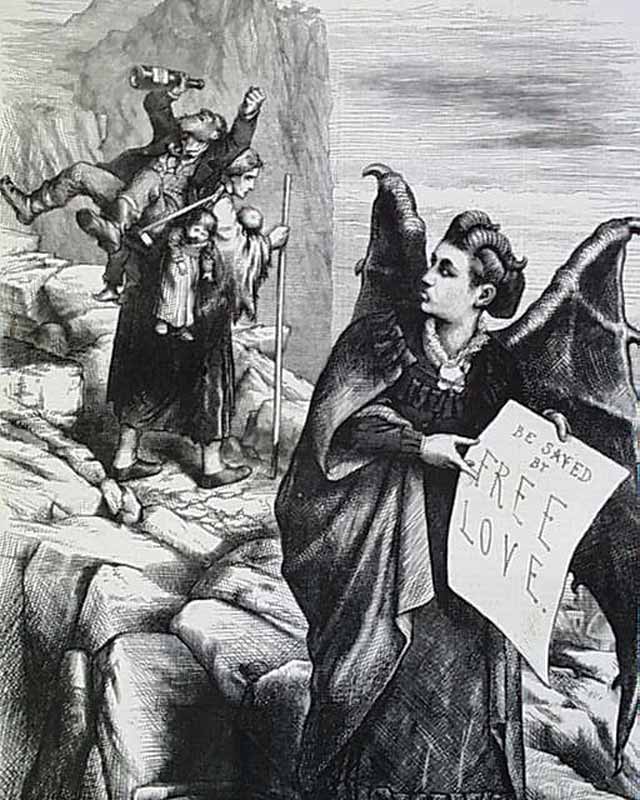
Suffragette Victoria Woodhull (1838-1927) was involved in the Spiritualist movement, and branded a witch by the misogynistic press. In 1872, when she became the first woman candidate to stand for the American Presidency – her campaign platform included universal gender and racial equality under the law – she was depicted in a political cartoon as Mrs. Satan in Harper’s Weekly.
Mary Jo Weaver (an American Roman Catholic theologian) wrote about the religious views of the First Wave feminists, in Journal of Feminist Studies 1989, stating:
“I am convinced that their iconoclastic religious writing helped to make the current revivial of Goddess religion possible. Stanton and Gage particularly, in urging women to reject the authority of the Bible and the institutional church, raise a challenge that, although ignored or condemned in their own time, has been taken up by neopagan feminists.”
Second wave feminism
The surge of feminism in the 1960s and 70s, with its emphasis of the deconstruction of gender roles, was closely entwined with developments in women’s spirituality, but by the 1980s a clear divide opened up between feminist activism and the Goddess movement.
A key development in the 1970s was the emergence of women-led witchcraft, who combined feminine spirituality with an activist, political drive. Major figures in the development of feminist witchcraft include Starhawk, Zsuzsanna Budapest, Carol Christ, Naomi Goldberg.
Zsuzsanna Budapest (born 1940 in Hungary), is surely the Grandmother of modern Feminist Spirituality. She fled to Austria at the start of the Hungarian Revolution in 1956 with her mother, Masika Szilagyi, a medium, witch and sculptress, and emigrated to the USA in 1959, where she married and had two sons, then divorced and came out as lesbian. (She said that she chose to avoid the “duality” between man and woman.) She is credited as founding the first women-only witch coven in 1971, which was named after the first wave feminist campaigner Susan B Anthony. She lives with her partner Bobbie Grennier in the San Francisco Bay Area and has organised Goddess Festivals since 1991.
In 1975, Zsuzsanna Budapest came to be widely known after she was arrested for “fortune telling” at her candle and book store in Venice, California following a “sting” by an undercover policewoman who received a tarot reading from her. Budapest was charged with violating a municipal by-law which made fortune telling unlawful. Budapest and her defense team described her as “the first witch prosecuted since Salem,” and the ensuing trial became a focus for media and pagan protesters. Budapest was found guilty. In response, Budapest and her legal counsel set out to establish Wicca, and more specifically Dianic Wicca, as a bona fide religion. She engaged in a 9 year process of appeals against the conviction on the grounds that reading the tarot was an example of women spiritually counselling women within the context of their religion. The state’s Supreme Court reversed the guilty verdict as unconstitutional and in violation of the Freedom of Religion Act and laws against “fortune telling” were repealed.
Naomi Goldenberg, who would in 1979 write a book called ‘Changing of the gods: feminism and the end of traditional religions’ heard Zsuzsanna Budapest speak about witchcraft as women’s religion at a conference in Boston, which led during the winter of 1975-6 to her taking along her friend Carol Christ to an Open University class on witchcraft taught by a young woman named Starhawk. Naomi and Carol had been active feminists for several years, Naomi an atheist, Carol a nonpractising Christian who was turned off the faith by its male dominance.
Carol Christ: “What I discovered in Starhawk’s class was a spirituality that named Goddess as female, affirmed the body and its connection to nature as spiritual, recognized death as a part of life, and worked with energy. I remember discussing the first class with Naomi and another friend in the car as we crossed back over the San Francisco Bay Bridge. They were questioning some of the things Starhawk had said, but I felt I had ‘come home.’”
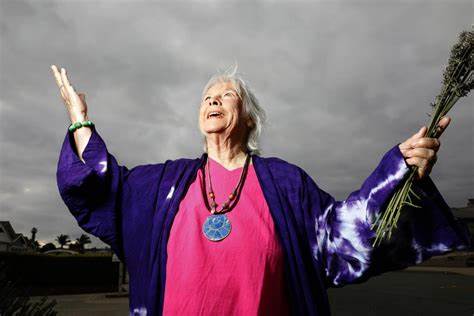


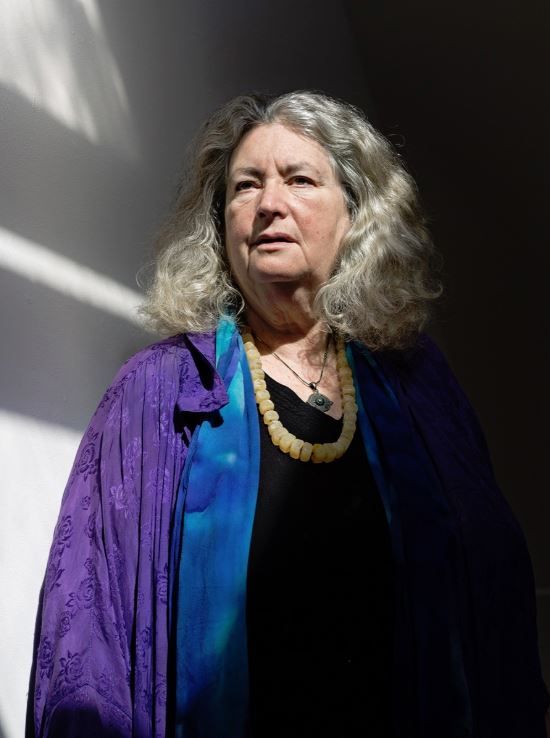
In the autumn of 1977 Carol plus Starhawk, Zsuzsunna Budapest and Naomi Goldenberg gave presentations about the Goddess in a discreet corner of a small seminar on Women and Religion. This was the quiet conception of a new feminist-goddess movement with these 4 women its Mothers – a few months later in the Spring 1978 Carol delivered the keynote address, called ‘Why Women Need the Goddess,’ at The Great Goddess Re-emerging Conference at theUniversity of California in Santa Cruz, to an excited audience of more than 500 women and a few men. Spiritual feminism was born.
Carol Christ’s address, “Why Women Need the Goddess”, which went on to be printed in many publications, critiqued male-dominated religious structures and emphasised the importance of feminine-focussed spirituality, especially the need for women to reconnect with the Goddess as a symbol of empowerment and identity. In it she asked, “Is the spiritual dimension of feminism a passing diversion, an escape from difficult but necessary political work? Or does the emergence of the symbol of Goddess among women have significant political and psychological ramifications for the feminist movement?”
“Because religion has such a compelling hold on the deep psyches of so many people, feminists cannot afford to leave it in the hands of the fathers. Even people who no longer “believe in God” or participate in the institutional structure of patriarchal religion still may not be free of the power of the symbolism of God the Father…
“Religious symbol systems focused around exclusively male images of divinity create the impression that female power can never be fully legitimate or wholly beneficent…”
“The symbol of Goddess has much to offer women who are struggling to be rid of the “powerful, pervasive, and long-lasting moods and motivations” of devaluation of female power, denigration of the female body, distrust of female will, and denial of the women’s bonds and heritage that have been engendered by patriarchal religion. As women struggle to create a new culture in which women’s power, bodies, will, and bonds are celebrated, it is natural that the Goddess would reemerge as symbol of the newfound beauty, strength, and power of women.”
35 years after the original piece, in an article called Why Women, Men and Other Living Things Still Need the Goddess, Carol Christ reflected back and summed up her intentions:
‘In ‘Why Women Need the Goddess’ I discussed four ways the symbol of the Goddess could transform women and culture: 1) the symbol of the Goddess affirms the legitimacy of female power as beneficent and independent; 2) it affirms the female body and its cycles; 3) it affirms female will; and 4) it affirms women’s bonds and heritage.’
“More than anything else the Goddess symbolizes a new and fierce love of women for ourselves that has the power to change the world. Because I did not mention men or God in the essay, it is sometimes assumed that I was saying that the divine power should only and always be imaged as female, that both men and women should pray exclusively to Goddess, or that there is no need for liberating male images of God. This reading suggests that I am simply reversing the status quo as found in Judaism and Christianity. ‘Why Women Need the Goddess’ was addressed to women and situated in the context of women’s space. The fact that I did not address the question of men and God should not be read to mean that I was suggesting that divine power is only or ontologically female. As I wrote in Rebirth of the Goddess, men can also benefit from imaging divine power as Goddess; doing so can help them to respect and honor women, nature, the female body, and all bodies.”
Naomi Goldenberg gave expression to the enthusiasm felt by the women at the birth of spiritual feminism. In her book Changing of the gods : feminism and the end of traditional religions, she predicted “The women’s movement will bring about religious changes on a massive scale. These changes will not be restricted to small numbers of individuals practicing nonsexist religions within a sexist society. Society itself will be transformed to the point that it will no longer be a patriarchy.” But already in 1979 she could see that “Many of today’s feminists are not yet willing to reject Jewish and Christian tradition at such a basic level. Instead, they turn to exegesis to preserve Jewish and Christian religious systems. They prefer revision to revolution.”
For those ready to reclaim women’s spirituality from the male hands of religion, the work of Budapest and Starhawk illuminated the way.

Zsuzsanna Goldenberg, in her work ‘The Holy Book of Women’s Mysteries’, first published 1980, which came out of her years with the women of the Susan B Anthony coven, made the case that “What people believe (faith-religion) is political because it influences their actions and because it is the vehicle by which a religion perpetuates a social system. Politics and religion are interdependent.”
“Women’s spirituality is rooted in Paganism, where women’s values are dominant. The Goddess worship, the core of Paganism, was once universal. Paganism is pleasure-oriented, joy- and feasting-prone, celebrating life with dancing and lovemaking. Working in harmony with Mother Nature, we discover and recover the All-Creatrix, the female power without whom nothing is born or glad…
“Male energy pretends to have power by disclaiming the female force. Today, given the patriarchal society within which we live, witchcraft with a feminist (Dianic) politic says clearly that the real enemy is the internalized and externalized policing tool that keeps us in fear and psychic clutter.”
In the book she presents the:
Manifesto of the Susan B. Anthony Coven No. l
We believe that feminist witches are women who search within themselves for the female principle of the universe and who relate as daughters to the Creatrix.
We believe that, just as it is time to fight for the right to control our bodies, it is also time to fight for our sweet woman souls.
We believe that in order to fight and win a revolution that will stretch for generations into the future, we must find reliable ways to replenish our energies.
We believe that without a secure grounding in womens spiritual strength there will be no victory for us.
We believe that we are part of a changing universal consciousness that has long been feared and prophesied by the patriarchs.
Starhawk (born 1951), like Carol Christ and Zsuzsanna Budapest, emphasises in her teachings the living reality of the Goddess, found in nature and in ourselves, versus the distant God:
“I don’t like it when people assume that the Goddess, the great female principle, is just God in skirts. The Goddess means that the sacred is imminent – it’s present right here and now, in nature and in ourselves. And by sacred what I mean is not a great something that you bow down to, but what determines your values, what you would take a stand for. If the forest is sacred, we can’t chop it down. It water is sacred, we can’t pollute it, even a little bit. If there is sacred authority in the human body, then no external authority can tell people what to do with it- how to love, whether or not to end a pregnancy.” Starhawk quoted in Visionaries : people & ideas to change your life, 2001
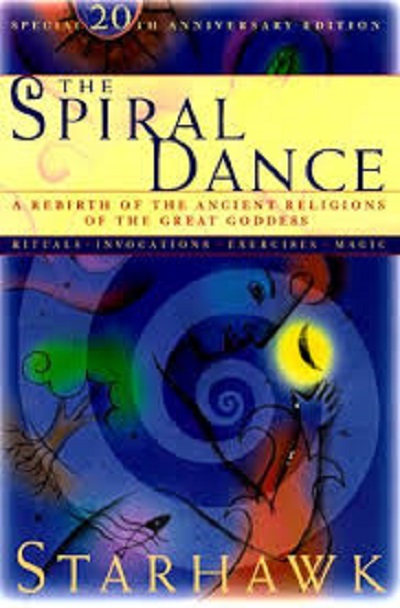

Starhawk’s books The Spiral Dance: A Rebirth of the Ancient Religion of the Great Goddess (1979) and Dreaming the Dark: Magic, Sex, and Politics (1982) are key texts of the modern pagan movement. Since their publication Starhawk has been central to the revival of earth-based spirituality and Goddess religion – she is a leading voice of the neo-pagan movement. But fear and lack of understanding of witchcraft, perhaps with a touch of homophobia added in (Zsuzsanna Budapest is lesbian and Starhawk is open about her bisexuality), is likely a reason that a backlash against the spiritual feminists came pretty quickly, and from other feminists.
In The Spiral Dance Starhawk “outlines the three pillars of her thealogy (a feminist approach to theism), which are that Goddess is immanent in the world; what affects one of us affects all of us; and Goddess religion is lived in community. Together, these thealogical imperatives require compassion, continuous striving for justice, and focus on common struggles rather than individual salvation.
“In subsequent work, Starhawk has emphasized the role of social change in Wicca with a particular emphasis on feminist transformation of patriarchal power over individuals, institutions, and policies. Consistent with many feminist theorists, Starhawk decries ‘power over’ and urges the embrace of ‘power-with.’ Ultimately, she calls for a transformative understanding of the social constructions ‘male’ and ‘female’.” From Encyclopedia of Women in Today’s World.

“STARTING IN THE LATE 1970s, alongside the enormous and continuing growth of women’s spirituality, there sprung up, in almost parallel fashion, a small spiritual movement among men. This movement was connected with the feminist critique of patriarchal notions of religion and authority, and with the attempt of both gay and straight men to create a new definition of maleness.
“One important impulse behind the notion of radical faeries was the idea that there had to be something beyond assimilation. Just as radical feminists wanted to go beyond women attaining equal rights in a man’s world, toward a notion that feminism implied a totally different reality, a different language, a different attitude toward power and authority, this group of gay men saw their own movement as implying a totally different view of the world, with different goals and different spiritual values than the “straight” world…” Margot Adler, Drawing Down the Moon, 1986
The Radical Faerie community continues to grow to this day, but in the 1980s and 90s the challenge of AIDS absorbed all the energy of queer activism, and took many creative, talented, magical men out of life’s game, mostly ones born in the 1950s and 60s, who might have united with the spiritual feminists to form a conscious coalition to lead the world into the Age of Aquarius. I am an AIDS survivor, my spiritual awakening came with that trial – it became my Accelerated Individual Discovery of Spirit – but as I offer my spiritual learnings that stem from that time I am aware that many of my brothers are just the other side of the veil that lifted for me, and our mission is to work together open the portal to the spiritual reality.
One of the founder Faeries, Mitch Walker, declared in his 1980 book Visionary Love: “All faggots are feminists, and militant ones at that. To cultivate your woman-energy, your feminism, is to increase your ability to see and walk through the great portal. In fact it’s essential.” The portal is the entrance to cosmic consciousness in ourselves, the consciousness of unity, love, bliss — of the immanent Goddess.
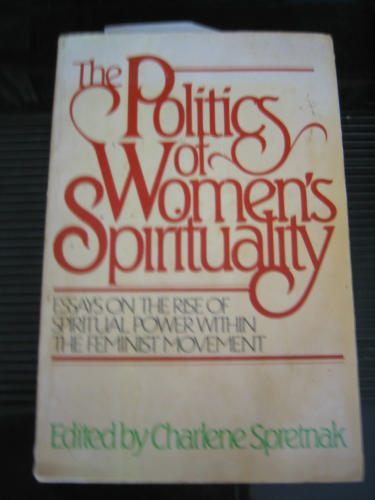
Charlene Spretnak’s 1982 book The Politics of Women’s Spirituality featured 50 essays by ‘Founding Mothers of the Movement’, including three by Starhawk. In the introduction Spretnak describes Goddess as “the intrinsic unity of all forms of being, the ‘life force’ or ‘life energy.’ Experiences of union with the One are accessible to everyone here and now; the truth of oneness is expressed in the consciousness of everyday existence.”
Spretnak honours the spirituality of the first wave feminists, explaining how “Analysts in both the first and second waves of feminism have exposed the sexism behind Judeo-Christian symbolism, ideology, structure, and ministry, but such revelations have often been dismissed by the feminist movement at large as wastes of energy that would better be spent on real political work. The message, however, that was voiced initially by Matilda Joslyn Gage in Woman, Church and State (1893) and by Elizabeth Cady Stanton and the Revising Committee in The Woman’s Bible (1895) is not that patriarchal religion is merely “unfair” in itself: The lies about the nature and function of woman that are intrinsic to patriarchal religion have informed the legal, educational, political, economic, and medical/psychiatric systems of our society and are accepted as “natural truths” by even the most modern and/or atheistic citizens.”
“Many women are fighting valiantly to become Judeo-Christian clergy and are attempting to reform the sexist language and concepts of that tradition. Others of us, however, have concluded that Judeo-Christian spirituality is too relentlessly patriarchal – in origin, content, form, and implication -to be redeemed. Although it has certainly been successful as an arm of patriarchal politics, we feel that patriarchal religion has failed, and failed with disastrous effects on hu mans and on the Earth, at perceiving and communing with “the higher powers” in a constructive and life-affirming way. We are committed to the evolution of postpatriarchal spirituality.”
“The worldview inherent in feminist spirituality is, like the female mind, holistic and integrative. We see connectedness where the patriarchal mentality insists on seeing only separations.”
Starhawk in Politics of Women’s Spirituality:
“Mary Daly, author of Beyond God the Father, points out that the model of the universe in which a male god rules the cosmos from out-side serves to legitimize male control of social institutions: “The symbol of the Father God, spawned in the human imagination and sustained as plausible by patriarchy, has, in turn, rendered service to this type of society by making its mechanisms for the oppression of women appear right and fitting.” The unconscious model continues to shape the perceptions even of those who have consciously rejected religious teachings. The details of one dogma are rejected, but the underlying structure of belief is imbibed at so deep a level it is rarely questioned. Instead, a new dogma, a parallel structure, replaces the old. For example, many people have rejected the “revealed truth” of Christianity without ever questioning the underlying concept that truth is a set of beliefs revealed through the agency of a “Great Man,”
“The symbolism of the Goddess is not a parallel structure to the symbolism of God the Father. The Goddess does not rule the world; She is the world. Manifest in each of us, She can be known internally by every individual, in all Her magnificent diversity. She does not legitimize the rule of either sex by the other and lends no authority to rulers of temporal hierarchies. In Witchcraft, each of us must reveal our own truth. Deity is seen in our own forms, whether female or male, because the Goddess has Her male aspect. Sexuality is a sacrament. Religion is a matter of relinking, with the divine within and with Her outer manifestations in all of the human and natural world… In the Craft, all people are manifest gods, and differences in color, race, and customs are welcomed as signs of the myriad beauty of the Goddess.”
The book, and spiritual feminism in general, were heavily critiqued for raging against ‘masculism’ and yearning for an Eden run by women. In the book, Hallie Iglehart wrote: “Objections to womanspirit seem to fall into three main categories: all spiritualities and religions are oppressive; spirituality is escapist; and it is a wasteful use of womantime and womanenergy. These attitude reflect a shallow view of history, and of spirituality and its relationship to political power. The oppression associated with religion and spirituality is real in a patriarchy. The oppression of political power is real -in a patriarchy. To dismiss all spirituality as oppressive, however is akin to dismissing all politics as oppressive. Refusal to recognize an deal with both oppressions is self-destructive. Moreover, we cannot build a strong movement without recognizing the value of all of work, and without communicating and working together.”
From the 1980s and right up until today many feminists did not want to hear about the spiritual side of things. In 1985, Caught in the Web: A Critique of Spiritual Feminism by Suzanna Danuta Walters accused feminine spiritualities of being separatist and old-fashioned forms of cultural feminism promoting biological essentialism and universalised conceptions of womanhood. She described spiritual feminism as different from radical feminism “in both its theoretical project (the development and articulation of a specifically woman-centered spirituality) as well as its explicit political agenda (the creation of alternative and self sustaining women’s community),” in contrast to the Marxist/leftist (and of course atheistic) agenda of the radical feminists – but concluded that spiritual feminism “presents no fundamental challenge to the status quo.” She and more recent writers such as Chris Bobel, in New Blood: Third Wave Feminism and the Politics of Menstruation, 2010, object to the way that spiritual feminism finds values in women’s traditional roles and dreams of a mythical age of matriarchal peace. Suzanna Danuta Walters, however, did not entirely dismiss the message of the spiritual women, whose views she describes in great detail, and calls for the left to regard the rise of spiritual feminism as a call to create a culture that honours the human need for a sense of connectedness, just one without the myth and mystery. She concludes, “Political culture should celebrate difference, instead of attempting to place all that is different into a category of OTHER.” (A message some modern feminists have completely lost sight of).
Cynthia Eller, in Relativizing the Patriarchy: The Sacred History of the Feminist Spirituality Movement, 1991, was scornful of the spiritual feminists, accusing them of an apocalyptic view of things. She wrote that it’s “not so much the specific characteristics of feminist spirituality’s future utopia but the fact that what is sought is a radical transformation of society as we have known it for several millennia. While more politically minded feminists have pursued wide-ranging social reforms, they have still maintained a stake in the present order and have been reluctant to trade it in for the hope of a future matriarchy. In contrast, feminist spirituality is apocalyptic in tone, envisioning the dramatic conclusion to society as we know it, and the birth of a society beautiful and new.” And with that damning conclusion, the self-realisation that went along with this vision of a transformed society, the connection to non-dual Goddess consciousness and appreciation of the interconnected unity of life, was dropped from the conversation.
Writing in 2013, American feminist Sally Kempton (1943-2023) reflected: “To my generation, feminism was not only a movement for woman’s economic and political equality. It also involved a deep and fearless self-exploration, a commitment to looking beyond our conditioned assumptions about masculine and feminine. That exploration got lost in a kind of backlash in the 1980s and 1990s.” But for her that exploration became central, and spiritual: following an enlightening LSD trip she was inspired to explore eastern spirituality and in 1982 became a Siddha Yoga swami. Later in life she travelled and taught meditation and non-dual philosophy, putting the blissful experience of Goddess consciousness at the centre of her message. Goddess Worship Is The Path to Bliss: Sally Kempton – YouTube

Third wave feminism, from the early 1990s turned the spotlight away from the deconstruction of gender roles and towards individualism, diversity and intersectionality. The unity of sisterhood – and attuning to the spiritual unity of life through Goddess consciousness fell off the feminist agenda, that energy instead channelling into the New Age, holistic spirituality movement, in which many women play prominent roles, a fact which many radical feminists find challenging. They feel spiritual feminism supports traditional female roles which they wish to eradicate. Meanwhile some accuse third-wave feminists of concentrating on sex, culture and identity at the expense of important structural issues that still uphold the patriarchal system, including religion.
Ella Poutiainen, of the Department of Gender Studies, University of Turku, Finland wrote in a 2024 study that while “second-wave cultural feminism was historically connected to the rise of alternative, women-centred spiritualities celebrating feminine divinity, contemporary feminine spirituality is rarely explicitly feminist. In addition, spiritual women frequently view feminism in negative terms. The ambivalent feminism within contemporary feminine spiritualities is captured in Kempton’s illustration of women’s interest in spirituality as a new phase of feminism – a feminism of the soul.” Sally Kempton, mentioned above, saw “goddess practice as a form of sacred feminism – not political feminism but feminism of the soul.” She left the political field and focussed on spirituality for the rest of her life.
And yet there is certainly some interest in spirituality within the contemporary feminist movement. Kristen Aune presented a study, in 2011, in a Feminist Review article called “Much less religious, a little more spiritual: the religious and spiritual views of third-wave feminists in the UK”. Among a wide sample of British feminists, found in local groups, national organizations, conferences, festivals, single-issue campaigns and web-based forums – who were mostly women in their 20s and 30s – she found the most popular response to the question ‘Do you particularly identify with any of the following types of feminism (tick all that apply)?’ was ‘Just identify with feminism generally.’ After this came ‘socialist’, ‘academic’, ‘liberal’ and ‘radical’. ‘Spiritual/religious’ was the fifth least popular, ahead of ‘womanist’, ‘trans’, ‘black’ and ‘separatist’. 39% declared themselves atheists. 11.2 per cent were part of a major religion and only 4.4 per cent of respondents placed themselves in the ‘spiritual but not religious’ grouping. The Goddess, and witchcraft – hailed in the 70s as women’s religion – did not get a mention.
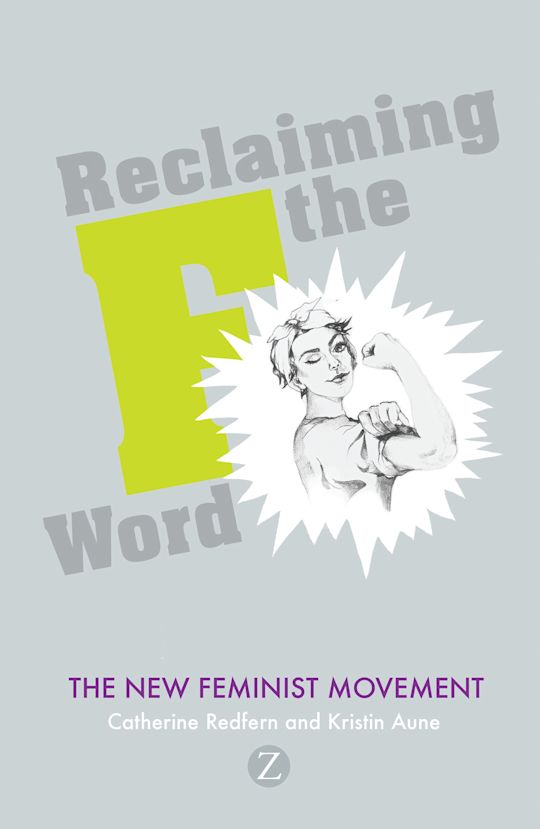
Kristen Aune and Catherine Redfern, inReclaiming the F Word: The New Feminist Movement, 2010, set out to reinvigorate feminism at a time when many young women were not embracing it. Redfern found that some “spiritualities that are perhaps less specific than New Age or neo-paganism have also found favour with feminists. For instance, the spiritual activism of Gloria Anzaldua, the spiritual rituals of Canadian anti-capitalist activists and the Gather the Women global network. Seeing spirituality as ‘a transcendent sense of interconnection that moves beyond the knowable, visible material world’, these feminists believe that spirituality enables them to approach activism with joy rather than anger, giving them energy to heal the world through transforming the self and relationship with others.”
CONCLUSION
“Feminist spirituality must be intersectional, recognizing the multiple and intersecting forms of oppression that women face. This means acknowledging the ways in which racism, classism, homophobia, and transphobia intersect with sexism to create unique experiences of oppression.” wrote Riane Eisler in The Chalice and the Blade, 1987, the clarion call for third wave feminism. But feminist spirituality was slipping away from the conversation. Feminism might be said to have made it possible for some women to play the games that men invented, it has changed society but it has not led to liberation from all patriarchal norms, it has not led to the ‘massive scale’ religious changes and the transformation of patriarchy that the 1970s witches dreamed of – not yet.

Feminism without spirituality may produce successful women, but some of them seem to behave more like men, spreading ignorance and division in the world. JK Rowling being a prime example. Feminism without knowledge and experience of the Goddess has made possible the recent upsurge of transphobic separatism in the feminist movement – the emergence of TERFS, Trans Exclusionary Radical Feminists, who quote biology, not spirituality, as a basis for their beliefs. Spiritual feminists, who see the Goddess alive in all beings, recognise that trans people are part of the divine design, and they also likely know that ‘gender-variant’ individuals have always existed, historically often fulfilling spiritual roles in pre-Christian communities around the world. While some modern, so-called, feminists seem to be pulling us back to a time of defined gender roles – or taking for themselves the right to be as aggressive and elitist as men can be – it would help to recall the basics, to listen again to the Mothers.

Charlene Spretnak: “Efforts to radically transform society must fall short if the deepest informing assumptions and core values are not challenged.” (States of Grace, 1991)
Audre Lorde: “For the master’s tools will never dismantle the master’s house. They may allow us to temporarily beat him at his own game, but they will never enable us to bring about genuine change. Racism and homophobia are real conditions of all our lives in this place and time. I urge each one of us here to reach down into that deep place of knowledge inside herself and touch that terror and loathing of any difference that lives here. See whose face it wears. Then the personal as the political can begin to illuminate all our choices.”
Starhawk has written that in spiritual feminism, ‘there are no fixed gender roles; women and men are equally capable of being warriors or healers.’’ She has said: “Too often we have seen the movement for trans and nonbinary rights as separate from the movement for women’s rights that arose from the second wave of feminism. That division only serves to reinforce the structures of authoritarian male rule. Our issues are not separate, and our interests are far more common than they are divided.”
Zsuzsanna Budapest understood and advised back in the early 80s that: “By accepting all elements in nature, we make whole the collective and individual Soul.” She wrote about queer people in Grandmother Moon, 1991: “One of nature’s most pleasant ways of coping with overpopulation is to increase the number of homosexuals in the community. Rather than producing children, gays provide support for those in the community who do have children. The gay uncles and aunts are the legendary fun relatives we remember as adults. Their productivity is directed into other areas. They have enriched our culture with outstanding works in the arts-theater, dance, music, and so on. They are the emotional and cultural caretakers of the population.” This equally applies to trans as well as gay people – we are all created by nature, we have gifts to share.
Carol Christ: “…identifying as queer means no longer having to try to fit in, to be like the others, to be normal. Identifying as queer means that it is fine to be different, eccentric, not like the others. It means telling the gender police to “go jump in a lake and swallow a snake and come out with a belly ache.”
TERFs are particularly disturbed by people who were born men wanting to live as, wanting to be, women – but a spiritually aware, consciously evolved, feminist would surely see this desire as a huge compliment to the divine feminine – because YES, the Goddess presence is in everyone, and – as many mystics have been saying for some decades – She is coming back strongly into human awareness. The thing is, in a culture that denies the Goddess, that does not understand how her shakti (the Hindu term for Her presence) exists within us, a person in western society born male yet with a strong connection to the divine feminine has to work out what to do with that part of themselves, without a coherent metaphysical framework.
Pagan spirituality can provide such a framework, which, whether a person decides to undergo physical transition or not, addresses the multi-layered nature of gender expression and sensation in all parts of our being – body, mind, soul and spirit, and gives us tools to elevate the exploration of gender, if that is a journey we feel called to take, into a spiritual quest of liberation and fulfilment.
**
Philosopher Simone de Beauvoir (1908-1986) wrote that: “Man enjoys the great advantage of having a god endorse the code he writes; and since man exercises a sovereign authority over women it is especially fortunate that this authority has been vested in him by the Supreme Being. For the Jew, Mohammedans, and Christians, among others, man is Master by divine right; the fear of God will therefore repress any impulse to revolt in the downtrodden female.” Until the world’s feminists grapple with this, patriarchy will continue to hang on to its deep, religious, roots, will continue to divide us and rule over us. Science is of course patriarchy’s latest way of perpetuating itself – once more it found a way to impose a collective belief system, and when ‘feminists’ espouse biology as a justification for harrassing and darkening the lives of other people, I think they have been blinded by the male gaze – that keeps us all turned outward, seeing separation, difference and division – and are failing to embrace the female vision, the Goddess sight that illuminates our inner worlds and which sees unity through diversity, sees the interconnectedness of all things and feels the love – the force that ties it all together.
**
WHEN WE LIVE FROM LOVE WE ARE WITH THE GODDESS, OUR MINDS OPEN TO THE ONENESS GOING ON ALL AROUND US.
Feminism turned away from the spiritual quest.
But the spirit is the realm of the feminine. The DIVINE feminine.
We are all part of Her. She is part of Us.
Be we woman, man, transgender. Be we gay, straight, bisexual.
The Goddess is in everything.
And when humanity finally wakes up to this, everything WILL change, for the better.
***
In Spretnak’s 1982 book, Hallie Iglehart, wrote an essay called ‘The Unnatural Divorce of Spirituality and Politics.’
“An unnecessary and destructive chasm exists between “spiritual” and “political” feminists. It is unnecessary because we are saying the same things about the abuse of power-over relationships, the right to physical and mental health, the destruction of the environment, the importance of the personal and the political, the individual and the collective, and the necessity of the overthrow of the patriarchy on all levels. We have the same goals and values, but sometimes use different words to de-scribe them or tools to actualize them. The split between us is created and maintained by patriarchal dualistic concepts of “spirituality” and “politics.” It is destructive because it prevents the synthesis of the “spiritual” and “political” approaches necessary to establish the kind of world we want to see. When we do make this synthesis within our-selves and within the feminist movement, we will have more power than we ever imagined possible...
“Ultimately, the goals of spirituality and of revolutionary politics are the same: to create a world in which love, equality, freedom, and fulfillment of individual and collective potential is possible. If we unite the two approaches to these common goals, we will experience this fulfillment.”

POSTSCRIPT
From Zsuzsanna Budapest’s Holy Book of Women’s Mysteries:
“What a beautiful spaceship we have to live on! As the Blue Planet in space, we have the only water in the entire solar system. Without water, there is no organic life. Aphrodite still lives here. Our Mother, Earth, Gaia, Demeter, Kore, Tara, Ceres, has dictated all seasons and changes into a calendar of life. Food is life. Knowing how to plant and reap is the core of every culture’s reservoir of knowledge. That is one cycle of change.
“Then there is the other-changes of the spirit, management of feelings, relationships, and personal well-being. Love is the food of the spirit. The communal events that bind communities together around spiritual issues make up our lives and are the highlights in our humanities.
“Having celebrations of all sorts-calling, summoning the people to rejoice, parading, gathering together, feasting, purifying togeth- er, making oaths together, producing culture together, worshipping together-were stock and trade of the most important concerns of the life-oriented society that women created. It is true these festivals and holy days were observed by both sexes for the most part, but they were “priestessed” by women.
“Although diverse in function, the celebrations all had to do with the theme of the communal spirit of the year. Following the simple observance of these festivals, holy days and Sabbats would give rich exposure to the other people in one’s community, and isolation of any one person (unless chosen) was virtually impossible. Hence, there was no loneliness as we know it today, that gnawing awareness that nobody cares. No one had to experience any deep degree of lovelessness, because the attitude toward love was such that, at least ritualistically, everybody had a chance to participate in communal sex as well as communal nurturing. Even the priestesses of Aphro- dite vowed to distribute their favors evenly.
“Today’s calendar, with the meaningless and artificial days of so- called “celebration,” which is usually synonymous with drinking and time off from work, pales in comparison with the genile Path of Old. Therefore, try to celebrate the many holy days of this ancient calendar as often as you can, choosing at least one or two from each end of the wheel, and making the celebration of these sacred days a tradition for your family from now on.
“Do not allow your soul to grow without tending to the spirits of old-our ancestors. You are part of a never-ending continuation and it is perfectly all right to take heart and sustenance from the past.
“When you allow the spirits to awaken in you, difficulties will be clarified and unseen powers suddenly revealed. Do not forget that the Goddess is re-emerging in the public consciousness today, but She has been with you from the beginning, and She is all that is attained at the end of desire.
“Tread lightly into the soul’s hidden desires. The hunger of the spirit will be satisfied by the motherly hands of the Goddess. The cost humanity will have to pay for ignoring and denying the Female Principle of the Universe is soaring. It is through this Female Prin- ciple that the Way will be found. Let this spaceship find home in the Mother’s harbor-paradise restored, at least spiritually. By accepting all elements in nature, we make whole the collective and individual Soul.”
 rainbow messenger