

Aphrodite, Greek Goddess of Love – Venus to the Romans – is one of the most ancient manifestations of the divine feminine. She was associated with the much older Mesopotamian Goddess Ishtar, Inanna to the Sumerians, and like her considered to appear in the sky as the planet Venus, and the Phoenician Goddess Astarte. She had two prime aspects – Urania, the heavenly Aphrodite who was regarded, in Plato’s Symposium, as the inspirer of same-sex love, and Pandemos – of the people – inspiration for procreative desire and promiscuity.
Being a Goddess of Love and Sexuality it’s no surprise Aphrodite had many lovers (both male and female) and children. Three prime gods stand out amongst her offspring, the three that Apollo, the sky God, mentions in Lucien of Samosata’s Dialogues of the Gods (written in the 2nd century CE), while conversing with Dionysus. Apollo marvels at the differences between these three sons of Aphrodite, Dionysus associates these differences with their Fathers.
EROS is a described as a stunningly beautiful man with his archer’s bow,
HERMAPHRODITUS as a blend of both masculinity and femininity, and
PRIAPUS as very unattractive, but endowed with an enormous, permanently erect penis.
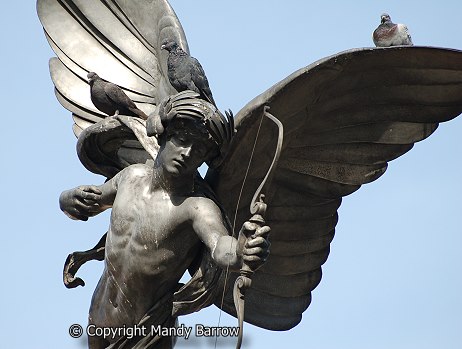
Eros is here seen as one of several sons of Aphrodite and Ares (the Olympian God of war and courage and son of Zeus and Hera, Mars to the Romans), but in the earliest Greek sources Eros appears as one of the primordial gods bringing the cosmos into being, after Chaos, Gaia and Tartarus (an Underworld realm where the dead are judged). Aristophanes described Eros as emerging from the depths of darkness “graceful… with his glittering golden wings, swift as the whirlwinds of the tempest.” Hesiod’s Theogony describes Eros as coming into the world with Aphrodite at her birth in the Ocean.
In the classical myths Eros is the god of erotic love and his power is such that his influence is held responsible for causing many of the lustful urges of other divine beings, and humans too. His cult was prominent in Athens – Plato’s Symposium can be read as a homage to the love god. Eros was seen as responsible equally for sexual attraction between men as between men and women. Love between women was more the territory of Aphrodite but also Athena, who was not interested in relationships with men. Eros can also inspire our passions in non-sexual, non-romantic directions – for example Eros can inspire us to fall in love with our creativity, with projects and places as well as people.
Lucien’s Dialogues no 23:
APHRODITE
Eros, dear, you have had your victories over most of the Gods—Zeus, Posidon, Rhea, Apollo, nay, your own mother; how is it you make an exception for Athene? against her your torch has no fire, your quiver no arrows, your right hand no cunning.
EROS
I am afraid of her, mother; those awful flashing eyes! she is like a man, only worse. When I go against her with my arrow on the string, a toss of her plume frightens me; my hand shakes so that it drops the bow.
APHRODITE
I should have thought Ares was more terrible still; but you disarmed and conquered him.
EROS
Ah, he is only too glad to have me; he calls me to him. Athene always eyes me so! once when I flew close past her, quite by accident, with my torch, `If you come near me,’ she called out, `I swear by my father, I will run you through with my spear, or take you by the foot and drop you into Tartarus, or tear you in pieces with my own hands’—and more such dreadful things. And she has such a sour look; and then on her breast she wears that horrid face with the snaky hair; that frightens me worst of all; the nasty bogy—I run away directly I see it.
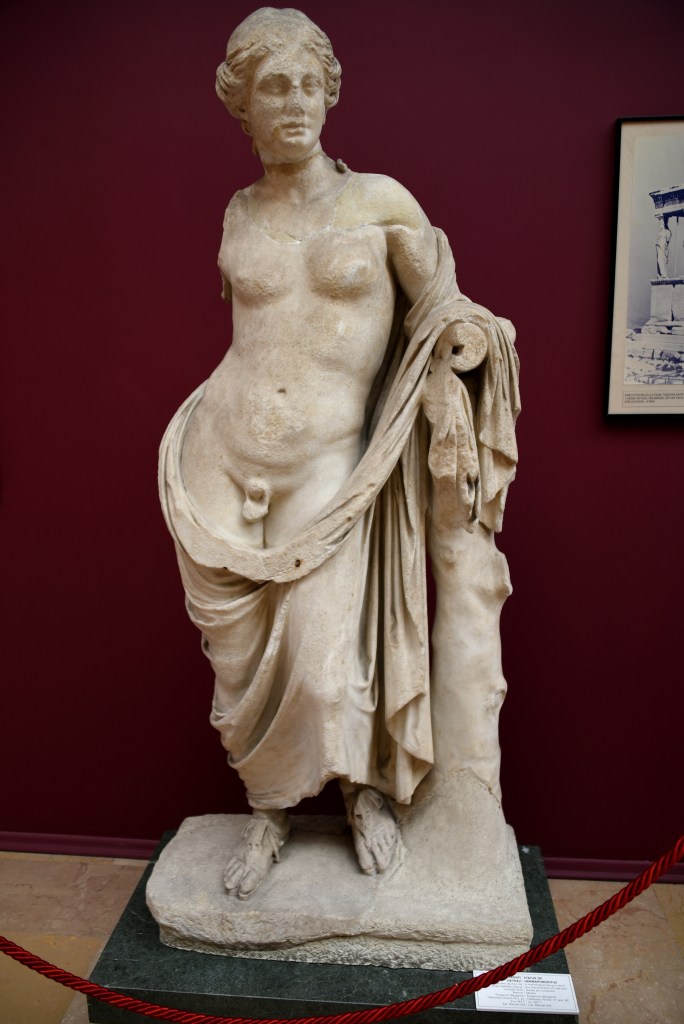
Hermaphroditus is the child of Aphrodite and Hermes, the messenger of the Gods who is able to move swiftly between mortal and divine worlds. Hermes also had male lovers, as Aphrodite had female, making both of them excellent icons for same sex relationships at the time, and today. Together they brought the world Transness…
In the Dialogues, Lucien tells us that Hermaphroditus was born a remarkably beautiful boy, whom the naiad Salmacis attempted to seduce. The 15 year old boy blushed – “He did not know what love was,” and he pushed her away. Thinking her gone Hermaphroditus strips bare and goes to swim in her pool, but she dives in after him: “She held him to her, struggling, snatching kisses from the fight, putting her hands beneath him, touching his unwilling breast, overwhelming the youth from this side and that. At last, she entwines herself face to face with his beauty, like a snake, lifted by the king of birds and caught up into the air, as Hermaphroditus tries to slip away. Hanging there she twines round his head and feet and entangles his spreading wings in her coils.” He still resists sexual union with her, but she calls to the gods who assist her in her goal: “Now the entwined bodies of the two were joined together, and one form covered both. Just as when someone grafts a twig into the bark, they see both grow joined together, and develop as one, so when they were mated together in a close embrace, they were not two, but a two-fold form, so that they could not be called male or female, and seemed neither or either.” Hermaphroditus saw that the pool’s waters had made him “a creature of both sexes and his limbs had been softened there.” He calls to the Gods: “Father and mother, grant this gift to your son, who bears both your names: whoever comes to these fountains as a man, let him leave them half a man, and weaken suddenly at the touch of these waters!”
In Greco-Roman art Hermaphroditus is shown as a female figure with male genitals. He was associated with marriage as his embodiment of both male and female qualities was seen to symbolise men and women forming sacred unions. 1st century BCE Greek historian Diodorus Sicilus wrote that “Hermaphroditus, as he has been called, who was born of Hermes and Aphrodite and received a name which is a combination of those of both his parents. Some say that this Hermaphroditus is a god and appears at certain times among men, and that he is born with a physical body which is a combination of that of a man and that of a woman, in that he has a body which is beautiful and delicate like that of a woman, but has the masculine quality and vigour of a man. But there are some who declare that such creatures of two sexes are monstrosities, and coming rarely into the world as they do they have the quality of presaging the future, sometimes for evil and sometimes for good.” Oh yes, the sad truth is that some people have been debating the validity of transgender people for a very long time.

Priapus is the son of Aphrodite and Dionysus himself. The two had a brief affair, for which Hera cursed Aphrodite and caused her to give birth to an ugly child with a permanent and huge erection – Priapus. The Gods refused to allow him to live on Mount Olympus so he was thrown to the earth where shepherds raised him. Although endowed with a constant erection, its size meant having actual sex was pretty impossible, causing Priapus much frustration.
The Priapeia, from the 1st century BCE, is a collection of 80 short poems, mostly featuring Priapus congratulating and praising himself for the size and virility of his sexual parts, while also issuing fearful warnings to those who would trespass upon his garden or attempt to steal its fruits, threatening such miscreants with various punishments of a sexual nature, including anal penetration.
Diodorus Sicilus wrote that, “the ancients record in their myths that Priapus was the son of Dionysus and Aphroditê and they present a plausible argument for this linage; for men when under the influence of wine find the members of their bodies tense and inclined to the pleasures of love.” He also relates a “myth about the birth of Priapus and the honour paid to him, as it is given by the ancient Egyptians,” giving the story of the dismemberment of Osiris by the Titans and the search by Isis for his body – “the only member she was unable to recover was the organ of sex she commanded them to pay to it the honours of a god and to set it up in their temples in an erect position.”
Diodorus tells that honour is given to Priapus “not only in the city, in the temples, but also throughout the countryside, where men set up his statue to watch over their vineyards and gardens, and introduce him as one who punishes any who cast a spell over some fair thing which they possess. And in the sacred rites, not only of Dionysus but of practically all other gods as well, this god receives honour to some extent, being introduced in the sacrifices to the accompaniment of laughter and sport.”
Three sons of Aphrodite – three sons of Love
one the sexy, mischievous, playful Eros, beloved of men and women (but not Athena!), son of Ares, God of War (Athena’s brother), the only ‘heterosexual’ of the 3 fathers
one a blend of male and female, Hermaphroditus, who blessed the marriages of women with men – son of Hermes, bisexual Olympian messenger
one a fierce, lustful, ithyphallic beast, Priapus – son of the genderfluid God of Ecstasy, Dionysus
I think it’s easy to see the energies of these three sons of love in our world today:
- those who are inspired by Eros are focussed on union with other, be that same sex or other sex.
- those who are inspired by Hermaphroditus are called to union of male and female within themselves
- those who are inspired by Priapus are led by the sexual drive alone
We do not have to define ourselves by who we are attracted to. That is a very recent development in human thinking (since the 19th century).
Gay men and lesbians who question the inclusion of trans people in our global community, often saying that trans is not a sexual orientation and so doesn’t belong with homosexuality, are sadly suffering from a very limited sense of who they are. The increased visibility of Trans people is a wake up call – to us all – challenging the illusions of the scientific-materialist paradigm, in which biology is somehow supposed to tell us who we are. The challenge is to realise that there is more to us than we’ve likely been told, and the ancient myths are clues and signposts to help us discover our deep divine nature.
Gay people and straight people are the same in the sense that we can be driven by Eros or Priapus. Meanwhile those inspired by Hermaphroditus are here to suggest to us all that wholeness will not be found in either of those two routes – wholeness comes via the union of male and female inside us (which opens the mystical doorway to the path that leads to union of our mortal human self with our eternal, divine, aspect).
 rainbow messenger