

February 2026 is an important anniversary in Britain’s gay history – 300 years since the raid of Mother Clap’s Molly House in Holborn, which brought molly culture into public view. This anniversary reveals that a gay subculture existed in London 300 years ago, which drives home how long it took to finally gain acceptance and rights in this country.
The molly houses had first come to public attention earlier in the century, with writings about them indicating a well formed culture in which groups of men met regularly at their ‘clubs’, using ‘maiden’ nicknames for one another, dancing together, camping it up, sometimes dressing in drag on special ‘festival nights’, and using a specialized molly slang.
London’s molly houses were subjected to police raids in February 1726, at Mother Clap’s 40 men were arrested. Several were prosecuted and on May 3 were executed at a public spectacle, an example and warning to other men who might be tempted by gender-bending behaviour or erotic play with members of the same sex.
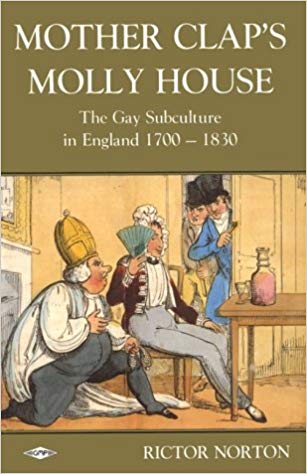
Historian Rictor Norton has written about the molly house raids and 18th century gay subculture in a 1992 book and on his website, and I think it’s worth sharing the story in some depth:
“On a Sunday night in February, 1726, a squadron of police constables converged upon the molly house kept by Mother Clap in Field Lane, Holborn, tucked away between an arch on one side and the Bunch o’Grapes tavern on the other. All the avenues of escape being blocked, by the early morning hours the rooms had been emptied of forty homosexual men – ‘mollies’ or ‘notorious Sodomites’ in the language of the day – who were rounded up and hauled off to Newgate prison to await trial. By the end of the month several more molly houses had been similarly raided, and more mollies imprisoned. None of the men were actually caught in flagrante delicto – though a few were discovered with their breeches unbuttoned – and eventually most of them were set free due to lack of evidence. A number of them, however, were fined, imprisoned, and exhibited in the pillory, and three men were subsequently hanged at Tyburn…
“Mother Clap and her company would have gone unmolested were it not for the jealousy of an embittered homosexual turned informant named Mark Partridge…Sometime during October 1724, Partridge had a quarrel with his lover Mr Harrington (whose first name doesn’t seem to be recorded). What we can piece together from confusing court testimony (which is scattered throughout several trials since neither Partridge nor Harrington were themselves tried) is that Harrington revealed to someone that Partridge was his lover, and that Partridge when he heard of this betrayal was angry at being revealed as a sodomite, so he proceeded to revenge himself by spreading the (true) rumour that Harrington was an habitue of a number of molly houses. The rumour got out of hand – that is, it spread outside the confines of the molly subculture – and soon Partridge was contacted by the police. He was probably coerced by them into becoming an informer in order to avoid being prosecuted himself. by late 1725, Partridge was leading various constables to all of the London molly houses that he knew of, and introducing one or the other of them as his ‘husband’ so they could be admitted as bona fide members of each group. On Wednesday, 17 November for example, Partridge took constables Joseph Sellers and William Davison to another molly house, one kept by Thomas Wright in Beech Lane, where there was a very big row because the others had heard that they had been informed upon. They called Partridge a ‘Treacherous, blowing-up, mollying-Bitch’, and threatened to kill anyone who would betray them. Partridge, however, was able to mollify them by arguing that it was Harrington who let out the secret in the first place. So they forgave him and kissed him – and kissed the constables too, little suspecting who they were, and little knowing how treacherous Partridge indeed was…
“Samuel Stevens, a Reforming constable (i.e. a member of the Society for the Reformation of Manners) who became a member of her club by pretending to be the ‘husband’ of a homosexual informant, reports a visit he made on Sunday, 14 November 1725:
I found between 40 and 50 Men making Love to one another, as they call’d it. Sometimes they would sit on one another’s Laps, kissing in a lewd Manner, and using their Hands indecently. Then they would get up, Dance and make Curtsies, and mimick the voices of Women. O, Fie, Sir! – Pray, Sir. – Dear Sir. Lord, how can you serve me so? – I swear I’ll cry out. – You’re a wicked Devil. – And you’re a bold Face. – Eh ye little dear Toad! Come, buss! – Then they’d hug, and play, and toy, and go out by Couples into another Room on the same Floor, to be marry’d, as they call’d it.
“In April 1726 five men were brought to trial. The first to be tried was Gabriel Lawrence, 43 years old, indicted on charges of having sodomised Thomas Newton on 20 July 1725, and of having sodomised Partridge on 10 November 1725… William Griffin, a 43-year-old furniture upholsterer, was tried in April on charges of having also sodomised Thomas Newton… Thomas Wright, a 32-year-old wool-comber, was charged with having sodomised Thomas Newton as well. According to Newton, Wright had been in the business of selling ale to various molly houses before he set up his own molly house in Beech Lane… Constable Sellers testified that he went to Wright’s house on 17 November 1725, ‘and there I found a Company of Men fiddling, and dancing, and singing bawdy Songs, kissing, and using their Hands in a very unseemly Manner’. At Sellers’ departure, Wright ‘kiss’d me with open Mouth’. Constable William Davison, who went there the night the mollies threatened Partridge, reported that ‘in a large room there, we found one a fiddling, and eight more a dancing Country-Dances, making vile Motions, and singing, Come let us [bugger] finely’. (Unfortunately this ditty has been censored by the court reports, and the full text is lost). ‘Then they sat in one another’s Laps, talked Bawdy, and practised a great many indecencies. There was a Door in the great Room, which opened into a little Room, where there was a Bed, and into this little Room several of the Company went; sometimes they shut the Door after them, but sometimes they left it open, and then we could see part of their Actions’.”
Gabriel Lawrence, William Griffin and Thomas Wright were all found guilty, sentenced to death then hanged together at Tyburn on Monday 9th May.
“At the same time, three other felons arrived in another cart to be hanged, and the notorious Catherine Hayes was brought in a cart to be burned for the murder of her husband. (She become the subject of Thackeray’s novel Catherine.) Before the hangman – Richard Arnett – could strangle her with a rope (as was customary), the flames reached his hands and he had to let go of the rope. The spectators were horrified by her screams as she struggled to kick away the burning faggots; she failed, and people watched in dismay as the eyes in her sockets melted from the heat; it required three hours for her body to be reduced to ashes… Such mass executions as these were quite popular, and the wealthier spectators could afford to sit in the viewing stands specially erected to accommodate them. On this particular occasion, the stands collapsed under the weight of 150 spectators, six of whom were killed”
More trials followed in July, Martin Mackintosh was sentenced to a year’s imprisonment, a fine and time in the pillory in Bloomsbury Square, which was also the fate of Mother Clap, who was found guilty of keeping a disorderly house, given two years imprisonment and forced to stand in the pillory at Smithfield: “She was treated so severely by the mob that she fainted and fell off the pillory several times, and was carried back to the prison having convulsive fits; the newspapers suggested that she would not survive the ordeal. No more is heard of her.”
“By August 1726, three men had been hanged at Tyburn, two men and one woman had been pilloried, fined and imprisoned, one man had died in prison, one had been acquitted, one had been reprieved, and several were forced to go into hiding. The court may have sensed a witch-hunt atmosphere in the proceedings, not so much because the victims were innocent, but because the accusations came almost solely from only two men, both of whom were participes crimen in every instance, and both of whom were demonstrable rogues of dubious credibility. Whether or not the judges fully appreciated the disrepute into which they may have precipitated the administration of British justice, the trials ceased, there were no more convictions (although in December 1726 Samuel Roper, alias Plump Nelly, died in prison while awaiting trial for keeping a molly house in Giltspur Street,) and this particular episode of homosexual history came to an end.”
The London Journal on 7 May 1726 contained a letter, signed by ‘Philogynus’ (Latin for ‘woman-lover’):
“According to him, the mollies commonly refer to each other as ‘Madam’ and ‘Miss Betty’, and in a quarrelling mood will say such things as ‘Oh you bold Pullet, I’ll break all your eggs’. (In the heterosexual underworld, a Game Pullet was a young whore-to-be.) He cites another slang phrase, ‘bit a Blow’, which is equivalent to the modern gay slang ‘score a trick’. Although Philogynus graciously acknowledges that the mollies ‘are really very good Customers where they frequent’, he denounces their ‘effeminacy’, suggests that they ‘despise the Fair Sex’, and concludes this uncomplimentary personality profile by suggesting that they are ‘brutish People … harden’d in Iniquity’.”
The same edition of the paper expressed horror about the molly trials, then proceeded to expose the major cruising grounds in London: “ ‘besides the nocturnal Assemblies of great Numbers of the like vile Persons at what they call the Markets, which are the Royal-Exchange, Moorfields, Lincolns-Inn Bog-houses [privies], the South Side of St James’s Park and the Piazza’s of Covent-Garden, where they make their Bargains, and then with draw into some dark Corners to indorse, as they call it, but in plain English to commit Sodomy’. This term comes directly from contemporary boxing slang, meaning ‘to cudgel upon the back’ or ‘to knock down one’s opponent upon the back’; ultimately it is derived from the Latin dorsus, the back.”
Citations from Rictor Norton, “Mother Clap’s Molly House”, The Gay Subculture in Georgian England, 5 February 2005 http://rictornorton.co.uk/eighteen/mother.htm
The Society for the Reformation of Manners had been going after ‘sodomites’ since the turn of the century, resulting in earlier trials in 1707 and 1709, the same year a journalist, Ned Ward, produced a pamphlet about the Mollies:
“There are a particular Gang of Sodomitical Wretches, in this Town, who call themselves the Mollies, and are so far degenerated from all masculine Deportment, or manly Exercises, that they rather fancy themselves Women, imitating all the little Vanities that Custom has reconcil’d to the Female Sex, affecting to Speak, Walk, Tattle, Cursy [i.e. curtsey], Cry, Scold, and to mimick all Manner of Effeminacy, that ever has fallen within their several Observations; not omitting the Indecencies of Lewd Women, that they may tempt one another by such immodest Freedoms to commit those odious Bestialities, that ought for ever to be without a Name.
“At a certain Tavern in the City, whose Sign I shall not mention, because I am unwilling to fix an Odium upon the House; where they have settl’d a constant Meeting every Evening in the Week, that they may have the better Opportunity of drawing unwary Youth into the like Corruption. When they are met together, it is their usual Practice to mimick a Female Gossipping, and fall into all the impertinent Tittle Tattle, that a merry Society of good Wives can be subject to, when they have laid aside their modesty for the Delights of the Bottle.
“Not long since, upon one of their Festival Nights, they had cusheon’d up the Belly of one of their Sodomitical Brethren, or rather Sisters, as they commonly call’d themselves, disguising him in a Womans Night-Gown, Sarsnet-Hood, and Nightrale, who, when the Company were met, was to mimick the wry Faces of a groaning Woman, to be deliver’d of a joynted Babie they had provided for that Purpose, and to undergo all the Formalities of a Lying in. The Wooden Off-spring to be afterwards Christen’d, and the holy Sacrament of Baptism to be impudently Prophan’d, for the Diversion of the Profligates, who, when their infamous Society were assembl’d in a Body, put their wicked Contrivance accordingly into practice.
“One in a high Crown’d Hat, and an old Beldams Pinner representing a Country Midwife, another busy Ape, dizen’d up in a Hussife’s Coif, taking upon himself the Duty of a very officious Nurse, and the rest, as Gossips, apply’d themselves to the Travelling Woman, according to the Midwife’s Direction, all being as intent upon the Business in hand, as if they had been Women, the Occasion real, and their Attendance necessary.”
A merry, gossipy, feast follows and then,
“No sooner had they ended their Feast, and run thro’ all the Ceremonies of their Theatrical way of Gossiping, but, having wash’d away, with Wine, all fear of Shame, as well as the Checks of Modesty, then they began to enter upon their Beastly Oscenities, and to take those infamous Liberties with one another, that no Man, who is not sunk into a State of Devilism, can think on without Blushing, or mention without a Christian Abhorrence of all such Heathenish Brutalities.”
The pamphlet then states that this culture had been going on for many years until the Society for the Reformation of Manners exposed it.
Read full pamphlet: Homosexuality in Eighteenth-Century England: The Mollies Club, 1709
The 1726 persecution was a witch-hunt – and it may be that the authorities realised that. The persecution ended, but as a result of it the molly scene for sure went further underground – and the news coming in of horrific persecutions of sodomites in the Netherlands in the 1730s must have added to keeping things discrete. Yet when mollies hit the newspapers again in 1810 following a police raid on the White Swan in Vere Street, the same cultural characteristics, including the birth ritual, were still present. At the White Swan raid 27 men were arrested. 8 were taken to trial and 6 ended up in the pillory, where they were subjected to virulent rage from the local population, especially the women. 200 special constables were brought in to control the crowd and prevent further harm to the men.
I have shared at some length from Rictor Norton’s fascinating research, but there is much more detail on his site, including the trial records of the executed mollies. Rictor Norton’s book Mother Clap’s Molly House: Gay Subculture in England 1700 – 1830 was published in 1992 and is not in print, but fortunately Rictor provides us with a fantastic online resource of his essays and a massive collection of source documents at rictornorton.co.uk
Queer Georgians by Anthony Delaney is a recently published work that also visits the Molly history, in deeply descriptive as well as informative style. He evokes the atmosphere of the city and takes us into the smells, sights and sounds of Field Lane, where Mother Clap’s house was situated and takes us into the drama of the February raid:
“On that Sunday night, as Gabriel Lawrence settled jovially amongst his friends, Stephens and Sellers watched on, preparing to spring their trap. Outside, acting on their intelligence, two reforming constables, Messrs Williams and Willis, had positioned themselves on Field Lane. A squadron of other constables and numerous key members of the Society used the shadows to provide cover. These invisible adversaries had been arranged to cut off all possible escape routes when the mollies inside were ambushed. Whether Stephens and Sellers within or Williams and Willis without made the first move in the early hours of the next morning is undocumented. Either way, upon realizing they had been betrayed the mollies ran for their lives. Although the accomplices of the Society hidden along Field Lane attempted to block their escape, some of the luckier men managed to evade capture and absconded across the cobbles. Nonetheless, approximately forty men, including the milkman Gabriel Lawrence, were rounded up that night, alongside the dynamic Mother Clap. The captured men will no doubt have been concerned for their mothers, their fathers, their wives, their children and the consequences their discovery would have for them, as well as thinking on which of their friends present that night had escaped to safety. They themselves would now be delivered to London’s notorious ‘prototype of hell’, as magistrate and novelist Henry Fielding called Newgate Prison. There they would await their fate.”
Delaney’s descriptive account takes us into the horrors of Newgate, the details of the trials and the turbulent atmosphere of the executions – due to the celebrity status of the murderess Catherine Hayes this death day was very well attended.
“Executions were public events, meant to be attended by all sections of society, high and low. As Dr Johnson observed to Boswell, the self-confessed gallows connoisseur, ‘Sir, executions are intended to draw spectators. If they do not draw spectators they do not answer their purpose’.”
Anthony Delaney’s conversational writing style takes us emotionally into the 18th century experience, and he concludes:
“To be a molly in the eighteenth century was a perilous thing, as Gabriel Lawrence and his friends knew only too well; but it was also a life worth pursuing, even in the face of such danger. In that way, their defiance is greater than their demise. That is our inheritance.”
 rainbow messenger