
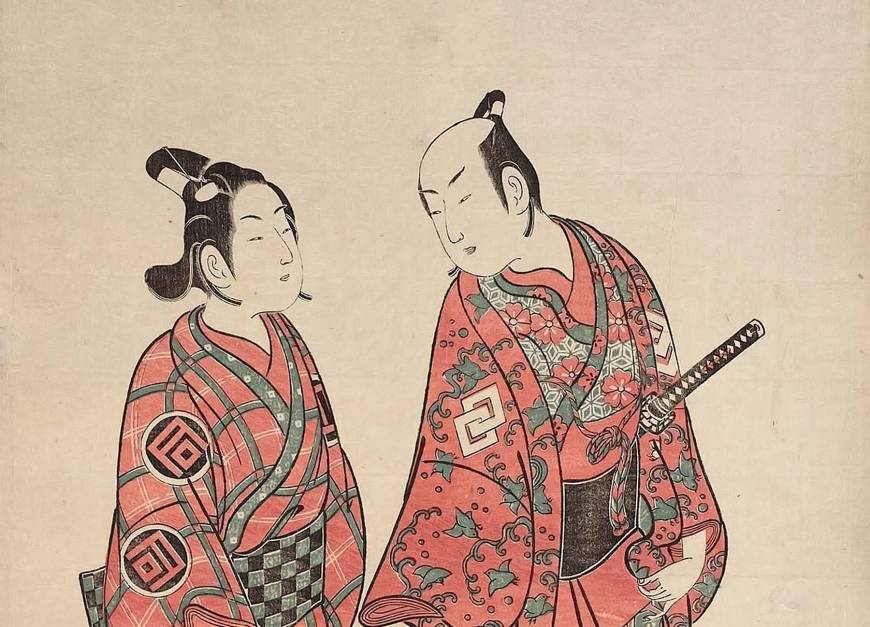
Magnus Hirschfeld (1868-1935) was one of the world’s first gay activists. Both a writer and a doctor, he sought not only to define sexual variation – homosexuality in both men and women, as well as what we would now refer to as trans identity – but also to repeal laws that policed their expression in his native Germany. His insistence that homosexuality was in-born, and that consenting adults should be free to form attachments without harassment from the law, was almost a century ahead of Western public consensus. Hirschfeld published in relative freedom under the German Empire and ensuing Weimar Republic but emigrated before Hitler came to power. As the Nazis cast his research to the fire, Hirschfeld resigned himself to exile, eventually settling in Nice where he died on his 67th birthday.
In 1933 Hirschfeld published A Doctor’s Travels; MEN AND WOMEN. The World Journey of a Sexologist. Here is an excerpt from the book revealing that homosexuality was considered normal and was ingrained into Chinese and Japanese society:
JAPAN
…from letters written me by Japanese and particularly from people who came to see me after my presence was known, that every form of homosexuality, in tendency as well as in expression, is precisely the same in Japan as in Europe. My old observation was again completely confirmed: the individual sex type is a far more important factor than the racial type.
A great many Europeans, who had been living with Japanese friends in firmly established homosexual relations for over ten years, looked me up in Tokyo and Osaka. The “regional life” around the lakes, grottoes and buildings of Hybiya Park in Tokyo is the most animated and romantic I have ever encountered. Especially in the evening, between seven and eleven o’clock, but day and night as well, at every hour, a crowd of the types in ques- tion rustle and buzz about in numbers and varieties such as one never sees either in Hyde Park in London, or in Central Park in New York, in the Prado in Madrid, or the Prater in Vienna. The activity in Hybiya Park reminds one chiefly of certain places in the Berlin Zoological Gardens. As much as forty years ago elderly “urnings” (homosexuals) told me that in their youth (now a hundred years since) the exact same thing was happening there. In Berlin, as in Tokyo, there are people who regard it as a post-war development, because they never heard about it until after the war. Here, as well as there, the homosexual types and their advances are recognizable only to the initiate. The great mass passes blindly by, too full of its own inclinations and interests to notice.
Still another and altogether different androgynous phenomenon occupied me while I was in Japan, one which gives the inquiring spirit an equal impetus to delve into the problem of bisexuality the figure of the Buddha.
Is it conceived of as asexual, heterosexual or bisexual? Are the features and expression of the Buddha, so full of compassionate meditation and gentle pity, of grave tranquillity and of sublimity -are they tender and maternal, or elevated and paternal ?
The more Buddhas I looked at-and I saw thousands, from the child Buddha to the copulating Buddha-the more difficult grew the answer…
… I saw the much younger and smaller Buddha (my personal favourite) with a Mona Lisa smile, the figure sitting in a dreamy temple garden hidden behind the street front not far from Kobe.
Again and again as I looked at this Buddha I thought of the excellent work which my Dutch friend, Dr. von Römer, published in one of my first Jahrbücher für sexuelle Zwischenstufen (Year- books of Intermediate Sex Stages) on “The Androgynous Con- cept of Life.” Indeed, the fusing of the male and female halves in the totality of all creatures, as in each separate one, is embodied in the image of the Buddha more than in that of any other deity.
In addition to the two official religions of Japan, Buddhism, which was probably introduced by wandering Indian and Tibetan priests long after the birth of Christ, relatively speaking, and the earlier Shintoism or ancestor worship-which sprang up on Japanese soil itself, remains of the ancient cult of the phallus are still to be found, especially in the country.
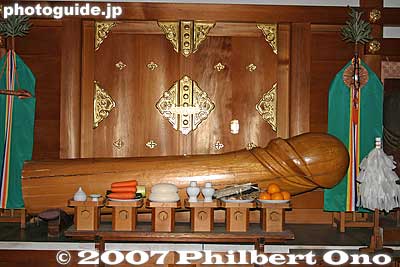
Strange as it may seem, there is some probability that, in its origins, at any rate, ancestor worship has a close relation to worship of the phallus. Intense reverence for male ancestors and an equally intense desire for male offspring have surrounded the phallus with the halo of the creative link between generation and generation, to which the naïve faith of a primitive people brought a veneration that was far removed from all impure thoughts, and from which it is but a small step to worship and the offering of sacrifices. Thus, the cult of the phallus originated in the idea of fertility, and is still intimately connected with it. I devoted a great deal of time and attention to this ancient custom in Japan, making my chief studies of the phallic cult in three localities:
1. In the northern part of the prefecture of Kanagawa, where, near the tiny village of Guzo on the Sagami River, there are great numbers of ancient phallic stones, which I went to see with Doctors Sawada and Hayashi, and some of which I photographed.
2. In Anamori, a little place about an hour from Tokyo, where, not far from the temple of the rice god, there is a large, much- visited “man stone” rising at the cross-roads. In a house nearby is a very large collection of phallic stones, which were shown us by the owner, the widow of the man who collected them. She assured us that she firmly believes the gifts and prayers dedicated to the phallic stone cure women of sterility, and attempted to prove it by citing examples.
3. In a village called Ayameike, between Osaka and Nara, where a Japanese student of folklore named Tsukome has brought many votive phalli together in a curious folk museum.
In the cities themselves one very rarely finds phallic stones, for the police (under missionary influence, I was told) have recently declared them obscene. In Tokyo, however, Professor Myaki took me to a little island in Nueno Park on which there is a most interesting phallic stone with a sacred image carved into the stone. It is chiefly visited by imbais and geishas.
To judge by notes found with the offerings (usually wreaths) beside the phallic stones, and by questions that my Japanese companions and I asked on the spot of the villagers, the chief groups who visit the phallic stones are:
I. Sterile women: this group seems to be the largest.
II. Women who have difficulty in quieting their nursing babies, or whose children are ill.
III. Women suffering from diseases of the abdomen, especially those with flux.
IV. Men whose potency is impaired.
V. Men suffering from venereal diseases, particularly gonor- rhœa.
VI. Unhappy lovers. Double suicides and individual suicides are consequently not infrequent in the vicinity of phallic stones.
VII. Men and women who are alone in the world and who feel erotically lonely

CHINA
The most noteworthy thing I saw there was the School of Silk Industry, headed by L. A. Waitzinger, the research man on heredity. This American savant revealed on taking leave of me that he was born in Miesbach in Bavaria. After my lecture at the Canton Hospital Dr. Waitzinger asked me whether I would be interested in seeing homosexual silk-worm moths. At first I thought my colleague was having his little joke, but he soon convinced me that it was a perfectly serious scientific discovery. The male and female moths, as they come out of the cocoons, are isolated in little watch cases under small glass domes. If you put the male insect with the female he immediately makes a rush for her, sniffs at her and mounts her. But some few among the males behave quite differently. They crawl around the female to he edge of the watch case, and, when placed right on top of the Female, keep running away again as fast as then can. Then Waitzinger showed me under his microscope that these males exhibit distinct feminine markings on their wings.
Now if these males, having feminine characteristics, are put with other male specimens, their behaviour becomes just as excited as it was sluggish when with the females. Thus there is no question that they show all the characteristics of homosexuality: they behave negatively toward the opposite sex and positively toward their own, and they exhibit feminine characteristics.

Ji Kang in 3rd century.
(In many chinese marriages) the wife or the husband avoids any physical contact and often manages cleverly to evade sharing home, table and bed.
Most consistent in this respect are the bachelor girls of the province of Kwangtung, the centre of mulberry and silk-worm culture. In the region of Suntak they have set up homes where they take refuge shortly before or after marriage, so as to be with similarly minded mates of their own sex.
As they make a fair living by unwinding the fine threads of the silk-worm cocoons, they are economically independent of men. Some of them build a little house of their own with the companion they have chosen for life and make a home.
The authorities in Canton have repeatedly, but so far unsucesfully, attempted to do away with this matrimonial comradeship between women, a custom which is not of recent date, but very ancient.
Homosexual men are almost all of them married. But they never take concubines and later on frequently separate from the women assigned to them by their parents. Among them there were relatively few of a pronounced feminine type-most of them showed only slight feminine characteristics or seemed to be entirely virile. I also encountered every other form of intersexuality: hermaphrodism, metatropism, transvestitism, and became acquainted with several cases of deficiency of the sexual glands (eunuchoidism). These microid types were easily diagnosed as such even while fully dressed. In China the law is very peculiar in the matter of homosexuality. The punishment of homosexual acts is unknown in Chinese law.

 rainbow messenger
Great post, thanks for sharing.
LikeLike