
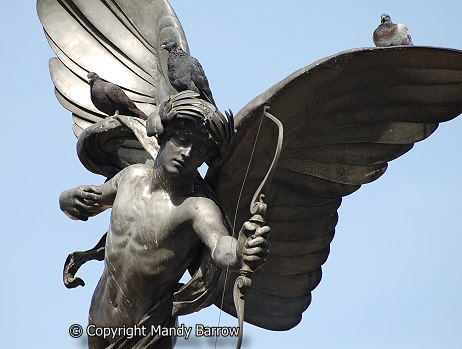
In the civilisations of ancient Europe LOVE was regarded as a primordial, winged deity: In Hesiod’s Theogony (Greece, C8 BCE) only Chaos and Gaia were said to be older. EROS was the last God to be born from the fundamental, raw, divine energies of Creation – after him, other gods manifested through the union of male and female.
In later centuries Eros was often seen as the son of Aphrodite, and Latin writers referred to his Roman equivalent – known as Amor or Cupid – as the son of Venus, usually without reference to a Father. Eros was enthusiastically worshipped in ancient Athens, and was associated with athleticism – statues of him were erected in gymnasia; the 4th day of each moon month (when the crescent moon is visible) was sacred to him. Spartans and Cretans made sacrifice to the love god before war campaigns. In Thespiae the city cult of Eros traced its origins to the myth of Narcissus, whose ill fate resulted from his disdain for the love of an older man, as was recorded in the 9th century by Photius, Patriarch of Constantinople, in a summary of a work written centuries earlier:
“In Thespia in Boeotia (a town near Mount Helicon) there was a boy Narcissus, very beautiful and indifferent to Eros and admirers [erastai]. Although the majority of his admirers gave up making love to him, Ameinias would not desist from his demands. But Narcissus not only did not admit him, but sent him a sword, which Ameinias used to kill himself, in front of Narcissus’s door, making many prayers of supplication to the god to be his avenger. And Narcissus caught sight of himself, the beauty of his form, reflected in the water of a spring and became his own first and only bizarre erastēs of himself. In the end finding himself at a loss and realizing that he was getting his just deserts for disdaining Ameinias’s love, he killed himself. And from that day forth the Thespians resolved to honour Eros exceedingly both in public celebrations and in private sacrifices. And the locals think the narcissus flower first sprang up on that piece of ground on which the blood of Narcissus was poured.”
(Source: The Greeks and Greek Love by James Davidson 2007)
The men involved in the in-depth discussion of Eros that takes place in Plato’s Symposium (written c 380 BCE) take for granted that Erotic Love flows between men. Phaedrus emphasises social function of love between men in encouraging virtue and valour in society. He sees Eros as “the ancient source of all our highest good,” “the great giver of all goodness and happiness.” Pausanias describes two kinds of love – that deriving from heavenly, Ouranian, Aphrodite (which is dedicated to the education of the soul), and that of Aphrodite Pandemos, her earthly counterpart (associated with sensual pleasure and directed indifferently towards women and boys).
The next speaker in the Symposium, Eryximachus, describes how Eros creates harmony between opposites, is active in the natural world, in religion, in music, and in medicine. Aristophanes then gives his well known tale of the primordial ’round people’, the first humans who were cut in two by Zeus for challenging authority of gods, leaving “each half with a desperate yearning for the other.” He describes sexual desire as wish to return to the original state, a complete merging in an utter oneness – not just of bodies but of souls.
Agathon celebates love’s gentleness, righteousness, temperance and valor, he praises the creative genius of Eros, seeing Love himself as so divine a poet that he can kindle in the souls of others the poetic fire, for no matter what dull clay we seemed to be before, we are every one of us a poet when we are in love! Then the Symposium reaches its climax with the teachings of the High Priestess Diotima, as described by Socrates – o yes, the greatest teachings on love came from a woman, no surprise there! Diotima taught that Eros was an intermediary between the divine and humans. Her teaching is that “To love is to bring forth upon the beautiful, both in body and in soul” – while also taking for granted that this will be happening between men: “He and his beloved will help each other rear the issue of their love – and so the bond between them will be more binding, and their communion even more complete, than that which comes of bringing children up, because they have created something lovelier and less mortal than human seed.”
Diotima goes on to initiate Socrates in the spiritual potential of love, saying “The candidate for this initiation cannot, if his efforts are to be rewarded, begin too early to devote himself to the beauties of the body.” With appreciation of physical beauty as the beginning point, the lover comes to recognise how little different one beautiful body is to another and to bring his love for the individual into proportion. Then he comes to recognise that beauty of soul is more desirable than beauty of body – this opens him to recognise the beauty in laws and institutions, in all kinds of knowledge and leads him toward philo-sophia, the love of wisdom itself. Then comes the final revelation “which bursts upon him all at once as a wondrous vision” – the real goal of the whole initiation is the seeing of the “very soul of beauty” – not in any of its appearances, not as a face or hand, or even words or knowledge, but in itself, the beauty of which every beautiful thing partakes. Diotima describes this “universal beauty” as beyond words, inexpressible; it can only be “seen” by “inward sight”, by imagination, by intuition. It is the ecstatic experience of oneness with beauty itself. She insists that mounting this ladder, which begins with the response to one beautiful body, with “prescribed devotion to boyish beauties” is “the way, the only way, to approach, or be led toward the sanctuary of Love.”
(Summary of the Symposium based on that given in MYTHS AND MYSTERIES OF SAME-SEX LOVE by Christine Downing. Published 1989.)

Historian Randy P. Connor said Eros “was often regarded as the protector of homosexual love between men.” Roman Emperor Hadrian (reigned 117-138 CE) made an offering to Eros during his visit to Thespiae, presenting the head of a bear to the shrine and asking in return for “the grace (charis) which comes from the heavenly Aphrodite.” Hadrian went on to enjoy a brief but epic love affair with Antinous, who became deified after his mysterious death on the Nile and became one of the most popular deities of the Roman Empire, his worship lasting until Christianity became the official religion in the 4th century.
Sometimes regarded as manifestations of the god Eros, the Erotes were a group of winged gods in Classical mythology, associated with love and sexual desire, who formed part of Aphrodite’s retinue. The individual Erotes are sometimes linked to particular aspects of love, and are often associated with same-sex desire. Among the named Erotes are Hedylogos (“Sweet-talk”), Hermaphroditus (“Hermaphrodite” or “Effeminate”), Himeros (“Impetuous Love” or “Pressing Desire”), Hymenaios (“Bridal-Hymn”), Pothos (“Desire, Longing”, especially for one who is absent), and Anteros (“Love Returned”- Anteros punished those who scorned love and the advances of others, he was the avenger of unrequited love. Anteros was the son of Ares and Aphrodite, and given to Eros as a playmate because Eros was lonely).
Romano-Spanish scholar and archbishop, Isidore of Seville (died 636 CE – he was called “the last scholar of the ancient world” by 19th-century historian Montalembert) explained in his work Etymolygiae, that Eros/Cupid is winged because lovers are flighty and likely to change their minds, and boyish because love is irrational. His symbols are the arrow and torch, “because love wounds and inflames the heart”.
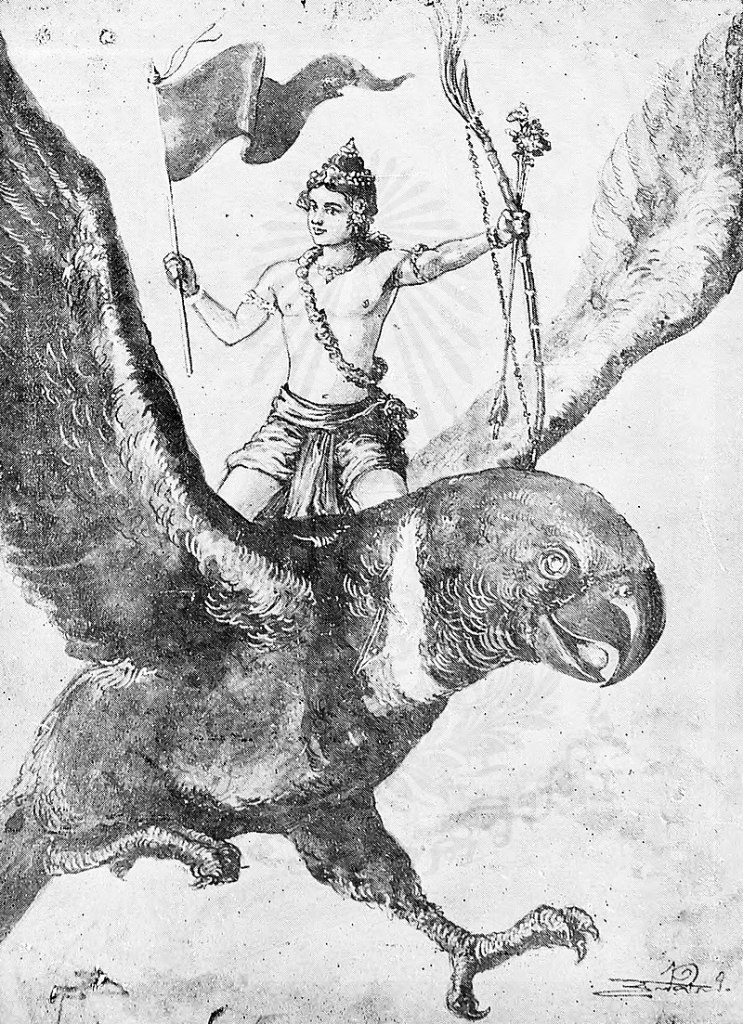
The love deity of ancient India, Kamadeva, the Hindu god of erotic love, desire and pleasure, like Eros and Cupid, was depicted as a young handsome male carrying a bow and arrow. The Atharva Veda regards Kamadeva as the wielder of the creative power of the universe, also describing him to have been “born at first, him neither the gods nor the fathers ever equalled”. As with the most ancient Greek texts, this God of Love was seen as primordial, created before gender-related birth came along – he is mentioned as a manasaputra (mind-born son) of the creator god Brahma in the Puranas. In other texts he is seen as the child of Vishnu (in his Krishna form) and Laxmi.
Wikipedia tells us: In the most common narrative, after Brahma creates all the prajapatis (agents of creations) and a maiden named Sandhya, an extremely handsome and youthful man emerges from his mind and enquires Brahma about the purpose of his birth. Brahma names him Kama and orders him to spread love in the world by shooting his flower-arrows. Kama decides to first use his arrows against Brahma and shoots him with his floral arrows …when Brahma regains consciousness he curses Kama to later be burnt to ashes by Shiva. The gods send Kamadeva to awaken Shiva from his deep meditation with a flower-arrow: Shiva, furious, opens his third eye, which incinerates Kamadeva instantaneously, turning him into ash. Shiva observes Parvati before him. Impressed by her ascetic practice, he allows her to choose a boon of her choice. She enjoins him to restore Kamadeva to life. Shiva agrees to let Kamadeva live, but in a disembodied form, travelling like the wind with his bow and arrow with his consort, Rati.
The Christian world has spent centuries trying to suppress love between men – totally ignoring that Jesus instructed us to throw out all other commandments and simply love each other: “God IS love” he said; he lived with a group of loving disciples, one of whom is described in John’s Gospel as his Beloved. People like to say that Jesus made no comment on same sex love – but miss the point that in those ancient times love (and sex) between men was so common, so normal, so ancient, that no comment was necessary. Jesus had plenty of criticisms to offer about family life, but made none about same sex relationships.
We know a lot about the Christian attempts to suppress erotic love between men through the centuries, but there were in fact plenty of men within the Christian establishment who quietly continued to celebrate love between men, and even made safe havens for it to flourish.
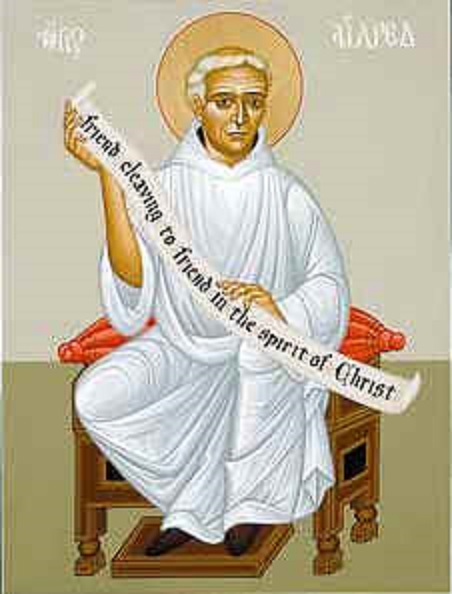
An English example is Aelred (1109-1167), the abbot of the Cistercian abbey of Rievaulx in Yorkshire. He wrote that, growing up in the court of Scottish King David I, “I delighted in the pleasure of being with my friends more than in anything else…. Nothing was more pleasant or more delightful or more useful than to seem to be loved and love in return.” He found divine love through friendships with other men: his treatise “On Spiritual Friendship” (De spirituali amicitia) is considered to be one of the best theological statements on the connection between human love and spiritual love: “God is friendship… He who abides in friendship abides in God, and God in him.”
“It is no small consolation in this life to have someone who can unite with you in an intimate affection and the embrace of a holy love, someone in whom your spirit can rest, to whom you can pour out your soul, to whose pleasant exchanges, as to soothing songs, you can fly in sorrow… with whose spiritual kisses, as with remedial salves, you may draw out all the weariness of your restless anxieties. A man who can shed tears with you in your worries, be happy with you when things go well, search out with you the answers to your problems, whom with the ties of charity you can lead into the depths of your heart; . . . where the sweetness of the Spirit flows between you, where you so join yourself and cleave to him that soul mingles with soul and two become one.”
Aelred supported loving friendships between monks, comparing them to the love between Jesus and his beloved disciple, and between Jonathan and David in his treatise on spiritual friendship.
In Renaissance Italy there were men who loved men who were well aware that this love was once considered divine. Michelangelo wrote in a sonnet, addressed to a male lover:
“And if the vulgar and malignant crowd
misunderstand the love with which we’re blessed
its worth is not affected in the least
our faith and honest love can still be blessed.”
In the late 19th century some were hailing Walt Whitman as the new prophet of same sex love and of liberated, cosmic consciousness which that love can give rise to. His poetry celebrated the bonding that erotically charged brotherhood between men can bring. Both Whitman, and english philosoper Edward Carpenter regarded love between men as fundamental to the establishment of true democracy!
Walt Whitman: ‘I will make the continent indissoluble,
I will make the most splendid race the sun ever shone upon,
I will make divine magnetic lands,
With the love of comrades, with the life-long love of comrades.’
Edward Carpenter Towards Democracy:
“The sun shines, as of old; the stars look down from heaven;
the moon, crescent, sails in the twilight;
on bushy tops in the warm nights, naked,
with mad dance and song, the earth-children address themselves to love;
Civilisation sinks and swims, but the old facts remain – the sun smiles, knowing well its strength. The little red stars appear once more on the hazel boughs, shining among the catkins;
over waste lands the pewit tumbles and cries as at the first day;
men with horses go out on the land – they shout and chide and strive –
and return again glad at evening; the old earth breathes deep and rhythmically, night and day,
summer and winter, giving and concealing herself.
“I arise out of the dewy night and shake my wings. Tears and lamentations are no more.
Life and death lie stretched below me. I breathe the sweet aether blowing of the breath of God.
Deep as the universe is my life – and I know it; nothing can dislodge the knowledge of it; nothing can destroy, nothing can harm me.
Joy, joy arises – I arise. The sun darts overpowering piercing rays of joy through me, the night radiates it from me.
I take wings through the night and pass through all the wildernesses of the worlds, and the old dark holds of tears and death – and return with laughter, laughter, laughter:
Sailing through the starlit spaces on outspread wings, we two – O laughter! laughter! Laughter!”
Conclusion:
NEVER UNDERESTIMATE WHAT LOVE CAN DO
but for the god of love to flow freely in this world and bring humanity to peace LOVE BETWEEN PEOPLE OF THE SAME GENDER must be equally as honoured as love between differently gendered people!
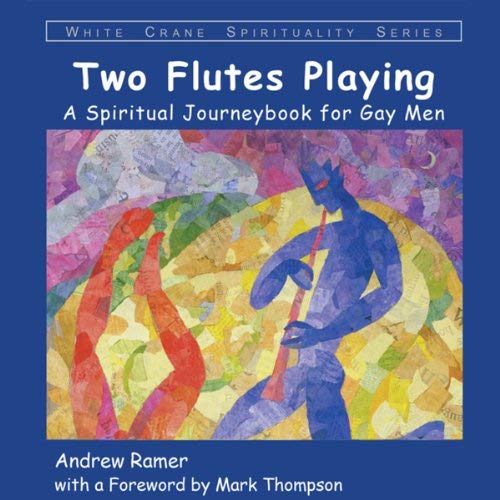
“In the love of man for man, the unity of the cosmos affirms itself. And in a world of two sexes, were it not for that sacred bonding, your species would unhinge itself into warring halves. A mystery. That men and women can come together in their loving because men love men, because women love women. Same-sex love affirms unity. Without that affirmation, men and women could not meet. Their polarities would unhinge them, each from each. In a world of two sexes, however different they are from each other, each sex bears within it the fullness of humanity. Where there is one human, female or male, in their heart, all of humanity lives. This is a paradox, that part is the same as the whole. But it is true. In a world of two sexes, where woman is, man is suggested. Where man is, woman is remembered. So that whosoever pulls away, man to man or woman to woman, from the mainstream of woman to man communing, in their closeness the fullness of humanity will flower, if they cast away fear, if they allow twoness to happen. For in their love, in their oneness, they are reminders to everyone of the fullness that every man and every woman carries. Sometimes it is easier to see the whole when part is not present, as men and women may forget when they dance their dance of bodies. Love between men can remind the world of that.” Two Flutes Playing, Andrew Ramer.


Thank you, Shokti, once again, for the fruit of your deep research into same sex love. Your posts are very much appreciated by this nearly 80(!) year old queer man and his husband.
LikeLiked by 1 person