
The First Flowering of Gay Culture in Britain
was in the Elizabethan Age –
just a few decades after the dissolution of the monasteries.
In the 1530s, Henry VIII had found the cloisters full of buggers, catamites and concubines –
ejected from the holy pathways, the buggers had to make their own communities –
they saw what was happening in the the homoerotic culture of the Italian Renaissance
and they brought a bit of it to London…
Theatre land was born, with boys playing the female roles,
and the darkness providing spaces for quiet communion with fellows.
At the end of every play, according to the Puritan Philip Stubbes (1555-1610) “every mate sorts to his mate… to play the sodomites, or worse.”
Henry VIII’s Buggery Act of 1533 was part of the King’s efforts to reduce the power of the Church, in this case by claiming powers of trial over sodomy, which the ecclesiastical courts had previously dealt with. He used the act primarily against the monastic communities, with a rare other example being that of Nicholas Udall, headmaster of Eton College, who in 1541 was charged for for sexually abusing his pupils. His sentence was commuted from execution to imprisonment and he was released in less than a year, going on to become headmaster of Westminster School. Repealed under Queen Mary, the law, renamed the Sodomy Act was brought back under Elizabeth in 1862. Prosecutions however were rare – historian Rictor Norton has identified less than a dozen cases prior to 1660 – and during the late 16th-early 17th century the atmosphere was tolerant enough for a gay subculture to start to flower.
By the 1590s the buggers were finding their voices:
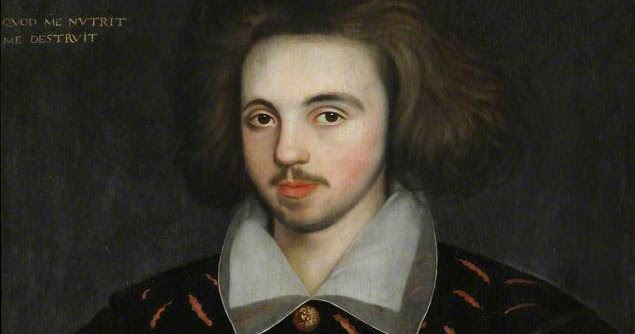
Three plays of that decade by Christopher Marlowe strongly feature same sex love between males:
Edward II, in which a character says of the king’s relationship with his favourite, Piers Gaveston:
The mightiest kings have had their minions;
Great Alexander loved Hephestion,
The conquering Hercules for Hylas wept,
And for Patroclus stern Achilles drooped;
And not kings only, but the wisest men:
The Roman Tully loved Octavuis,
Grave Socrates, wild Alcibiades.
Dido, which starts with a homoerotic interaction between Zeus and Ganymede that bears no relevance to the rest of the plot. In the opening line, Jupiter says “Come, gentle Ganymede, and play with me. I love thee well, say Juno what she will.” He calls Ganymede “the darling of my thoughts,” and presents him with jewels which Jupiter has stolen from his wife Juno. Ganymede says: “I would have a jewel for mine ear, And a fine brooch to put in my hat, And then I’ll hug with you an hundred times.” Jupiter affirms: “And shall have, Ganymede, if thou wilt be my love.”
Jupiter cannot understand why the other Gods are not celebrating Ganymede:
“Why, are not all the gods at thy command
And heaven and earth the bounds of thy delight?
Vulcan shall dance to make thee laughing sport,
And my nine daughters sing when thou art sad.
From Juno’s bird I’ll pluck her spotted pride
To make thee fans wherewith to cool thy face,
And Venus’ swans shall shed their silver down
To sweeten out the slumbers of thy bed.
Hermes no more shall show the world his wings,
If that thy fancy in his feathers dwell,
But, as this one, I’ll tear them all from him,
Do thou but say, “their colour pleaseth me.”
However, Venus comes along describing Ganymede as a “female wanton boy,” and is furious with Jupiter for dallying with Ganymede – blaming the relationship with the young Ganymede for the downfall of Troy, since Juno, in her jealousy, caused the Trojan war to take her revenge for the affair.
Massacre at Paris, a play about the religious and political turmoil around the St Batholomew’s Day Massacre of protestants that took place in Paris in 1572, features French king Henri III who was famous for his young male ‘mignons.’ The Queen Mother, Catherine says of her son, “His mind, you see, runs on his minions, And all his heaven is to delight himself…”
Marlowe is famous for saying ‘all that love not tobacco and boys are fools.’
Murdered in May 1593, various accounts of Marlowe’s death circulated. In Palladis Tamia, published in 1598, Francis Meres said Marlowe was “stabbed to death by a bawdy serving-man, a rival of his in his lewd love” as punishment for his “epicurism and atheism”.
Male-male love features in the most acclaimed poetry of the era:
Michael Drayton‘sPiers Gaveston is poem written from the perspective of 14th century King Edward II’s male favourite –
This daintie Bait I layd for EDWARDS Love,
Which soone upon Him got so sure a Tye,
As no misfortune e’r could it remove,
When She the utmost of Her force did trye,
Nor death it selfe had after power to sunder,
O seld-seene Friendship, in the World a Wonder!
Love, on this Earth, the only Meane thou art,
Whereby we hold Intelligence with Heaven,
And it is thou that only do’st impart,
The good that to Mortalitie is given
O, Sacred Bond, by Time that art not broken!
O thing Divine, by Angels to be spoken!
Thus with young EDWARD , bath’d in worldly Blisse,
Whilst Tutors care His wandring Yeeres did guide,
I liv’d, enjoying whatsoe’r was His:
Who ne’r my Pleasure any thing deny’d.
Whose watchfull Eye so duly Me attended,
As on my safetie, if His life depended.
Written in 1593 Shakespeare’s poem Venus and Adonis celebrates the beauty of a boy who is indifferent to feminine charms.
Richard Barnefield‘s 1594 poem, ‘The Affectionate Shepherd sicke for Love: or, the Complaint of Daphnis for the Love of Ganymede,’ written when he was 20 years old, is an outspoken statement of the love of an older man for a younger, following a poetic tradition born in ancient Greece and carried through the Middle Ages by monastics from all three Abrahamic faiths (eg Hilary the Englishman).
If it be sin to love a sweet-fac’d Boy,
(Whose amber locks trussed up in golden tramels
Dangle adowne his lovely cheekes with joy,
When pearls and flowers his faire haire enamels)-
If it be sin to love a lovely lad,
Oh then sinne I, for whom my soul is sad.
Sonnets were all the rage in the 1590s, the peak decade of the Elizabethan cultural Renaissance. Barnefield’s Sonnet XI, 1595:
Sighing, and sadly sitting by my Love,
He ask’d the cause of my heart’s sorrowing,
Conjuring my by heaven’s eternall King
To tell the cause which me so much did move.
“Compell’d” (quoth I) “to thee will I confesse,
“Love is the cause, and only love it is
“That doth deprive me and of my heavenly blisse.
“Love is the paine that doth my heart oppresse,”
“And what is she” (quoth he) “whom thou dost love?”
“Looke in this glasse” (quoth I) “there shalt thou see
“The prefect forme of my felicitie.”
When thinking it would strange Magick prove,
He open’d it: and taking off the cover,
He straight perceiv’d himself to be my Lover.
Christopher Marlowe’s poem Hero and Leander contains elaborate descriptions of male beauty:
“His dangling tresses were never shorn,
Had they been cut, and unto Colchos borne,
Would have allured the vent’rous youth of Greece,
To hazard for more than the Golden Fleece…
“Had wild Hippolytus Leander seen,
Enamour’d of his beauty had he been;
His presence made the rudest peasant melt,
That in the vast uplandish country dwelt..
For in his looks were all that men desire.”
Sea god Neptune is entranced by Leander’s beauty:
“The lusty God embrac’d him, call’d him love…
“Leander made reply, ‘You are deceiv’d. I am no woman, I.’
Thereat smil’d Neptune.”
Aged 18, Francis Beaumont wrote Salmacis and Hermaphroditus, a ‘a voluptuous and voluminous expansion of the Ovidian legend,’ the poem praising a boy’s beauty and celebrating an androgynous ideal of beauty. This poem appeared in 1602, the year before James VI of Scotland became King James I of England – when this happened the English populace, quite aware and at ease with the queer goings on in the Court, quipped: Rex fuit Elizabeth: nunc est regina Jacobus – Elizabeth was King, now James is Queen.
Like Edward II, his predecessor on the throne three centuries prior, James would be well known for his male favourites. When criticised for his intimate relationship with the Duke of Buckingham, King James spoke up in Parliament (in 1617), citing the Bible to demonstrate its validity, saying, “I wish to speak in my own behalf and not to have it thought to be a defect, for Jesus Christ did the same, and therefore I cannot be blamed. Christ had his John, and I have my George.”
The two Jacobean decades saw a flowering of theatre culture in London, this was the peak of Shakespeare’s output, plays in which young men played female parts and became celebrities for it. Some of Shakespeare’s work, such as As You Like It, was criticized for inciting male spectator desire on boy-to-female characters in his plays where boys played highly sexualized female characters.
Shakespeare’s Sonnets, published in 1609, explore themes of same sex love and desire- 120 of the 154 sonnets are addressed to the ‘Fair Youth’, such as sonnet 20:
A woman’s face with Nature’s own hand painted
Hast thou, the master-mistress of my passion;
A woman’s gentle heart, but not acquainted
With shifting change, as is false women’s fashion;
An eye more bright than theirs, less false in rolling,
Gilding the object whereupon it gazeth;
A man in hue, all “hues” in his controlling,
Which steals men’s eyes and women’s souls amazeth.
And for a woman wert thou first created;
Till Nature, as she wrought thee, fell a-doting,
And by addition me of thee defeated,
By adding one thing to my purpose nothing.
But since she prick’d thee out for women’s pleasure,
Mine be thy love and thy love’s use their treasure.
There was no censorship of this queer artistic output until the Puritan revolution brought in by the English Civil War of the 1640s. 18 years of Puritan ‘terror’ saw the closure of theatres, bars and other entertainments, the end of Maypole dances in every town and village – this was an attempt to suppress any lasting pagan festivities, which same sex love was definitely seen as, not least due to the goings on in the mythologies of ancient Greece.
The suppression of same sex erotic relationships, alongside the repression of gender-variant expression, was part of the effort, firstly by the Hebrew Fathers, then the Christian Fathers of the Church, to eradicate practices associated with the Goddess worshipping pagan folk all around them. In the Middle Ages same sex love was seen as heresy – because of its pagan associations – and the word BUGGER was born, at first referring to a Bogomil heretic from Bulgaria, but by the time of Henry VIII the word was associated with anal sex. Heretical groups were well known for not sharing the Church’s abhorrence of sex for pleasure. The Bogomils translated means God’s Beloveds. Therefore Gods Beloveds = Buggers.
The gay flowering of the second half of the 16th century and first decades of the 17th was gone by the 1650s, and although queer cultural phenomena would slowly return, it now had much more vocal and active enemies. Theatre land returned to London after the Restoration of of King Charles II in 1660 – and queerness soon shows up. The ‘Farce of Sodom’ in 1684 was a lampoon on the effeminacy common in the court of James I. Described as “One of the most flagrantly outrageous works in the English language” the play is about what happens when the King of Sodom, Bolloxinian, authorises sodomy as a legal practice. General Buggeranthos reports that this policy is welcomed by the soldiers, who spend less on prostitutes as a consequence, but has deleterious effects on women of the kingdom who have recourse to “dildoes and dogs”. With the court and country reduced to erotic madness, the court physician counsels: “Fuck women, and let Bugg’ry be no more”. The king himself, however is unconvinced, while the Queen dies of venereal disease. Amid the appearance of demons, fire, and brimstone, Bolloxinion declares his intention to retire to a cavern and die in the act of sodomising his favourite – Pockenello.
During the decades following the Restoration, the Molly House culture emerged, which we know about largely due to the activities of the Society for the Reformation of Manners (founded in 1691 with the aim of suppression of profanity, immorality, and especially of prostitution). The Society flourished until the 1730s and was responsible for the exposure of Molly Houses and the prosecution of Molly House landlady Mother Clap, who was indicted for keeping a disorderly house and for encouraging her customers to commit sodomy.
Ned Ward’s The Secret History of London Clubs, published in 1709, described The Mollies’ Club as a place where a “curious band of fellows,” who called each other sister and used feminine pronouns, met and held parties. The mollies, he said, “rather fancy themselves women, imitated all the little vanities that custom has reconcil’d to the female sex, affecting to speak, walk, tattle, curtsy, cry, scold, and mimick all manner of effeminacy”.
Throughout the 18th, 19th, and ¾ of the 20th century gay culture had to find its way between the cracks, had to struggle against massive resistance from the state, the church and the people too – for the long term effect of the Puritan era was to poison people’s minds against same-sex love. The Molly subculture may have existed in some corners, but so did the public executions for sodomy, so did the stocks – where many gay men ended up for punishment. The authorities would happily encourage the local population to take their frustrations and rage out on the prisoners in the stocks, some of whom did not survive. Punishing the queers for the problems of the world – same old story…
When the First Flowering of Gay Culture in Britain came about in the late 16/early 17th centuries, there was comment and complaint from some sources for sure, but nothing like the level of homophobic discourse and activity that would come from the 18th century onwards. The Buggery, then Sodomy Acts of the mid 16th century were little used until the 18th, but then became fiercely wielded weapons in an effort to control public morality and behaviour.
As with Marlowe’s reference to historical queers in his play Edward II, and the words from James I in Parliament comparing his relationship with the Duke of Buckingham to that between Jesus and his beloved disciple John, reveal to us that for some people there was an awareness of same sex love as having a noble and ancient lineage. That’s never been what the religious- the legal – the ‘straight’ world has said about it, but the likelihood is that, in every time and place, there were some queer folk who got it. And whenever there was a window of safety and opportunity, those queers created community – and culture.
 rainbow messenger
This is all very interesting, but it leaves out that homosexuality was first criminalised by Henry VIII with the Buggery Act 1533. The act was repealed by Good Queen Mary in 1553. Homosexuality was then re-criminalised under Elizabeth Tudor with the Sodomy Act of 1562.
LikeLiked by 1 person
you’re absolutely right i need to add the buggery act into the story, with the question of whether that very definition in law in fact encouraged the development of a bugger’s culture and self-identification.
LikeLike
Thank you for this posting. I didn’t know about the ‘Farce of Sodom’ in 1684 It fits into the idea of the early Stuart dynasty having a Court that almost rivalled that of France.
LikeLike