
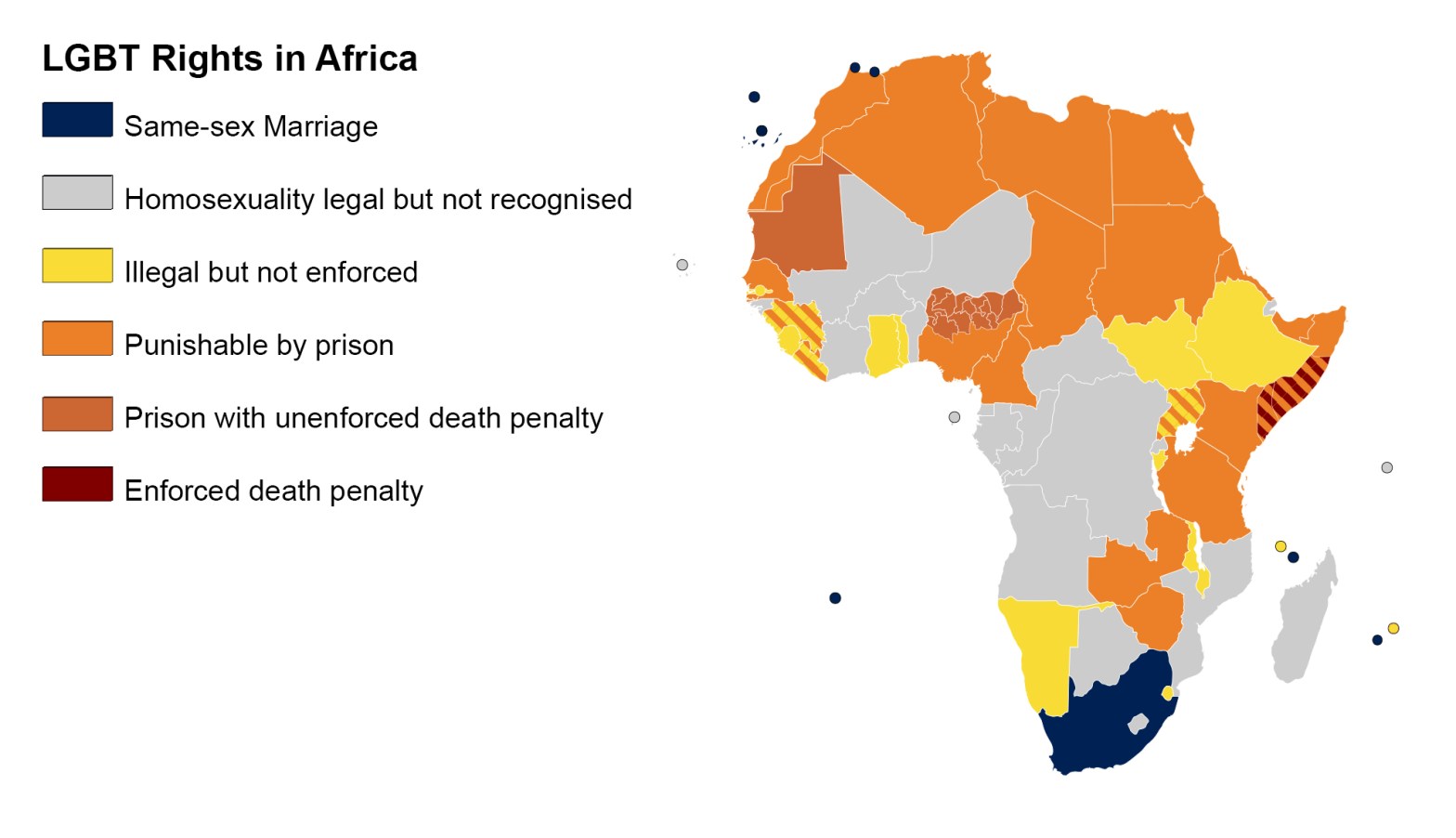
The French and the British — especially the British — in the age of European imperial expansion imposed laws against homosexuality and transgender expression that are still causing injustice and suffering around the world today. These laws were attempts to impose European morality on the cultures the imperialists were subduing, as well as attempts to control the sex lives of the colonists.
Wherever anti-gay laws exist, even when these laws are used on rare occasions, their very existence creates a criminal class of queer people, who are consequently targeted for violence, harassment and discrimination because of their criminal status.
Although consensual sexual acts between men were decriminalised in France in 1791, the French imposed sodomy laws on some of its colonies as a means of social control — with versions of these still surviving, and even being strengthened after independence, eg in Cameroon and Senegal.
(Several former French colonies passed anti-homosexuality laws after gaining independence, including Algeria, Mauritania and Chad.)
In England, where sodomy had been a criminal offence since Henry VIII’s Buggery Act of 1533, attitudes hardened in the early 19th century — and although the death penalty was finally removed in 1861, long terms of imprisonment and hard labour remained as punishments. This came the year after the British had updated the Indian Penal Code, article 377 of which criminalised “sexual acts against the order of nature.” The Code became the model for British legal systems in Asian and African colonies — Article 377 is still a law in India (4,690 cases of violations were prosecuted between 2014 and 2016), but a Supreme Court decision in 2018 limited the act to exclude consensual private sexual acts between consenting adults. The code is still in force in former Asian British colonies Pakistan, Bangladesh, Sri Lanka, Myanmar and Malaysia. In Africa, 13 former British colonies still have laws against the LGBTQ+ community — and of the 69 countries in the world that still criminalise homosexuality, 38 were once under British rule. (source: migrantwatch.org)
In India, authorities amended the Penal Code in 1897 to include ‘eunuchs’ as a designated group. The word was “deemed to include all members of the male sex who admit themselves, or upon medical inspection clearly appear, to be impotent.” In practice this meant India’s third-gender community, the hijra, could be arrested without warrant and imprisoned for up to two years if they simply appeared “dressed or ornamented like a woman in a public street … or… dances or plays music or takes part in any public exhibition, in a public street.” The law denied eunuchs legal personhood, including the rights to draw up a will or to adopt children, and authorities had to keep a register of all eunuchs “reasonably suspected” of “committing offences under Section 377.”
***
Empire-building was at first a largely male activity and attitudes to sexuality in the colonies were for a long time more liberal than at home — to such an extent that some places even became known for a while as havens for sodomites. There were very few white women around in the Caribbean colonies during the 17th century — a tabulation of Barbados residents made in 1635 indicates 94% were male. Richard Ligon chronicled Barbados life in the 1640s, saying of the men there: “So frank, so loving, and so good natur’d were these Gentlemen one to another; and to express their affections yet higher, they had particular names one to another, as, Neighbour, Friend, Brother, Sister: So I perceived nothing wanting, that might make up a firm and lasting friendship amongst them.” Writing from Antigua in 1655, Madam Margaret Heathcote put it bluntly: “… they all be a company of sodomites that live here.” Sometime between 1678 and 1680, Francis Dilly was executed in Jamaica by order of the Governor for being the ringleader of a group of ‘sodomites’ but the other three men implicated were pardoned.
In the early 18th century, when the gender balance had been rectified, Barbadian official Thomas Walduck still complained about homosexual conduct in the Caribbean:
“All Sodom’s Sins are Centered in thy heart
Death is thy look and Death in every part
Oh! Glorious Isle in Vilany Excell
Sins to the Height — thy fate is Hell.”
(source: Burg, B. R. (1983) Sodomy and the Perception of Evil: English Sea Rovers in the Seventeenth-Century Caribbean)
And hell would eventually be delivered — via the exported British laws, which became even more oppressive to homosexual men after 1885 when the Labouchere Amendment, in the Criminal Law Amendment Act, proscribed two years at hard labour for, “Any male person who in public or private commits or is a party to the commission of or procures or attempts to procure the commission by any male person of any act of gross indecency with another male person.” Gross indecency was a broad offence designed to include virtually all kinds of non-penetrative sexual acts between two men, whereas previous laws had focused on the act of anal intercourse. The Act declared itself to be aimed at “the Protection of Women and Girls,” (raising the age of consent from 13 to 16 years), but became the weapon most used against gay men in Britain through most of the 20th century — and its impact spread and is still being felt around the world.
The crime of gross indecency appeared in the Sudanese Penal Code in 1899, which listed seven types of “vagabonds,” including the “catamite,” defined as a “any male person who 1) dresses or is attired in the fashion of a woman in a public place or 2) practises sodomy as a means of livelihood or as a profession.” A person’s clothing became criminal in itself and potentially the sign of a criminal sexual history. One legal commentator clarified that “catamite” meant a “habitual” practitioner of sodomy, adding that “it is not necessary to prove when and where any individual act of this nature occurred.” Beyond the person’s appearance, no evidence was needed for his (or her) arrest and jailing.
Also in 1899, in Australia, the Queensland Penal Code declared that anyone who “has carnal knowledge of any person against the order of nature … {or} permits a male person to have carnal knowledge of him or her against the order of nature, is guilty of a felony and is liable to imprisonment for fourteen years.” This made it crystal clear that both the top and bottom were at fault. This code went on to be a major influence in African law. Legal amendments in 1938 introduced the gross indecency provision in 1938 in Singapore and Malaysia. Some governments dropped the reference to males, making the code applicable to women too.
The Queensland Penal Code was adopted in Papua New Guinea in 1904, Nigeria in 1916 then copied in East Africa, in modern Kenya, Uganda, and Tanzania.
In Asia and the Pacific, colonies and countries that inherited versions of that British law were: Australia, Bangladesh, Bhutan, Brunei, Fiji, Hong Kong, India, Kiribati, Malaysia, Maldives, Marshall Islands, Myanmar (Burma), Nauru, New Zealand, Pakistan, Papua New Guinea, Singapore, Solomon Islands, Sri Lanka, Tonga, Tuvalu, and Western Samoa.
In Africa, countries that inherited versions were: Botswana, Gambia, Ghana, Kenya, Lesotho, Malawi, Mauritius, Nigeria, Seychelles, Sierra Leone, Somalia, Swaziland, Sudan, Tanzania, Uganda, Zambia, and Zimbabwe
In the Caribbean, when independence came to Jamaica and Trinidad & Tobago in 1961 the existing homophobic colonial laws were kept intact, resulting in a difficult and dangerous situation for queer Jamaicans to this day. Several Caribbean countries — including Antigua & Barbuda, Barbados, St. Kitts & Nevis, and St. Lucia — have recently decriminalized same-sex intimacy (2022–2025), but Jamaica and Guyana are among those with laws still in place.
***
Wherever anti-gay laws exist, even when these laws are used on rare occasions, their very existence creates a criminal class of queer people, who are consequently targeted for violence, harassment and discrimination because of their criminal status. The 1885 Labouchere Amendment was soon being called the ‘Blackmailers Charter’ in the British newspapers, and so it proved over the next 80 years. These laws are used by authoritarian governments to create scapegoats in society, direct the anger of the populace away from themselves and onto a truly vulnerable, defenceless section of society. Plato identified this behaviour in the 4th century BCE, when one of the diners in the Symposium observes that it does not suit tyrannical powers to encourage love between men because of the bonds of trust that love produces.
“Sodomy laws exist to brand gay men and lesbians as criminals. Social ordering necessitates the criminalization of sodomy, thereby creating a hierarchy that values heterosexuality over, and often to the exclusion of, homosexuality. This symbolic effect of sodomy laws is not dependent on their enforcement. Even though very few men and virtually no women ever suffer the full range of criminal sanctions permitted under state sodomy laws, these statutes impose the stigma of criminality upon same-sex eroticism”. Leslie, C. R. (2000) ‘Creating criminals: the injuries inflicted by unenforced sodomy laws’, Harvard Civil Rights-Civil Liberties Law Review 35.

