

We’re often told that the only references in the Bible to same sex relationships are negative ones. The condemnations found in Leviticus and the letters of Paul are often said to be the only references from the enormous book. But this is completely wrong.
GAY PRIESTS OF THE GODDESS
Unknown to most people today, including Christians, queer men who served as sacred priests of the Mother Goddess are highly visible in the Old Testament, with 5 references across 3 books of the OT in which we find the word Qadesh – meaning Holy Men dedicated to the Goddess, but translated in the 17th century King James Bible as ‘sodomites’ and in modern versions usually given as ‘male shrine prostitutes’. These men worked alongside the female Qedesha, holy women who also provided blessing to devotees via sexual services. English heretic John Lollard’s earlier medieval translation gave Qadesh as ‘womanish-men’ and ‘men of women’s condition’, who ‘committed all the abominations of the heathens’.
Sir James Frazer in his 19th century study of mythology translated Qedesha as Holy Men – and his studies of global myths and cultures led him to state that “…it often happens that a goddess chooses a man, not a woman, for her minister and inspired mouthpiece. When that is so, the favoured man is thenceforth regarded and treated as a woman…These unsexed creatures often, perhaps generally, profess the arts of sorcery and healing, they communicate with spirits and are regarded sometimes with awe and sometimes with contempt, as beings of a higher or lower order than common folk.”
“…the Hebrews’ abhorrence of sodomy was largely due to their hatred of a foreign cult. According to Genesis, unnatural vice was the sin of a people who were not the Lord’s people, and the Levitical legislation represents Canaanitish abominations as the chief reason why the Canaanites were exterminated. Now we know that sodomy entered as an element in their religion. Besides kedeshoth, or female prostitutes, there were kedeshim, or male prostitutes, attached to their temples. The word kadesh, translated “sodomite,” properly denotes a man dedicated to a deity; and it appears that such men were consecrated to the mother of the gods, the famous Dea Syria, whose priests or devotees they were considered to be. The male devotees of this and other goddesses were probably in a position analogous to that occupied by the female devotees of certain gods, who also, as we have seen, have developed into libertines; and the sodomitic acts committed with these temple prostitutes may, like the connections with priestesses, have had in view to transfer blessings to the worshipers. In Morocco supernatural benefits are expected not only from heterosexual, but also from homosexual intercourse with a holy person. The kedeshim are frequently alluded to in the Old Testament, especially in the period of the monarchy, when rites of foreign origin made their way into both Israel and Judah.” The making of man, by V. F. Calverton 1931
There shall be no holy sexworker of the daughters of Israel, nor a holy sexworker of the sons of Israel.
And there were also holy womanish-men in the land: and they did according to all the cult rituals of the nations which the LORD cast out before the children of Israel.
And he took away the holy womanish-men out of the land, and removed all the idols that his fathers had made.
And the remnant of the holy womanish-men, which remained in the days of his father Asa, he took out of the land.
And he brake down the houses of the holy womanish-men, that were by the house of the LORD, where the women wove hangings for the grove.
We can see it took several attempts (over several centuries in fact) to remove the Qadesh, and we can presume there was strong resistance to the process, because cross-dressing, gender-bending, priests were the norm in all the surrounding cultures and had been for millennia.
Bible Hub acknowledges the holy regard in which these men were held, but dismisses it as fake: “The Hebrew term קָדֵשׁ (qā∙dēsh, Strong’s 6945) identifies a male cult-prostitute who served in the fertility rites of Canaanite religions. The word is etymologically linked to the concept of “holy” or “set apart,” but in this context it denotes a counterfeit holiness whereby sexual immorality is offered as worship to pagan deities.”
The belief instilled by Christianity that Jesus is the only true way to God has meant that no gay Christians seem to have spoken out about the Qadesh. The condemnation of them as prostitutes is just swallowed whole. But in fact these Holy Men were part of an ancient association between queerness and the sacred.
As historian Will Roscoe has put it:
“At the time of the birth of Christ, cults of men devoted to a goddess flourished throughout the broad region extending from the Mediterranean to south Asia. While galli [priests of Great Mother Cybele] were missionizing the Roman Empire, kalu, kurgarru, and assinnu continued to carry out ancient rites in the temples of Mesopotamia [worshipping Inanna/Ishtar], and the third-gender predecessors of the hijra were clearly evident in lndia. To complete the picture we should also mention the megabyzoi, or eunuch priests of Artemis at Ephesus; the western Semitic qedesha, the male “temple prostitutes” known from the Hebrew Bible and Ugaritic texts of the late second millennium; and the keleb, priests of Astarte at Kition and elsewhere… These roles share the traits of devotion to a goddess, gender transgression and homosexuality, ecstatic ritual techniques (for healing, in the case of galli and Mesopotamian priests, and fertility, in the case of hijra), and actual (or symbolic] castration. Most, at, some point in their history, were based in temples and, therefore, part of the religious-economic administration of their respective city-states.”
When Jesus refers in Matthew 19:12 to people who choose to become eunuchs (see more below), ie self-castrate, “for the sake of the kingdom of heaven,” he was talking about these Goddess priests.
The prohibitions on cross-dressing and gay male sex recorded in the Old Testament were an attempt by the Hebrew Fathers to distinguish their cult from all the other tribes around them. The word translated as ‘abomination’ was in fact a reference to a cultic practice forbidden to Jews because it was associated with other people and beliefs. IT NEVER MEANT ABOMINATION – rainbow messenger
Comments of the Leviticus text written in the Middle Ages by Anselm of Laon (died 1119) in his ‘Glossa Ordinaria’ “associates the sins against nature with idolatry and interprets Leviticus 18:22 as a prohibition against idol-worship and the introduction of pagan philosophy into the church. This identification is extended in the gloss to Exodus 22:19, where sodomy is associated with the practice of the arts of magic, dabbling with the devil’s work, and heresy, all of which lead to excommunication and death…” says Michael Goodich in ‘The unmentionable vice : Homosexuality in the Later Medieval Period.’ In the Middle Ages same sex relations were seen as ‘pagan’ and Christians who engaged in them as heretics, flirting with pagan ways. So deep was the association between heresy and male-male relationships that the word buggery originally meant heresy, coming into the language from the Bogomil heretics from Bulgaria, whose ideas spread to western Europe. This all stems from the memory of the holy queer priests in the ancient temples, a memory long since eradicated from our culture (though of course Christian churches and monasteries have always been full of gay priests, because the calling to serve spirit that some gay men feel did not go away just because the Church decided to name their way of loving a sin).
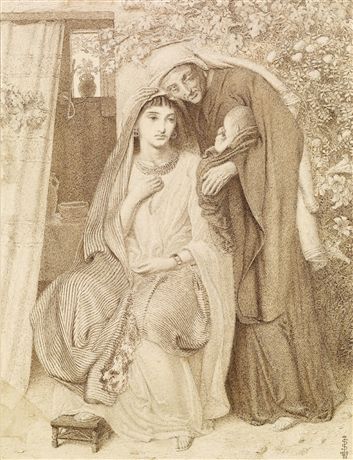
LOVE BETWEEN WOMEN – Ruth and Naomi.
Ruth was part of a Moabite pagan family before she married the son of a Judean couple living in Moab. In Judaism she is honoured as a convert. Naomi was the mother-in-law of both Ruth and Orpah. After their husbands died, Naomi urged both of them to return to their families and remarry. But Ruth refused and stuck with Naomi, moving together to Bethlehem, where Ruth married a Jewish man Boaz, producing a son, Obed, who would become the grandfather of King David, whose same-sex love relationship with Jonathan I cover below.
BibleHub goes so far as to say that Ruth “demonstrates extraordinary love and loyalty to Naomi. Despite Naomi’s insistence that she stay in Moab, Ruth clings to her, uttering the famous words: “Do not urge me to leave you or to turn from following you. For where you go, I will go, and where you stay, I will stay. Your people will be my people, and your God will be my God” (Ruth 1:16).
There are no actual wedding vows in the Bible, and these same-sex vows have long been used as a model for heterosexual unions.
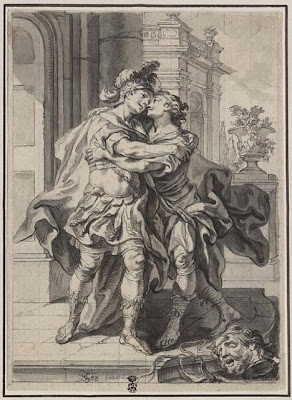
LOVE BETWEEN MEN – David and Jonathon
One of the most famous love stories of the ancient world sits right there in the book of Samuel.
More chapters are dedicated to David and Jonathon than any other love story. The two meet when David delivers the head of the giant Goliath, whom he has just killed, to Jonathon’s father, King Saul. Scholars estimate that David was about 18 years old at the time and Jonathon late 20s, and the love seems to have been instant. The Bible says, “The soul of Jonathan was knit with the soul of David, and Jonathan loved him as his own soul.” (1 Samuel 18:1).
1 Samuel 18:3-4: “Then Jonathan made a covenant with David, because he loved him as his own soul. Jonathan stripped himself of the robe that he was wearing, and gave it to David, and his armor, and even his sword and his bow and his belt.” Circumstances tear them apart but they renew their vows twice more. David’s promise in 1 Samuel 20:4 is translated as “I will do the desires of your heart” or “Whatever you want me to do, I’ll do for you.” When David has to flee the threat from Jonathon’s father, “Then they kissed each other and wept together—but David wept the most. Jonathan said to David, ‘“Go in peace, for we have sworn friendship with each other in the name of the Lord, saying, ‘The Lord is witness between you and me, and between your descendants and my descendants forever.’” 1 Samuel 20:41-42
When Jonathan is killed in a battle against the Philistines at Mount Gilboa, along with his father and brothers, David is devastated. His lament includes these lines:
“I am distressed for you, my brother Jonathan;
You have been very pleasant to me;
Your love to me was wonderful,
Surpassing the love of women.” 2 Samuel 1:17-27
JESUS!
“Jesus Himself said nothing about sex except that which can be inferred from his references to divorce and remarriage. In the Sermon on the Mount (and elsewhere), He is quoted as stating that it was wrong for a man to divorce his wife except on the grounds of adultery, and that anyone who married a divorced woman committed adultery. He is also quoted as saying that any man who put away his wife and married another also was committing adultery. After hearing Jesus expound on such matters, the disciples wondered whether it might be better to remain unmarried than to chance committing such a sin. He replied:
‘All men take not this word, but they to whom it is given. For there are eunuchs, which were born so from their mother’s womb; and there are eunuchs, who were made so by men; and there are eunuchs, who have made themselves eunuchs for the kingdom of heaven. He that can take, let him take it.‘
… Saint Luke… states that a man must hate his own wife and children in order to be a disciple of Jesus.” Vern Bullough: sexual practices and the medieval world 1982
That quotation, from Gospel of Matthew chapter 19, clearly tells us that Jesus was well aware of, and had no problem with, men who did not have sex with women. The word eunuch in the ancient world was used to refer to same-sex inclined men as well as castrated men – it referred to men who did not have sex with women. Jesus makes reference to eunuchs ‘born so from their mother’s womb.’ He also recognises that not every one will be able to understand, to ‘take’, this knowledge.
The Gnostic Gospel of Thomas contains the famous saying of Jesus that “… when you make the male and the female into a solitary one, so that the male is not male nor the female female… then you will enter the kingdom.” (Saying 22)
This line about the heavenly kingdom in LUKE 20:35 makes the whole thing even gayer: “they which shall be accounted worthy to obtain that world, and the resurrection from the dead, neither marry, nor are given in marriage.”
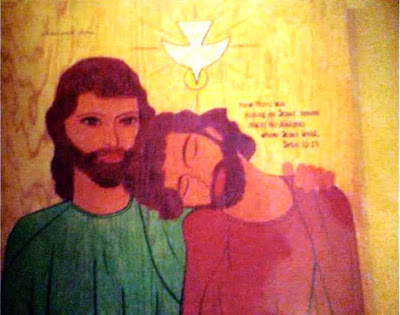
Jesus and John:
“Certainly, the most controversial same-sex couple in the Christian tradition comprised Jesus and… the beloved disciple. The relationship between them was often depicted in subsequent art and literature as intimate, if not erotic.” John Boswell, historian
“For centuries, the beloved disciple has remained a powerful metaphor for homoerotic friendship and love, and even today gay men intuit an identifiable love relationship between Jesus and the beloved disciple.” Robert E Goss ‘The Beloved Disciple’ in Take back the Word : a queer reading of the Bible
In his 1593 trial for blasphemy English playwright Christopher Marlowe was accused of claiming that “St. John the Evangelist was bedfellow to Christ and leaned always in his bosom, that he used him as the sinners of Sodoma.”
English King James I responded in Parliament to criticisms of his relationship with his favourite, George Villiers, Duke of Buckingham, saying “I wish to speak in my own behalf and not to have it thought to be a defect, for Jesus Christ did the same, and therefore I cannot be blamed. Christ had his son John, and I have my George.”
Frederick the Great of Prussia 1749 poem Palladium includes the lines: “This good Jesus, how do you think He got John to sleep in his bed? Can’t you see he was his Ganymede?”
The disciple whom Jesus loved is mentioned six times in the Gospel of John:
- He is the disciple who, while reclining beside Jesus at the Last Supper, asks Jesus who it is that will betray him, after being requested by Peter to do so
- “Near the cross of Jesus stood His mother and her sister, as well as Mary the wife of Clopas and Mary Magdalene. When Jesus saw His mother and the disciple whom He loved standing nearby, He said to His mother, “Woman, here is your son.” Then He said to the disciple, “Here is your mother.” So from that hour, this disciple took her into his home.” John 25–27
- When Mary Magdalene discovers the empty tomb, she runs to tell the beloved disciple and Peter. The two men rush to the empty tomb and the beloved disciple is the first to reach it.
- In John 21, the last chapter of the Gospel of John, the beloved disciple is one of seven fishermen involved in the miraculous catch of 153 fish and is the first to recognise Jesus on the beach.
- Also in the book’s final chapter, after Jesus implies the manner in which Peter will die, Peter sees the beloved disciple following them and asks, “What about him?” Jesus answers, “If I want him to remain until I come, what is that to you?”
- In the Gospel’s last chapter, it states that the very book itself is based on the written testimony of the disciple whom Jesus loved.
Jesus had a boyfriend, a beloved male friend — there should be nothing shocking there — it’s what educated men did in the ancient world. Marriages with women were seen as functional, not passionate —for some, it was love of man for man that was viewed as reaching to the heavens. Among the greatest love stories of the ancient world were those of Zeus and Ganymede, Apollo and Hyacinth, Hadrian and Antinous, and, from the Holy Book, David and Jonathon, Jesus and John. More: Jesus Had A Boyfriend – rainbow messenger
The Gay Centurion:
“Both Matthew 8:5-13 and Luke 7:1-10 tell how a centurion asked Jesus to heal the young man referred to in the original Greek as his “pais” (παῖς). The word was commonly used for the younger partner in a same-sex relationship. It is usually translated into English as boy, servant or slave. In recent years progressive Bible scholars have concluded that the centurion was in a homosexual relationship with the “slave who was dear to him” in the gospel story — in other words, his boyfriend. However being gay today implies an egalitarian relationship, while the centurion and his pais were obviously unequal male partners, as was common at the time.
“The centurion asks Jesus to help because his servant is in physical and mental agony: paralyzed and “tormented.” Jesus was willing to go into the centurion’s house to heal his lover, but the centurion stopped him, saying, “Sir, I am not worthy to have you come under my roof. But just say the word, and my servant will be healed. For I myself am a man under authority, with soldiers under me. I tell one to go, and he goes; and another to come, and he comes. I tell my servant to do something, and he does it.” … Jesus marveled and told the crowd around him, “Not even in Israel have I found such faith!” To the centurion he said, “Go; be it done for you as you have believed.” And his boyfriend was healed at that moment.” Gay centurion: Jesus heals a soldier’s boyfriend in the Bible on Qspirit

SODOM and GOMORRAH
The word that became the most associated with sex between males, did not have that association in the time of Jesus. Louis Crompton, in Homosexuality and Civilisation, relates that Jesus, like Ezekiel before him, laid emphasis on the Sodomites’ “sins of inhospitality, arrogance born of wealth and mistreatment of aliens and the poor.” But in the early 1st century the seeds of the later association of Sodom only with sex between men were sown by Jewish philosopher Philo of Alexandria, He wrote, “The land of the Sodomites… was brimful of innumerable iniquities, particularly such as arise from gluttony and lewdness… they threw off from their necks the law of nature and applied themselves to deep drinking of strong liquor and dainty feeling and forbidden forms of intercourse. Not only in their mad lust for women did they violate the marriages of their neighbours, but also men mounted men without regard for the sex nature which the active partner shares with the passive.” But really to most people of that time, including Jesus, sex and relationships between men were seen as a completely normal part of life, barely worth mentioning.
The writings of 4th century preacher John Chyrsostom and Augstine of Hippo in the 5th century emphasised the homosexual nature of the sins of Sodom. Augustine described Sodom as a place “where sexual intercourse between males had become so commonplace that it received the licence usually extended by law to other practices.” (Did they have gay marriage?). John Chrysostom condemned the pagan world for its indulgence in murder, adultery and “love of boys.” He declared that Sodom’s men “had a passion for boys, and on that account they suffered this punishment.” However, Chrysostom’s own description of the city of Antioch (in modern Turkey) in the 380s, a few decades after the establishment of Christianity as an official religion and just before the iconoclasm of the 390s when rampant Christians destroyed many pagan temples and shrines, suggests, says historian Louis Crompton in ‘Homosexuality and Civilisation’, “at the moment when Christianity was enjoying its final triumph over paganism, there was widespread dissent from the new values.” Chrysostom wrote that, “Fornication now seems a minor offence against forms of unchastity. There is some danger that womenkind will become unnecessary in the future with young men instead fulfilling all the needs women used to… No-one is ashamed, no one blushes, but rather they take pride in their little game”.
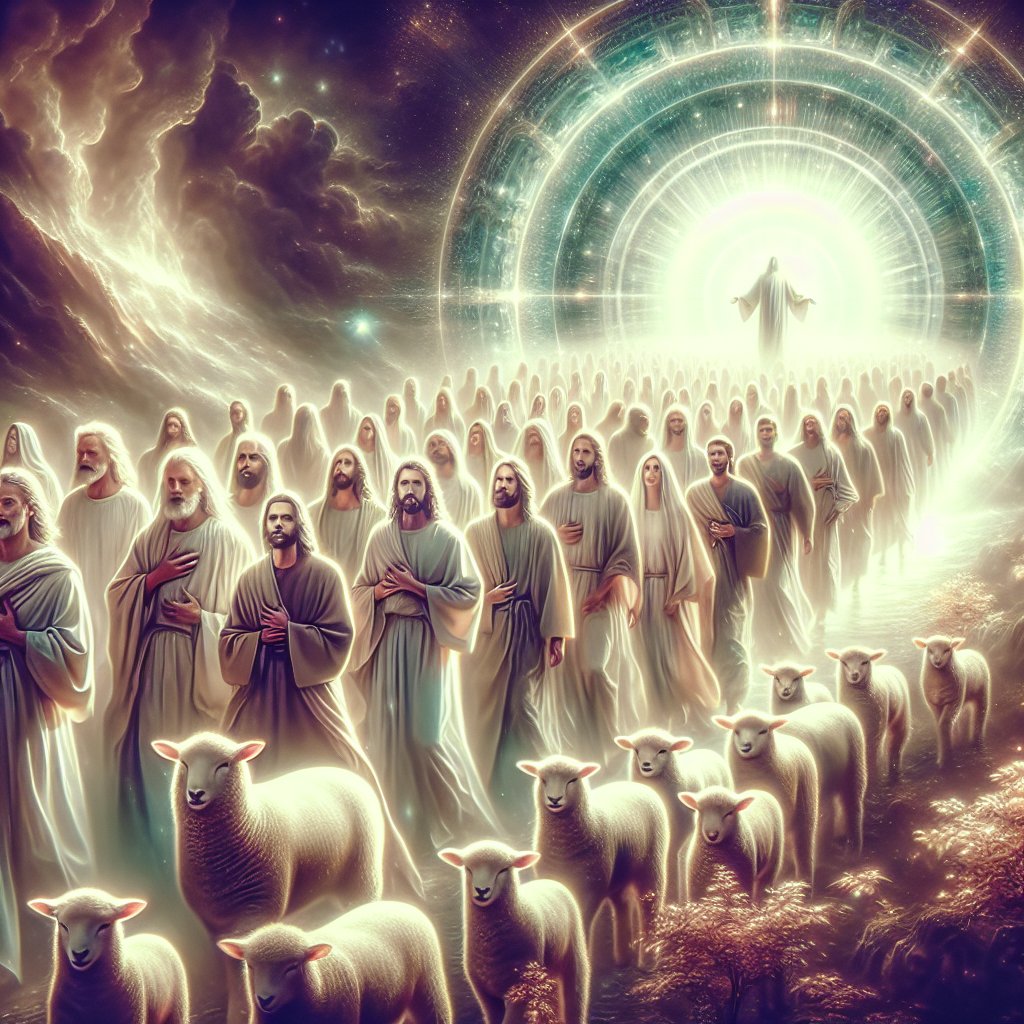
REVELATION
REVELATION 14:4 describes a procession of the 144,000 redeemed as consisting of male virgins not ‘defiled by women.’ A point rarely mentioned by the evangelical ‘ascension’ brigade!
“These are the ones who have not been defiled with women, for they are virgins. They follow the Lamb wherever He goes. They have been redeemed from among men as firstfruits to God and to the Lamb.”

