
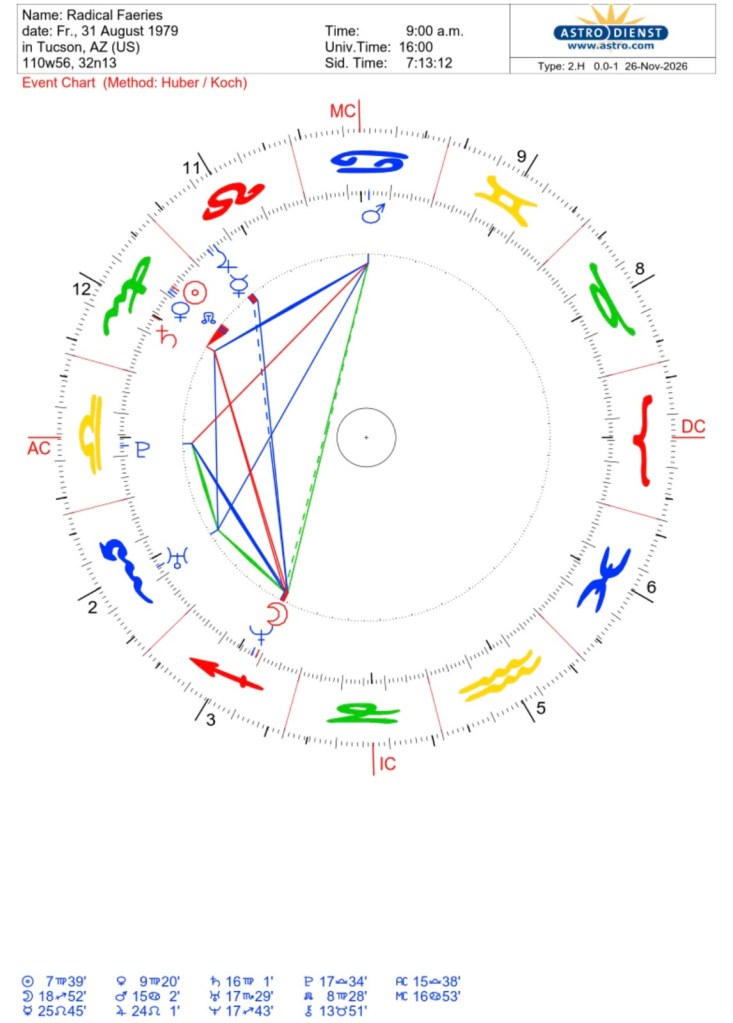
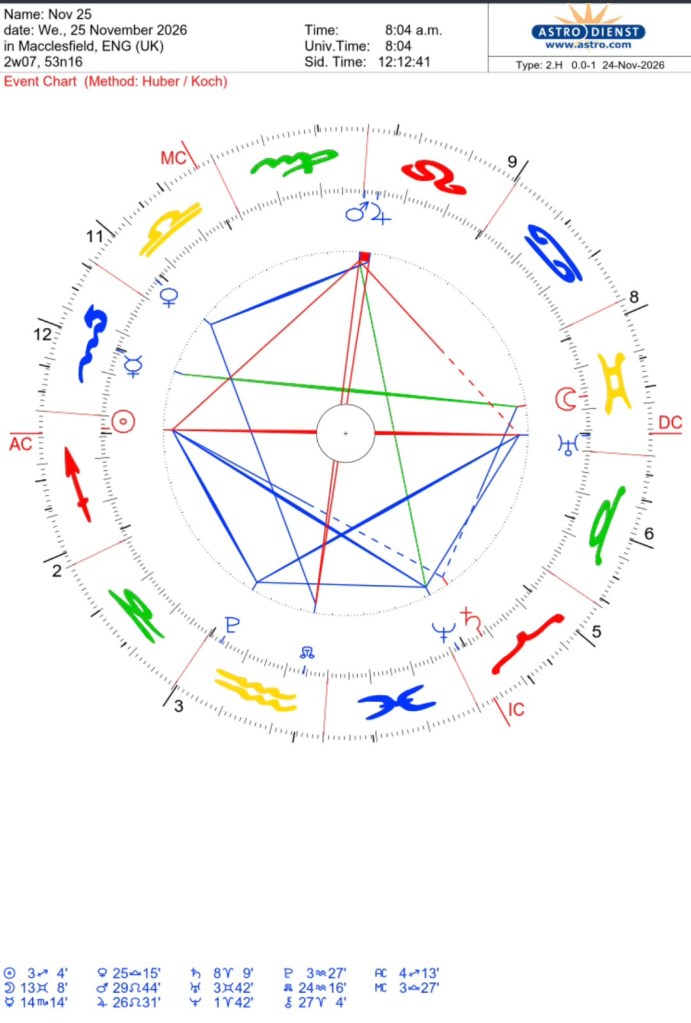
The first ‘Spiritual Gathering of Radical Faeries’ took place 31 August-2 September 1979 in the Sonoran Desert in Arizona, USA. The first chart below is cast for 9am on 31 August 1979, the start time of the First Great Radical Faerie Circle. The second chart below shows the astrology active on November 25th 2026, revealing the geometry of what astrologer Deborah Maw, who has produced these charts and analysis for us, calls the SoulStar Portal. The reading below compares the two in order to give a picture of the initial Faerie spirit energies and an update on how they are manifesting in the world after nearly 5 decades, during which the Rad Fae tribe has grown into a global network of spiritually engaged, heart focused, LGBTQ+ warriors working for liberation for themselves and all our kind – politically, socially and spiritually.
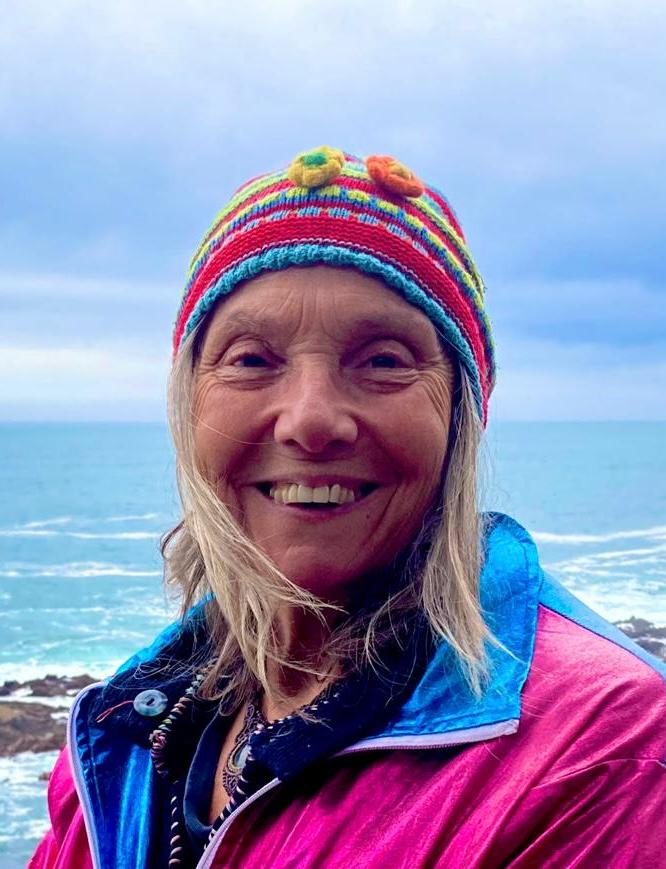
Deborah Maw is an astrologer, tarot reader and author of Radical Trust: The Call of the West, an account of her travels along the Pacific coast of the USA from San Diego to British Columbia in Canada. Long aware of herself as a being of the Faerie realm she has recently met the Radical Faeries of Albion and become the first facilitator of the Astrology Temple at Queer Spirit Festival. Dr Deborah Maw – Speaking & Keynotes
From a new identity to a new way of living
The Radical Faerie gathering of 1979 and the re-formation of the SoulStar portal in 2026
There is something rather special about bringing these two charts together. They describe two moments, separated by nearly half a century, but connected through a remarkable continuity of themes: freedom, identity, community, creativity, love and the possibility of living outside the assumptions of the established culture.
The 1979 chart describes the emergence of a different way of being. The 2026 chart suggests a further expression of that possibility, but with a shift in emphasis. It is less about finding somewhere to be different and more about allowing that difference to become a way of living, a way of meeting life and relating to everything around us.
Perhaps the biggest change is in the understanding of what freedom actually means. It is not simply freedom from something. It is the freedom to live from a completely different place.
The freedom to be completely ourselves
In 1979, Pluto had just crossed the Ascendant into the first house in Libra. This is a powerful image of identity being transformed. There is a refusal to accept that the identity given to us by society has to define us. Instead, there is the possibility of discovering who we really are, beyond the expectations, labels and restrictions imposed from outside.
Uranus in Scorpio in the second house takes this into the very personal territory of values, self-worth, sexuality and embodiment. It is about reclaiming parts of ourselves that may have been hidden, denied or regarded as unacceptable.
But from the perspective of an embodied spirituality, this is about more than accepting ourselves intellectually. It is about actually enjoying being ourselves. Feeling at home in our bodies. Having the freedom to express our individuality through how we dress, move, play, create and relate to others. Not needing to apologise for being different.
There is a particular joy in discovering that we don’t have to perform an acceptable version of ourselves. We can simply be.
In 2026, the Sun is just behind the Ascendant, about to rise, while Uranus is setting on the Descendant. The emphasis moves from the transformation of identity to its expression in the world. The Sun is coming into visibility, but it is directly opposite Uranus, suggesting that this emergence takes place through our encounters with others.
This is where freedom becomes relational. We discover ourselves not only by looking inward, but through meeting people who are different from us, who challenge our assumptions and invite us to see life differently.
There is a freedom in allowing other people to be completely themselves too. No need to fit them into our expectations, no need to make them conform to our version of reality. We can meet one another with curiosity, openness and acceptance.
The sacredness of ordinary life
The Moon conjunct Neptune in the 1979 chart gives the gathering a strong emotional, imaginative and spiritual quality. Neptune in Sagittarius brings a search for a larger meaning, a different philosophy and a different relationship with life itself.
But perhaps the deepest expression of this conjunction is not about believing in something spiritual. It is about experiencing the sacredness of being alive.
When everything is approached as sacred, the distinction between spiritual life and ordinary life begins to disappear. A meal shared with friends, the beauty of a flower, the playfulness of an encounter, the changing light, the presence of an animal: none of these needs to be elevated into something special. They are already part of the experience of being alive.
This is where the 2026 chart adds another dimension. Pluto in Aquarius in the third house clicks with the Moon–Neptune territory of the 1979 chart. The imaginative and spiritual sensitivity of the earlier gathering is now connected with a deeper transformation of how we think, communicate and understand the world.
It is an invitation to question the assumption that we are separate observers of life, looking out at a world that exists independently of us. What changes when we become participants? When we pay attention? When we listen to the natural world rather than treating it simply as scenery? When we allow an encounter with a bird, a tree or another person to become a genuine meeting?
This doesn’t require a complicated spiritual practice. It can begin with noticing.
From creating a sanctuary to living in the world differently
Mars in Cancer on the Midheaven in 1979 gives the gathering a protective and nurturing public expression. Cancer is concerned with belonging, care, emotional security and the creation of a place where people can feel safe.
The Radical Faerie gathering can be understood in this light: creating a space where people could explore different ways of being without having to defend themselves against the expectations of the outside world.
The concentration of the Sun, North Node, Venus and Saturn in Virgo in the twelfth house adds another layer. These were identities and experiences that were not necessarily recognised or welcomed by mainstream society. There was a need to create something practical and sustainable in a territory that existed largely outside conventional structures.
There is a beautiful progression in the 2026 chart. Venus is now in Libra in the eleventh house, the territory of community, friendship and shared aspirations. The emphasis is on relationships based on equality, mutual appreciation and the freedom to be different.
The movement is from needing a sanctuary in which to experience freedom to creating relationships and communities in which that freedom is simply how people live.
And this is a very different idea of community. It isn’t about everybody agreeing, believing the same things or adopting the same identity. It is about being able to share space, experience and joy without needing to control one another.
There is room for difference. There is room for play. There is room for the unexpected.
From a shared vision to a lived experience
One of the strongest correspondences between the charts is Jupiter in Leo.
In 1979, Jupiter was closely associated with Mercury in Leo, near the balance point of the eleventh house. This brought expansion to ideas, communication, creative expression and the sharing of a vision within a community.
In 2026, Jupiter is conjunct Mars in Leo, at almost the same degrees, but in the ninth house and on the South Node.
The change from Mercury to Mars is significant. Mercury gives a vision language. Mars gives it the energy to become action.
The 1979 combination suggests people discovering a different way of being and finding the words, the creativity and the community through which to express it. The 2026 combination brings the impulse to live that vision, to give it expression through action, courage, enthusiasm and creative freedom.
Leo is important in both charts. It is about the joy of being an individual, the pleasure of creative expression, the freedom to play and the confidence to let ourselves be seen.
But this is not about performance or attracting attention. It is about the natural exuberance that comes when we are no longer trying to suppress ourselves.
Think of the difference between talking about joy and actually being joyful. Between discussing creativity and allowing ourselves to play. Between understanding love as a spiritual principle and meeting another person with genuine warmth and generosity.
The Mars–Jupiter conjunction suggests that the energy wants to be lived. It wants movement, expression and participation.
The North Node in Aquarius in the third house provides the other end of the axis. The movement is towards sharing that experience, communicating it and allowing it to develop through encounters with others. It isn’t about imposing a philosophy or persuading people to adopt a particular worldview. It is about creating the conditions in which people can discover new possibilities for themselves.
A different kind of relationship with the world
The changes in Uranus and Pluto between the charts are particularly revealing.
In 1979, Uranus in Scorpio in the second house brings freedom into the personal experience of identity, values and embodiment. Pluto in Libra in the first house transforms the way people understand themselves and their place in society.
In 2026, Uranus is on the Descendant in Gemini, while Pluto is in Aquarius in the third house.
The emphasis has moved towards communication, relationship and collective understanding. But from an embodied perspective, this is not simply about exchanging ideas. It is about the quality of attention we bring to our encounters.
What happens when we really listen? When we are curious rather than defensive? When we allow ourselves to be changed by what another person says or by what we experience?
Gemini brings curiosity and playfulness. Aquarius brings freedom from established patterns of thinking. Uranus can open up entirely new ways of seeing and relating.
There is also a connection here with the natural world. The more attentive we become, the more we notice that life is full of relationships and exchanges that we may previously have overlooked. We are not separate from the world around us. We are part of it.
The ordinary can become extraordinary, not because we have turned it into a spiritual concept, but because we are actually present to it.
Giving the vision roots
Neptune and Saturn either side of the IC in the 2026 chart bring another essential dimension.
Neptune represents the vision, the inspiration and the sense of connection with something larger than ourselves. Saturn brings the responsibility of giving that vision form. With both in Aries, there is an impulse to begin something new and to establish a different foundation.
This is important because an embodied way of living cannot remain an ideal. It has to find expression in the choices we make, the way we treat people, the way we organise our lives and the way we respond to the world around us.
It is easy to talk about love, acceptance and freedom. The real question is how we live them when things are difficult, when someone disagrees with us, when we are tired, when we encounter something unfamiliar or when our own expectations are challenged.
Saturn gives the vision substance. It asks us to take responsibility for the reality we are creating.
Neptune keeps that reality connected with imagination, compassion and the recognition of something sacred in life.
What might this feel like?
Perhaps it feels like waking up without immediately having to become somebody.
It feels like being comfortable in your own skin, enjoying your own individuality and allowing other people the same freedom. It feels like laughter, colour, creativity, music, dressing up, making things, dancing, sharing food and being completely absorbed in the pleasure of the moment.
It feels like meeting someone without first deciding who they are or what they represent. It feels like being able to disagree without withdrawing love or respect. It feels like discovering that people can be wonderfully different and that difference is something to celebrate rather than something to manage.
It feels like spending time outdoors and becoming aware of the life around you. Noticing the birds, the trees, the weather, the changing light. Being interested in what is happening rather than constantly trying to make something happen.
It feels like gratitude without obligation. Beauty without ownership. Freedom without isolation. Community without conformity.
And perhaps most importantly, it feels like play. Not play as an escape from reality, but play as a way of participating in reality. The ability to experiment, explore, create and be surprised. The willingness to let life show us something we hadn’t thought of before.
Living the possibility
The two charts together suggest a movement from the emergence of a new identity towards the embodiment of a different relationship with life.
In 1979, the emphasis was on freedom from the restrictions of an established culture, on discovering an authentic identity and finding others with whom that identity could be shared. The gathering created a space in which a different reality could be experienced.
In 2026, the emphasis is on bringing that possibility into everyday life, into relationships, communication, community and the wider culture.
Perhaps this is what people mean when they talk about New Earth. Not necessarily a new place, or a future society that will suddenly appear, but a different way of inhabiting the world that is available through how we live now.
The sacredness is already here. The beauty is already here. The possibility of love, freedom, play and acceptance is already here.
The question is whether we are prepared to live from that place, rather than simply imagine it.
The 1979 chart describes the discovery that another way of being is possible. The 2026 chart asks what happens when we actually live it.

