
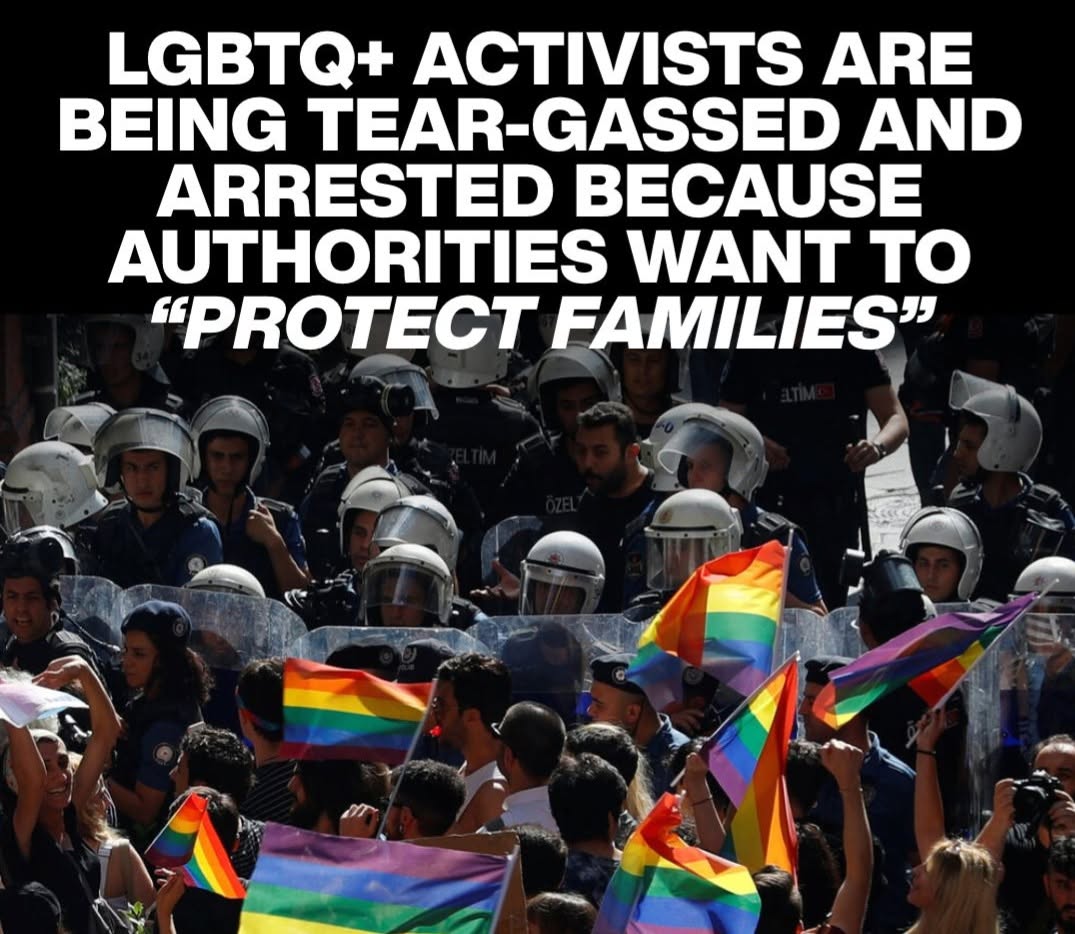
Under the guise of ‘protecting the family’ the government of Turkey has initiated a nation-wide coordinated attack on the freedom of same sex attracted and gender-nonconforming people. Never mentioned is the fact that queer children are born in, raised in, and are part of family structure, and of course always have been. This kind of attack on us – making queer people a scapegoat for society’s ills, as a way of diverting attention from failures of leadership and policy – as we are all well aware, is far from new. Plato named this back in the 4th century BCE when one of the diners in the Symposium observed that it does not suit tyrannical powers to encourage love between men because of the bonds of trust that produces – history provides plenty of examples of that in practice and in the 2024 USA election the Republican party used an updated version of the formula very successfully with their ‘Kamala is for They/Them, President Trump is for You’ campaign.
Excerpt from: Human Rights Watch says Turkey’s LGBT crackdown threatens rule of law – Stockholm Center for Freedom
“Coordinated police raids between September 12 and 14 targeted seven LGBT rights organizations, two groups supporting people living with HIV and bars and nightclubs in Istanbul, Ankara, İzmir, Aydın and Mersin. At least 112 people were detained, with courts subsequently ordering 82 held in pretrial detention, of whom some 24 were activists, founders or executives of the targeted organizations, while one was a journalist.
“Justice Minister Akın Gürlek said authorities had initiated legal proceedings against 162 suspects, nine associations and 13 businesses across 15 provinces as part of an operation called “My Family Is Safe.” The figure of 162 referred to people subject to legal proceedings and was not the number detained.
“The investigations, coordinated by prosecutors in Istanbul, Ankara, İzmir, Aydın and Mersin, involve allegations including facilitating prostitution, producing or distributing obscene material and exposing children to such material. Authorities have also cited drug-related allegations and possible violations of Turkey’s law on associations…
“The crackdown has also extended to online content. Courts issued orders between September 12 and 16 blocking dozens of websites and social media accounts belonging to LGBT organizations, rights groups and activists, according to the Freedom of Expression Association, a Turkish group that monitors internet censorship.
“Police also detained more than 100 people who gathered outside Istanbul’s Çağlayan courthouse on September 15 to protest the crackdown. They were released after being held for more than 24 hours.
“The operations come amid an increased government emphasis on what officials describe as protecting the traditional family. The government of President Recep Tayyip Erdoğan has designated 2026-2035 as the “Family and Population Decade,” while Gürlek has linked the recent investigations to government policies aimed at protecting children, the institution of the family and what authorities describe as public morality.”
Some history:
This crackdown is not the first to happen in the Turkish lands. In fact rulers here have been trying to suppress same sex love for 1500 years. You would think by now they would have got over it.
The Law Code of the Eastern Roman, Byzantine emperor Justinian, issued in 534 CE in Constantinople (modern Istanbul), blamed same sex relations for ‘famines, earthquakes and pestilence,’ establishing a legal climate regarding homosexuality that would influence Europe until the 20th century – and his violent actions in 528 CE against men who loved men established a climate of fear that still infects the world. Byzantine historian John Malalas (c491–578) recorded that:
“… bishops of divers provinces were prosecuted for the lustful act of sleeping with males…Shortly after, the emperor passed a law that the crime of sex with males should be punished by castration. And at that time many androkoitai (men who slept with men) were seized and their genitals were cut off. And a great fear ensued among those who suffered from the evil desire for males.”
Procopius, Justinian’s court historian, wrote a ‘Secret History’ in which he informs us that there were more than religious motives underlying this action. Having described his horror at the “reckless fashion” in which this law was enforced, Procopius indicates that the punishment was directed at first towards political opponents and those “possessed of great wealth or those who in some other way chanced to have offended the rulers.” Justinian soon emptied the imperial treasury through expensive wars and building churches and palaces: Procopius informs us that “No sooner had he thus disposed of the public wealth, than he turned his eyes towards his subjects, and he straightaway robbed great numbers of them of their estates… charging some with belief in polytheism, others with adherence to some perverse sect among the Christians, or with paiderastias.”
During the many centuries of the Ottoman empire,(13th – early 20th), which conquered Constantinople, ending the Christian eastern Roman empire, in 1453, there were legal prohibitions on same sex acts but in practice little persecution. In medieval Islamic culture, mukhannathun was a term used to refer to effeminate men or people of ambiguous sex characteristics who appeared feminine or functioned socially in roles typically carried out by women.
“According to the Iranian scholar Mehrdad Alipour, ‘in the pre-modern period, Muslim societies were aware of five manifestations of gender ambiguity: This can be seen through figures such as the khasi (eunuch), the hijra, the mukhannath, the mamsuh and the khuntha (hermaphrodite/intersex).’ Generally, adolescent men were socially permitted to desire older men or women. After puberty, they were expected to desire young boys or women. Being in both roles could have led to social censure. There is evidence, however, that egalitarian same-sex relations also occurred.” (wikipedia)
In the 19th century exposure to western European attitudes brought a more tense atmosphere around same sex attraction. The 1858 Ottoman Penal Code stated the following:
Art. 202—The person who dares to commit the abominable act publicly contrary to modesty and sense of shame is to be imprisoned for from three months to one year and a fine of from one Mejidieh gold piece to ten Mejidieh gold pieces is to be levied.
This is sometimes interpreted as decriminalising private sex, but it should be remembered that this had not been persecuted previously, and this act set the scene for much darkness for queer Turks in the 20th century.
Beginning during the Turkish Republic under Attaturk in the 1920s a process of ‘europeanisation’ led to behaviour such as open affection for the people of the same sex, or “feminine” behaviour from males becoming stigmatized, but queer people were not openly discussed until in 1974 when the coalition government made queer people the target of repressive policies, with the result that attacks against the community became more frequent and violent. Some members of the LGBT+ community kept on fighting for their rights and, to protect themselves, attempted to create their own political identity. Multiple cities became centers of queer resistance such as Istanbul, Izmir and Ankara – cities where this year’s raids were focussed.
But 1980 brought a military coup – political parties were banned and freedom of demonstration, association, speech, and the press were censored. The authorities initiated a campaign of mass persecution against the members of the LGBT community – including a 1981 law that prohibited drag queens from performing on nightclub stages. “As a response to the situation they were living in, the entire trans community started organizing protests in Istanbul, Izmir and Ankara… Because of the increasing violent actions from the police, on April 29, 1987, trans people, lesbians, and gay men initiated a ten-day hunger strike in Gezi Park by Taksim Square. The strike started in a house in Taksim and was moved to Gezi Park the next day until it was dispersed by the police. However, the protest continued in different houses for weeks, and managed to get support from the Radical Democratic Green Party and some famous artists and intellectuals. This hunger strike is considered to be the first large-scale LGBTQ+ protest before the 1990s, and a turning point in the contemporary queer movement.” wikipedia
In the UK in 1987 we were dealing with the homophobia of Margaret Thatcher’s Conservative government, which brought in a prohibition of the ‘promotion of homosexuality’, known as ‘Section 28’. I wonder how many of us in the UK at the time knew about the queers on hunger strike on in Turkey? I certainly didn’t. But today in the Internet age the whole gay world hears about this new crackdown – but what do we do about it?
I believe it helps to know the history, both of Turkey and of other lands. Raids and laws against us are nothing new in the world – and as we look for how to respond, we should not forget that England has suffered centuries of the like itself:
In England, Henry VIII’s Buggery Act of 1533 was part of the King’s efforts to reduce the power of the Church, in this case by claiming powers of trial over sodomy, which the ecclesiastical courts had previously dealt with. He used the act primarily against the monastic communities, using the excuse of sodomy in the monasteries as a way to close them and seize their wealth.
Repealed under Queen Mary, the law, renamed the Sodomy Act was brought back under Elizabeth in 1862. Prosecutions however were rare – historian Rictor Norton has identified less than a dozen cases prior to 1660 – and during the late 16th-early 17th century the atmosphere was tolerant enough for a gay subculture to start to flower. However this also led to the first police raids on queer establishments in the early 18th century when London’s Molly Houses were targeted – commencing FOUR CENTURIES OF PUB RAIDS AND LEGAL PERSECUTION OF QUEERS IN THE UK. Yes this was still happening in the post-decriminalisation era – in January 1987 famous drag pub, the Royal Vauxhall Tavern in London, was raided by police wearing marigolds to protect themselves from the perceived danger of catching AIDS from the queers. Performer Lily Savage famously asked if they’d come to do the washing up.
In early 20th century Germany a diverse and creative queer subculture was developing fast – also in Russia during the first decade after the Revolution, there was tolerance of gay people. The 1930s brought repressive, authoritarian regimes under Hitler and Stalin, during which once again gay folk were blamed for society’s ills, persecuted, arrested, killed.
Back to Turkey:
In the 1990s queer activists, supported and encouraged by European groups, stepped forward in Turkey and in the 2000s the wish of the new government to get closer to the European Union led to a more tolerant period in which LGBTQ groups and culture could emerge, but the ruling party has never been comfortable with that. “In 2014 the pride march counted more than 100,000 participants, making it one of the biggest pride marches in Southeastern Europe, and politicians of the main opposition parties… lent their support to the demonstration. As a consequence, the following year, Turkish authorities stopped the annual pride parade in Istanbul through violence, making use of tear gas, rubber bullets and water cannons against the marchers.” Wikipedia.
The authorities have continued to send out riot police with tear gas and rubber bullets to Pride events ever since. The September 2026 raids and arrests are the latest stage of a long fight, a repetition of an ancient prejudice still playing out, a political manoeuvre so blatant but so long used they continue to be able to get away, from Trump to Putin to Erdogan they continue to get away with it. To close on a more optimistic note let’s remember that Viktor Orban’s attempt to ban Pride led to the largest lgbt+ rights parade there ever and his government lost power the next year.
All tyrants fall in the end. Queer people carry on.
Owen Jones interviews Yıldız Tar, a LGBTQI+ and human rights defender in Turkey and the Editor-in-Chief of KaosGL.org: Turkey Calls Gay Kisses “Obscene”. Then Came The Raids.
At the Queer Spirit Faerie Drum Circle at the Wheatsheaf Hall in Vauxhall, south London, this Friday 25th September 2026 we will dedicate our rhythms to our queer kin in Turkey, reaching out through the queer cosmic web to send them prayers for strength and resilience, to stand with them in spirit as we try to fathom out, how do we rid the world of this age old ignorance and prejudice for ever?

